
Nearshore medical billing specialists have quietly become one of the fastest-growing staffing moves for independent practices, group clinics, and specialty offices across the US. If you're deciding between a medical billing VA and a medical billing company in 2026, the numbers look very different than they did even two years ago — and the right answer depends on how much control, margin, and visibility matter to your practice.
This post breaks down the real cost comparison, the workflow differences, and the situations where each model wins. No vague claims — just the numbers and the decision framework.
What Is a Medical Billing VA? (2026 Definition)
A medical billing virtual assistant is a dedicated, full-time remote staff member who handles the end-to-end billing cycle for your practice — charge entry, claims submission, denial management, payment posting, and patient follow-up. They work in your practice management software (Kareo, DrChrono, AdvancedMD, eClinicalWorks, or whichever platform you use), under your login, on your schedule.
A nearshore medical billing VA, specifically, is based in Latin America and works US business hours with English fluency scored at 8/10 or higher at the point of hire. That's a meaningful distinction from offshore billing staff in the Philippines or India, because real-time availability during your billing day eliminates the overnight batching problem that causes claim lag.
A medical billing company, by contrast, is a third-party vendor that takes over your revenue cycle entirely. They typically charge 4–8% of net collections, work across hundreds of client accounts simultaneously, and give you access to a portal rather than a person.
According to the Medical Group Management Association (MGMA) (2023), billing and collections costs average 14.5% of total medical revenue for physician practices — a figure that includes both vendor fees and staff time. Cutting even 2–3 percentage points off that number moves real money for a $1M+ practice.
How the Cost Math Works in 2026
Here's the comparison most practice managers never actually run. Assume your practice collects $800,000 per year.
- Medical billing company at 6%: $48,000/year ($4,000/month). That rate scales up every time your revenue grows.
- In-house biller: Median salary $42,000–$52,000/year, plus benefits, payroll taxes, PTO, and replacement cost when they leave. All-in cost typically $58,000–$70,000/year, according to the U.S. Bureau of Labor Statistics (2024).
- Nearshore medical billing VA through Rose: $2,500/month flat — $30,000/year. Full-time, 40 hours/week. Recruiting, vetting, payroll, HR, and ongoing management included.
At $800K in collections, a billing company costs $18,000 more per year than a dedicated VA — and that gap widens every year your practice grows. At $1.2M in collections, the billing company is charging $72,000/year at 6%. The VA is still $2,500/month.

How a Medical Billing Company Actually Handles Your Claims in 2026
Medical billing companies batch claims. Your account is one of dozens or hundreds managed by the same team. When a denial comes back on a $340 orthopedic claim, it enters a work queue — not someone's dedicated inbox. The company's financial incentive is to collect the easiest revenue fastest; complex denials on smaller claims may sit longer than you'd like.
Turnaround time on denial appeals is a key benchmark. The industry average for first-pass claim resolution sits around 93–95% for top-tier billing companies, according to the Healthcare Financial Management Association (HFMA) (2023). That sounds solid until you realize a 5–7% denial rate on $800K is $40,000–$56,000 sitting in unpaid claims — and the follow-up speed depends entirely on how backed-up your billing company's team is.
A dedicated VA works only your claims. When a denial comes in, they see it immediately, research it, and resubmit it the same day. If you've set up your VA on DrChrono, for example, our DrChrono-trained medical billing VA workflow means they already know how to navigate the exact denial codes your specialty generates most often.
"Denial management is where most practices hemorrhage revenue — not because their billers are bad, but because no single person owns the follow-up queue. A dedicated resource with clear accountability changes that equation entirely." — Kem Tolliver, Revenue Cycle Consultant at MGMA (2023)
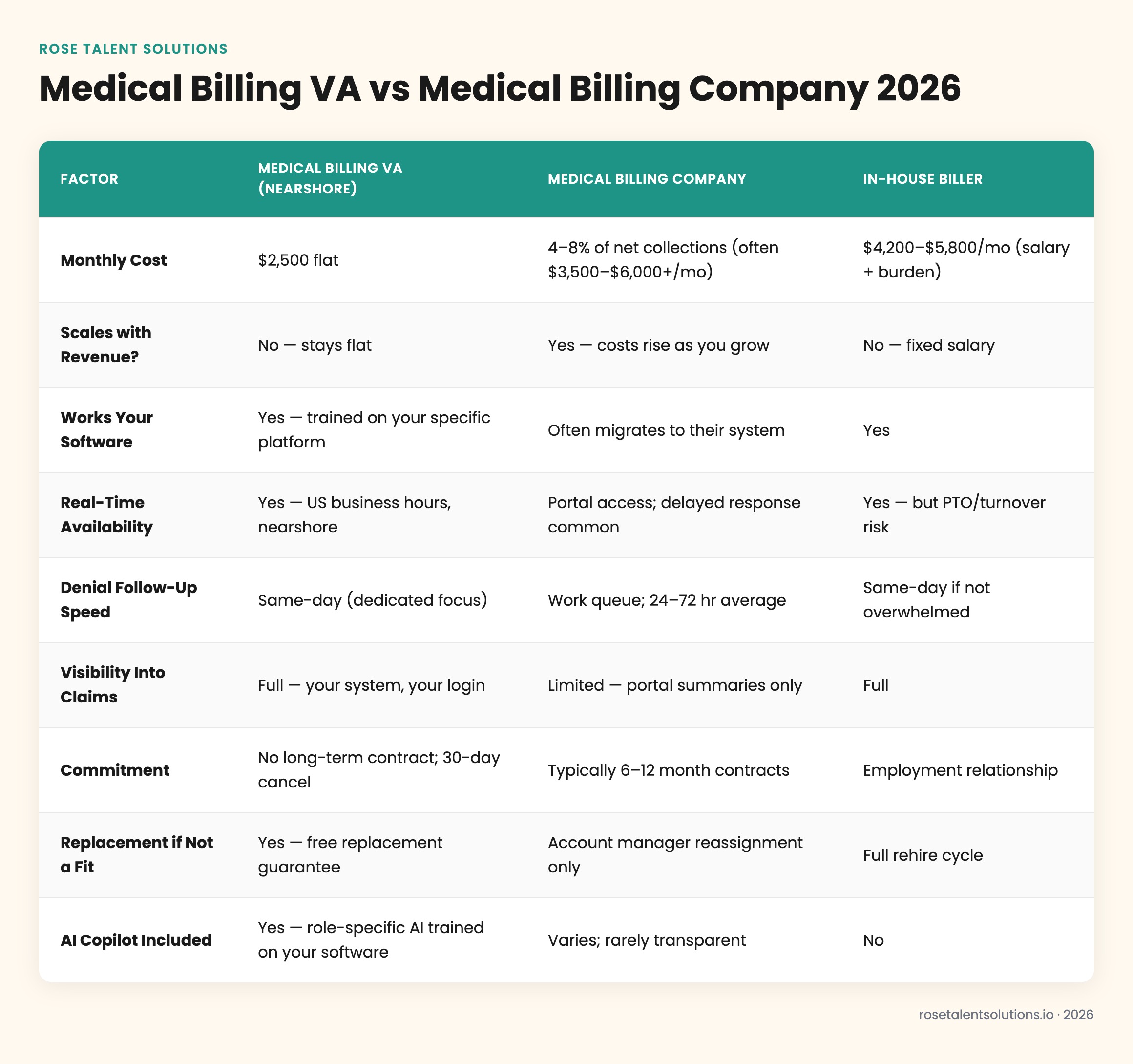
Medical Billing VA vs Medical Billing Company: 2026 Comparison Table
| Factor | Medical Billing VA (Nearshore) | Medical Billing Company | In-House Biller |
|---|---|---|---|
| Monthly Cost | $2,500 flat | 4–8% of net collections (often $3,500–$6,000+/mo) | $4,200–$5,800/mo (salary + burden) |
| Scales with Revenue? | No — stays flat | Yes — costs rise as you grow | No — fixed salary |
| Works Your Software | Yes — trained on your specific platform | Often migrates to their system | Yes |
| Real-Time Availability | Yes — US business hours, nearshore | Portal access; delayed response common | Yes — but PTO/turnover risk |
| Denial Follow-Up Speed | Same-day (dedicated focus) | Work queue; 24–72 hr average | Same-day if not overwhelmed |
| Visibility Into Claims | Full — your system, your login | Limited — portal summaries only | Full |
| Commitment | No long-term contract; 30-day cancel | Typically 6–12 month contracts | Employment relationship |
| Replacement if Not a Fit | Yes — free replacement guarantee | Account manager reassignment only | Full rehire cycle |
| AI Copilot Included | Yes — role-specific AI trained on your software | Varies; rarely transparent | No |
Where Medical Billing Companies Still Win
Honesty matters here. Medical billing companies are the right answer in specific situations. If your practice is brand new and your volume is below $300K/year, the flat cost of a full-time VA may not pencil yet. If you operate in a highly specialized payer mix — rare procedure codes, complex government contracts — a billing company with that narrow specialty may justify their fee through higher first-pass rates.
Medical billing companies also absorb compliance risk more explicitly. Their contracts typically include HIPAA liability provisions and they carry E&O insurance on billing errors. A VA requires you to maintain your own HIPAA compliance framework and BAA agreements, which is standard for any in-house staff arrangement but worth noting.
The breakeven point between a billing company and a dedicated VA typically hits at $500,000–$600,000 in annual collections, depending on the billing company's percentage rate. Above that threshold, the VA model saves money every single month — and those savings compound as your practice grows.
For multi-specialty groups, the VA model also scales differently: you hire one VA per specialty or billing function, keeping workflows clean and accountability clear. The same practices that start with a single medical billing VA often add an insurance verification specialist within 6–12 months, because those two roles together eliminate the majority of preventable denials before claims are even submitted.

How Rose Places a Medical Billing VA in 2026
The placement process at Rose is built around one outcome: a VA who can open your software on day one and produce real work by day three. Here's how the process runs:
Intake & Role Definition
Rose scopes the exact billing functions you need covered — charge entry, claims submission, denial management, ERA posting, patient collections, or all of the above. Your payer mix and software stack are documented before sourcing begins.
Sourcing & Vetting
Candidates are screened for medical billing experience specifically, English proficiency scored at 8/10 or higher, and software familiarity with your platform. Rose rejects the majority of applicants at this stage.
AI Copilot Setup
Every Rose VA ships with a role-specific AI copilot trained on their assigned software — whether that's Kareo, AdvancedMD, DrChrono, or eClinicalWorks. This cuts the ramp time that kills most VA placements.
Placement & Onboarding
Your VA is introduced, credentialed under your HIPAA/BAA framework, and working live in your system within days. Rose handles payroll, HR, and ongoing performance management.
Replacement Guarantee
If the fit isn't right, Rose replaces the team member at no additional cost. No long-term contract locks you in — cancel with 30 days written notice.
This model works across medical verticals beyond general billing. Practices running high appointment volumes — chiropractic clinics, dental offices, and specialty groups — follow the same placement process. If you're running a chiropractic clinic specifically, the workflow adapts naturally; see how a chiropractic office virtual assistant handles the specific billing and scheduling demands of that specialty. Dental practices have similar parallels — dental office VA services cover the same insurance verification, claims submission, and patient communication cycle.
The AI Advantage: Why 2026 VAs Outperform 2022 VAs
The single biggest shift in the VA market between 2022 and 2026 is AI augmentation. A Rose medical billing VA doesn't just know how to navigate your software — they work alongside a role-specific AI copilot trained on it. That copilot surfaces denial pattern alerts, flags missing modifiers before submission, and auto-drafts appeal letters for common denial codes.
AI-augmented billing staff catch an estimated 30–40% more claim errors before submission compared to manual review alone, according to the Healthcare IT News analysis of RCM AI deployments (2024). That reduction in first-pass denials directly increases your clean claim rate — which is the single metric most correlated with faster reimbursement cycles.
You can explore what that AI layer looks like in practice on the Rose AI Advantage page — it's built specifically so the VA's AI tools mirror the software workflow they're already trained on, not a generic chatbot bolted on afterward.
Medical Billing VA: Pros
- Flat monthly cost that doesn't scale with revenue
- Full visibility — works inside your system, your login
- Real-time availability during US business hours
- Dedicated focus on your claims only
- AI copilot included, trained on your software
- No long-term contract; free replacement if not a fit
Medical Billing VA: Cons
- You maintain your own HIPAA/BAA framework
- Requires onboarding time investment upfront
- Less cost-effective below ~$400K/year in collections
- You manage the workflow structure and KPIs
If you're ready to scope a placement, the Rose intake process takes about 15 minutes and produces a role spec you can review before committing to anything. Billing, verification, patient communication, or the full revenue cycle — the process starts the same way regardless of scope.
According to SHRM's Human Capital Benchmarking Report (2023), the average cost to replace a healthcare billing employee is $4,700–$8,400 once recruiting, onboarding, and productivity loss are factored in. A free replacement guarantee at no additional cost isn't a minor perk — it eliminates one of the biggest hidden risks in any staffing decision.