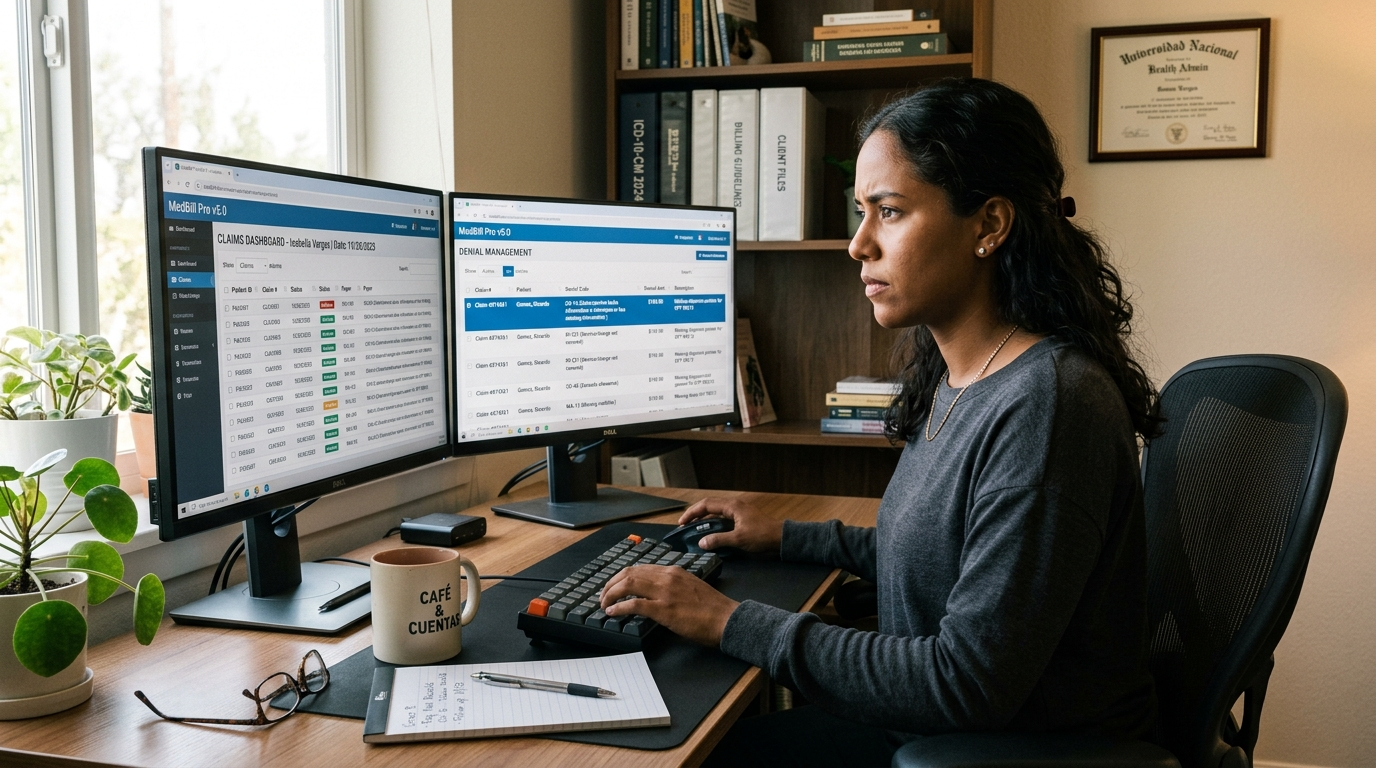
Nearshore virtual assistants are quietly becoming the most cost-effective weapon US medical practices have against rising claim denial rates. If your billing team is drowning in rejected claims, aging AR, and insurer appeal deadlines, a medical billing denials management virtual assistant — based in Latin America, working your exact business hours — can close that gap without the overhead of a full-time domestic hire. This guide explains exactly how they work, what they cost, and what to look for in 2026.
What Is a Medical Billing Denials Management Virtual Assistant?
A medical billing denials management virtual assistant is a remote billing specialist who identifies denied or rejected claims, determines the root cause, and executes the corrective action — whether that's a corrected claim submission, a formal appeal letter, or a payer phone call. They work inside your existing practice management software (AdvancedMD, Kareo, DrChrono, Availity, and others) under your billing protocols.
This is not a generalist VA who sends emails and schedules meetings. A denials management VA understands ICD-10/CPT coding logic, knows the difference between a technical denial and a clinical denial, and can read an Explanation of Benefits (EOB) the way a biller reads a pay stub. The role sits at the intersection of revenue cycle management and administrative follow-through — and it is one of the highest-ROI hires a growing practice can make.
According to MGMA (Medical Group Management Association) (2023), the average cost to rework a single denied claim is $25.20 — and practices that fail to work denials within 30 days lose an estimated 15–20% of that revenue permanently. A dedicated VA working denials full-time can process dozens of those claims every day.
If your practice is sitting on recoverable denials without the bandwidth to chase them, you are leaving real money on the table — every single month.
Why Denial Rates Are Rising in 2026 — and Why Staffing Is the Bottleneck
Payer complexity has increased sharply. More insurers are requiring prior authorizations, tightening medical necessity criteria, and deploying AI-based claim scrubbers that flag submissions for reasons that weren't an issue three years ago. The result: denial rates that were once manageable at 5–8% are now climbing toward 10–15% at many independent practices, according to Healthcare Finance News (2023).
The staffing side is equally strained. The Bureau of Labor Statistics projects that medical records and billing specialist roles will grow 9% through 2032 — faster than average — meaning competition for qualified domestic billers is fierce. When you do find one, salaries for experienced denial specialists in major US metros run $55,000–$75,000 annually before benefits and payroll taxes, according to BLS Occupational Employment Statistics (2024).
That's why practices are increasingly turning to nearshore talent. A nearshore VA through Rose Talent Solutions costs a flat $2,500/month — full-time, 40 hours per week, all-in — with recruiting, vetting, payroll, HR, and ongoing management included. That's roughly one-third the fully loaded cost of a domestic specialist.

For independent practices, specialty groups, and DSOs that need denials worked aggressively without ballooning their payroll, this model is increasingly the default choice — not the experimental one. If you are also evaluating support for front-end eligibility checks, see how Rose's insurance verification virtual assistant service pairs with a denials VA to create a complete revenue cycle front-to-back solution.
How a Nearshore Denials VA Outperforms Offshore for Medical Billing in 2026
The phrase "offshore VA" gets used loosely. In practice, most offshore medical billing VAs are based in the Philippines or India — 12 to 14 time zones away from US practices. That gap creates a specific, painful problem in denials management: payer phone queues and appeal deadlines don't wait for overnight batches. When a payer's provider relations line is open 8am–5pm Eastern and your offshore team starts their day at 9pm Eastern, you lose same-day resolution on every call-required denial.
Nearshore VAs in Latin America work your business hours — real-time, same-day, in sync with your billing manager, your front desk, and your payers. English fluency is screened at 8/10 or higher before any candidate reaches you. That matters enormously when a VA needs to speak directly with a UnitedHealthcare or Cigna provider rep to escalate a wrongly denied claim.
"Timezone alignment is the single most underrated factor in revenue cycle outsourcing. A billing specialist who can call a payer at 10am your time — not 10pm their time — recovers more money, period." — Kem Tolliver, Revenue Cycle Consultant and former Director of Patient Financial Services, University Health System (2023)
| Factor | Onshore Specialist | Nearshore VA (Rose) | Offshore VA |
|---|---|---|---|
| Monthly cost (fully loaded) | $5,500–$7,000+ | $2,500 flat | $800–$1,400 |
| Timezone alignment (US hours) | ✅ Full overlap | ✅ Full overlap | ❌ 10–14 hr gap |
| English proficiency | Native | 8/10+ screened | Varies widely |
| Payer phone follow-up (live) | ✅ Yes | ✅ Yes | ❌ Typically batched |
| Recruiting + HR overhead on you | High | None (Rose manages) | Medium–High |
| AI copilot on billing software | Depends on hire | ✅ Included | Rarely |
| Replacement if not a fit | Full rehire cost | ✅ Free replacement | Varies |
| Long-term contract required | Employment law applies | No long-term contract | Often locked in |
What Does a Denials Management VA Actually Do Each Day in 2026?
The daily workflow of a billing denials management VA is structured and measurable — which is part of what makes it so well-suited to a remote specialist. Here's a realistic breakdown of the role:
Morning Denial Queue Review
The VA pulls the overnight denial report from your billing system (DrChrono, Kareo, AdvancedMD, Availity, etc.), sorts by dollar value and appeal deadline urgency, and flags any claims that require same-day action before payer lines get busy.
Root Cause Categorization
Each denial gets coded by root cause: duplicate claim, incorrect subscriber ID, authorization required, medical necessity, timely filing, or coding mismatch. Categorizing correctly is what determines whether the fix is a resubmission, a corrected claim, or a formal appeal.
Corrected Claims and Resubmissions
For technical denials (wrong NPI, missing modifier, incorrect date of service), the VA corrects the claim directly in the billing system and resubmits electronically — often same-day resolution with no appeal needed.
Appeal Letter Drafting and Submission
Clinical and medical necessity denials require formal written appeals, often with attached clinical notes and supporting documentation. The VA drafts the appeal, attaches the relevant records (provided by your clinical team), and submits via payer portal or certified mail as required.
Payer Follow-Up Calls
For appeals in progress, the VA makes live calls to provider relations lines, documents the call reference number, and logs outcomes in your PM system. This is where timezone alignment — and fluent English — directly translate to recovered revenue.
This kind of structured daily output is exactly what the AI copilot advantage at Rose is built to amplify. Every VA ships with a role-specific AI copilot trained on their specific billing software — cutting repetitive lookup time and letting the VA spend more hours on high-value appeal work instead of navigating payer portals manually.

How the AI Copilot Makes a Denials VA 2026-Ready
Rose's AI copilot program is one of the clearest differentiators in the nearshore VA market right now. Every billing VA is trained not just on the workflow, but on the specific software your practice uses. That means they arrive already fluent in your claim scrubbing rules, denial code libraries, and payer-specific appeal requirements — not learning them on the job at your expense.
The practical effect: ramp time shrinks from weeks to days. A VA who already knows how to navigate DrChrono's denial worklist, pull EOBs in Availity, and queue an appeal in your specific payer portal is productive by week one — not week four. If your practice runs on DrChrono specifically, Rose's dedicated DrChrono virtual assistant for medical billing post covers the platform-specific workflow in detail.
The real cost of a billing VA isn't the monthly rate — it's ramp time multiplied by denial volume. A VA pre-trained on your billing software starts recovering revenue in days, not months. The AI copilot is what makes that possible at $2,500/month instead of $6,500.
According to McKinsey & Company's healthcare digital transformation research (2023), administrative automation and AI-assisted workflows can reduce revenue cycle labor costs by 25–35% without reducing output quality. Pairing a trained nearshore VA with an AI copilot is exactly that model — human judgment on the decisions that require it, automation on the repetitive lookups.
Denials management is also a natural entry point into broader revenue cycle support. Many Rose clients start with a denials-focused VA and expand into bookkeeping and accounting support for their practice — keeping financial reporting clean and reconciled as AR recovery improves. The two functions work best together when they're staffed in parallel.
How Rose's Hiring Process Works for Medical Billing VAs in 2026
Rose handles the entire sourcing and vetting process so you don't have to post a job, screen resumes, or conduct billing skills assessments. The process is straightforward:
What Rose handles for you
- Recruits from a vetted Latin America talent pool with billing experience
- Screens English proficiency to 8/10+ floor before you see a candidate
- Verifies billing software experience (DrChrono, Kareo, AdvancedMD, Availity)
- Manages payroll, HR compliance, and ongoing performance oversight
- Deploys role-specific AI copilot at no additional cost
- Replaces the VA at no additional cost if they're not the right fit
What you handle
- Provide access to your billing system and payer portals
- Share your practice's denial workflows and escalation protocols
- Designate an internal point of contact for the VA's first two weeks
- Provide clinical documentation for appeal submissions (your clinicians, not the VA)
The engagement runs month-to-month with no long-term contract. Cancel with 30 days written notice. For practices that want to pilot the model before expanding headcount, that structure removes the usual risk of a long-term staffing commitment. To explore fit, the natural starting point is Rose's intake form — it takes about three minutes and triggers a same-business-day response from the placement team.
Rose's medical VA services extend beyond billing. If your practice also needs front-desk and scheduling coverage, the model scales. Chiropractic and multi-specialty clinics have found particular success — the chiropractic office virtual assistant use case is a useful reference for how the full administrative coverage model works in a smaller specialty setting.
According to SHRM's human capital benchmarking data (2022), the average cost-per-hire in the US is $4,700 — before the first paycheck clears. For a specialized billing role requiring revenue cycle experience, that number climbs higher. Rose's model eliminates that line item entirely: recruiting is included in the $2,500/month flat rate.
Dental practices running similar denial and insurance follow-up workflows have also adopted the nearshore VA model at scale. If your group includes dental operations alongside medical, Rose's dental office virtual assistant services overview covers how the same staffing framework applies to dental billing and insurance coordination.
The bottom line: in 2026, a medical billing denials management virtual assistant is not a cost center — it is a revenue recovery function. The practices that staff it properly, with timezone-aligned, software-trained nearshore talent, will outperform those that leave denials to overworked in-house billers. The math is straightforward, and the path to getting started is shorter than most practice managers expect.