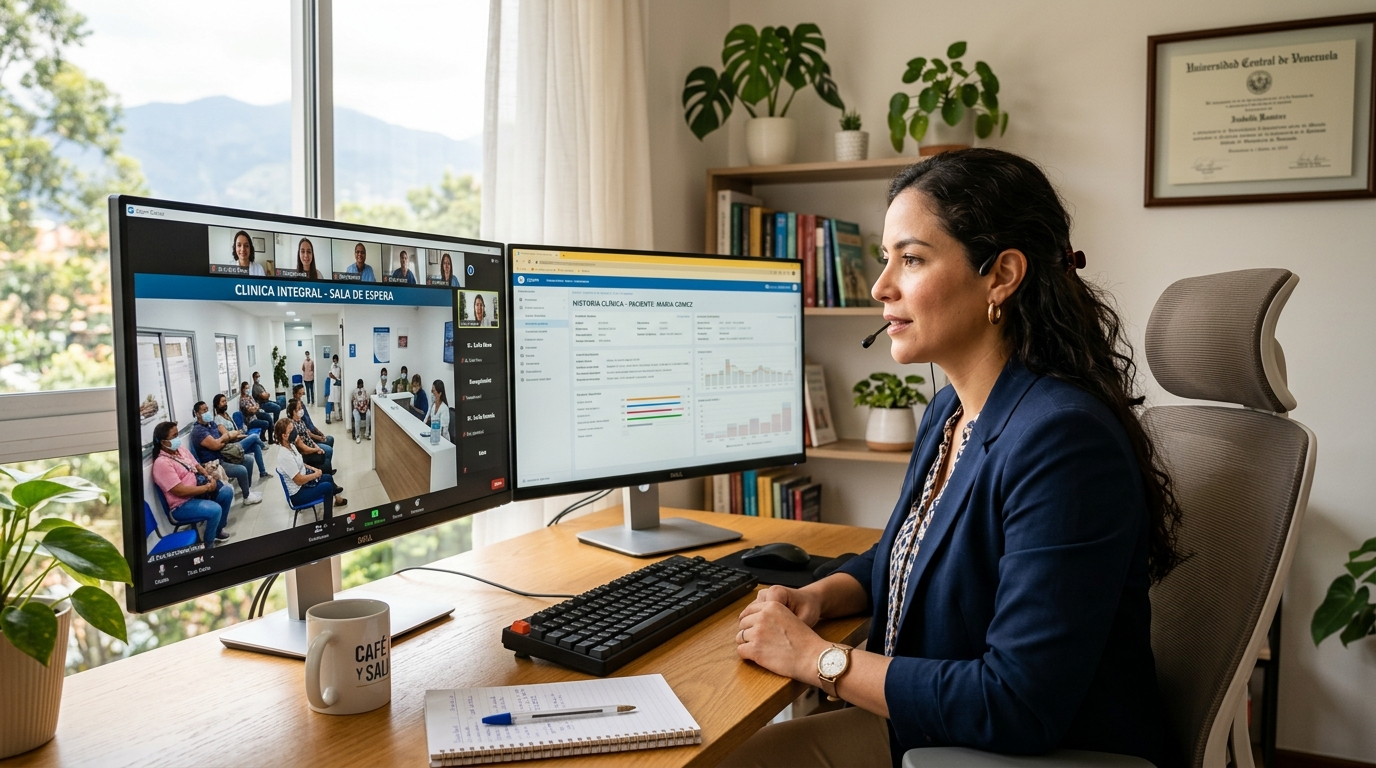
Nearshore live-streaming medical receptionists are quietly replacing in-office front desks at independent clinics, specialty practices, and multi-location medical groups across the US — and the economics make it hard to argue against. A dedicated, video-present receptionist based in Latin America, working your exact business hours, handling everything from patient check-in to insurance verification, costs a fraction of what a local hire runs. This guide covers exactly how the model works, what to look for in 2026, and how to avoid the common mistakes practices make when they try to do it on their own.
What Is a Live-Streaming Medical Receptionist?
A live-streaming medical receptionist is a remote staff member who appears on a tablet or dedicated screen mounted at your front desk. When a patient walks in, they see a real human face — not a kiosk, not a chatbot. The receptionist greets them by name (pulled from your EHR), collects co-pays, answers questions, and routes them to the correct provider room. The experience for the patient is nearly identical to an in-office receptionist; the difference is purely logistical on the back end.
This model is distinct from a standard virtual assistant who works invisibly behind the scenes. A live-streaming receptionist is video-present and synchronous — they are watching your waiting room in real time via a two-way camera feed and responding to patients as they arrive. Response latency is measured in seconds, not hours. That distinction matters enormously for patient experience and HIPAA compliance protocols, which require staff to be actively monitoring rather than asynchronously processing.
According to the U.S. Bureau of Labor Statistics (2024), the median annual wage for medical secretaries and administrative assistants is over $42,000 — and that number doesn't touch benefits, PTO, or the cost of re-hiring when they leave. Live-streaming staffed by a nearshore receptionist through a managed model collapses that number significantly while keeping a real human on screen.
How a Live-Streaming Medical Receptionist Works in 2026
The setup is simpler than most practice managers expect. You mount a screen — typically an iPad Pro or a dedicated Android display — at your reception counter. A two-way camera sits beside or above it. Your nearshore receptionist logs into a secure, HIPAA-compliant video platform at the start of their shift, which aligns exactly with your clinic's opening hours because Latin America-based staff work US business hours without the overnight-shift friction you get from Philippines or India-based teams.
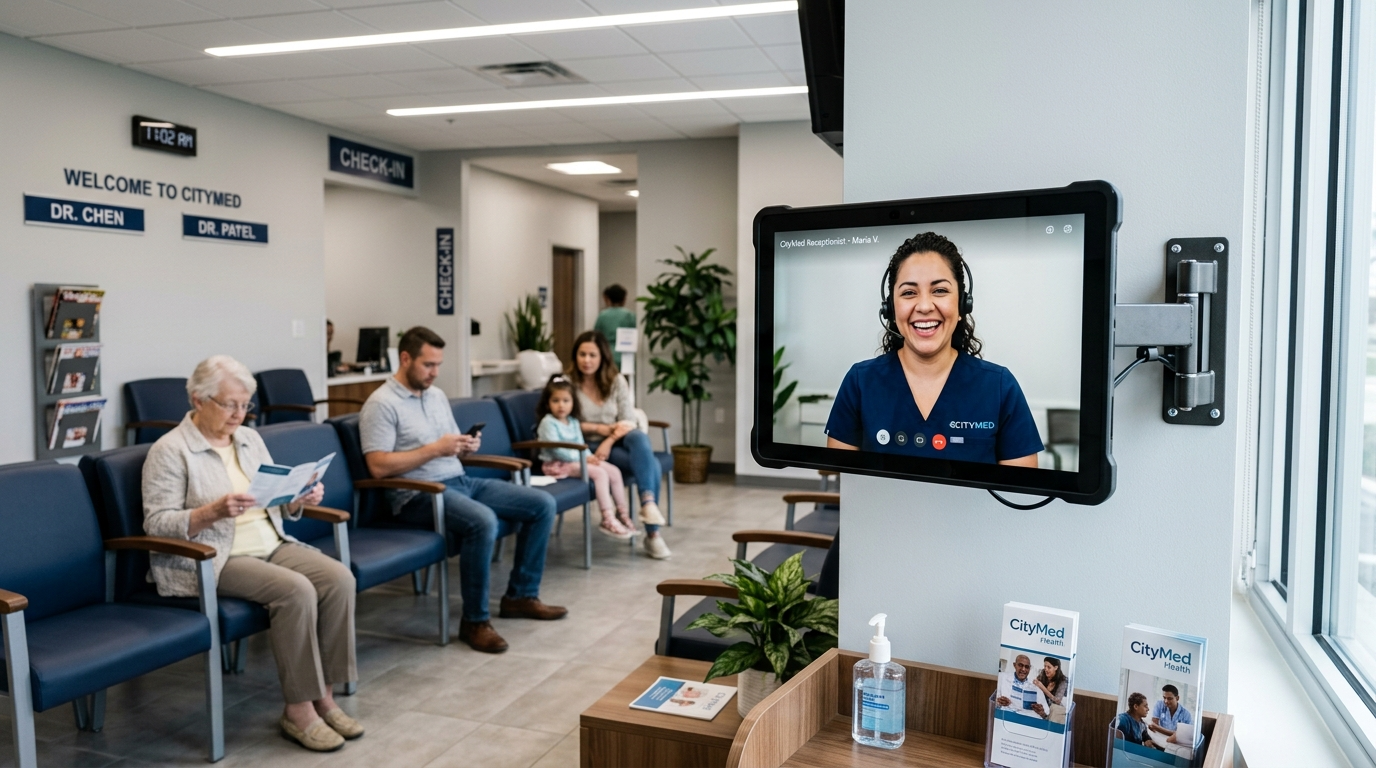
The receptionist has access to your EHR (Epic, Athenahealth, Kareo, eClinicalWorks — pick your stack), your scheduling software, and your payment processor. They pull up the patient file before the patient reaches the screen, so the greeting is personal. If your practice also needs help with insurance verification running behind the scenes, that same staff member or a paired team member can toggle between the live-streaming desk and verification queues during slower walk-in windows.
The staffing model that makes this work at scale is a managed nearshore placement: recruiting, vetting, payroll, HR, and ongoing management are handled by the agency. You're not hiring a freelancer off Upwork and hoping their internet holds. You're getting a full-time dedicated employee managed on your behalf, with a replacement guarantee if the fit isn't right — no additional cost, no long-term contract required.
How Does a Nearshore Live-Streaming Receptionist Compare to Other Options?
The three options practices typically evaluate are: (1) an in-office local hire, (2) an offshore VA from the Philippines or India, and (3) a nearshore VA from Latin America. Each has a dramatically different cost, availability profile, and patient-experience outcome. The table below breaks it down.
| Factor | In-Office (US Local Hire) | Offshore VA (Philippines/India) | Nearshore VA (Latin America) |
|---|---|---|---|
| Monthly All-In Cost | $4,500–$6,500+ | $800–$1,400 | $2,500 flat |
| Time Zone Alignment | Perfect | 6–12 hour gap (overnight shifts required) | Same US business hours |
| English Fluency | Native | Variable (accent friction common) | 8/10+ screened; neutral accent |
| Live Video Presence | Yes | Possible but latency/connection unstable | Yes — stable, real-time |
| Turnover Risk | High (US front desk ~50% annual turnover) | High (high freelance churn) | Low (managed, salaried placement) |
| EHR/Software Training | You train from scratch | You train from scratch | AI copilot pre-trained on your EHR |
| Replacement if Not a Fit | Full re-hire cycle (4–8 weeks) | You absorb the loss | Free replacement, no added cost |
What Tasks Does a Live-Streaming Medical Receptionist Handle in 2026?
The job description for a live-streaming receptionist in 2026 is broader than most practice managers initially assume. Because they're working in your systems all day — not just greeting patients at the door — a well-placed nearshore receptionist covers the full administrative front-desk function. Here's what that looks like in practice:
- Patient intake and check-in via live video screen at the front desk
- Appointment scheduling and rescheduling in real time (see how a patient scheduling virtual assistant handles this at scale)
- Insurance eligibility verification before each visit
- Co-pay collection through integrated payment links
- New patient registration via intake form guidance
- Referral coordination and prior authorization queue management (practices running high referral volumes often pair a live-streaming receptionist with a dedicated prior authorization specialist)
- After-visit follow-up calls — prescription pickups, lab result notifications, recall reminders
- Provider schedule management — blocking, template adjustments, wait-list calls
The hidden cost of offshore live-streaming is not the hourly rate — it's the 6–12 hour time zone gap that forces your clinic to either run overnight shifts or accept that patients who walk in at 8 a.m. are greeted by a groggy, end-of-shift worker running on the wrong clock. Nearshore eliminates that entirely.
According to SHRM's 2022 Employee Benefits Survey, the average cost to replace a single front-desk employee in healthcare runs between 50% and 200% of annual salary when you account for recruiting, onboarding, and lost productivity. For a $42,000 receptionist, that's $21,000–$84,000 in replacement cost alone — money that doesn't appear on any single line item but quietly drains practices every 18 months when the front desk cycles again.
How the AI Copilot Makes Your Live-Streaming Receptionist Faster in 2026
Every Rose Talent Solutions team member ships with a role-specific AI copilot trained on the software your practice already uses. For a live-streaming medical receptionist, that means the AI is pre-loaded with your EHR's workflows — whether you're running Athenahealth, Kareo, eClinicalWorks, or another platform. When a patient arrives, the receptionist isn't hunting through menus; the AI surfaces the relevant patient file, flags outstanding balances, and prompts the next step automatically.
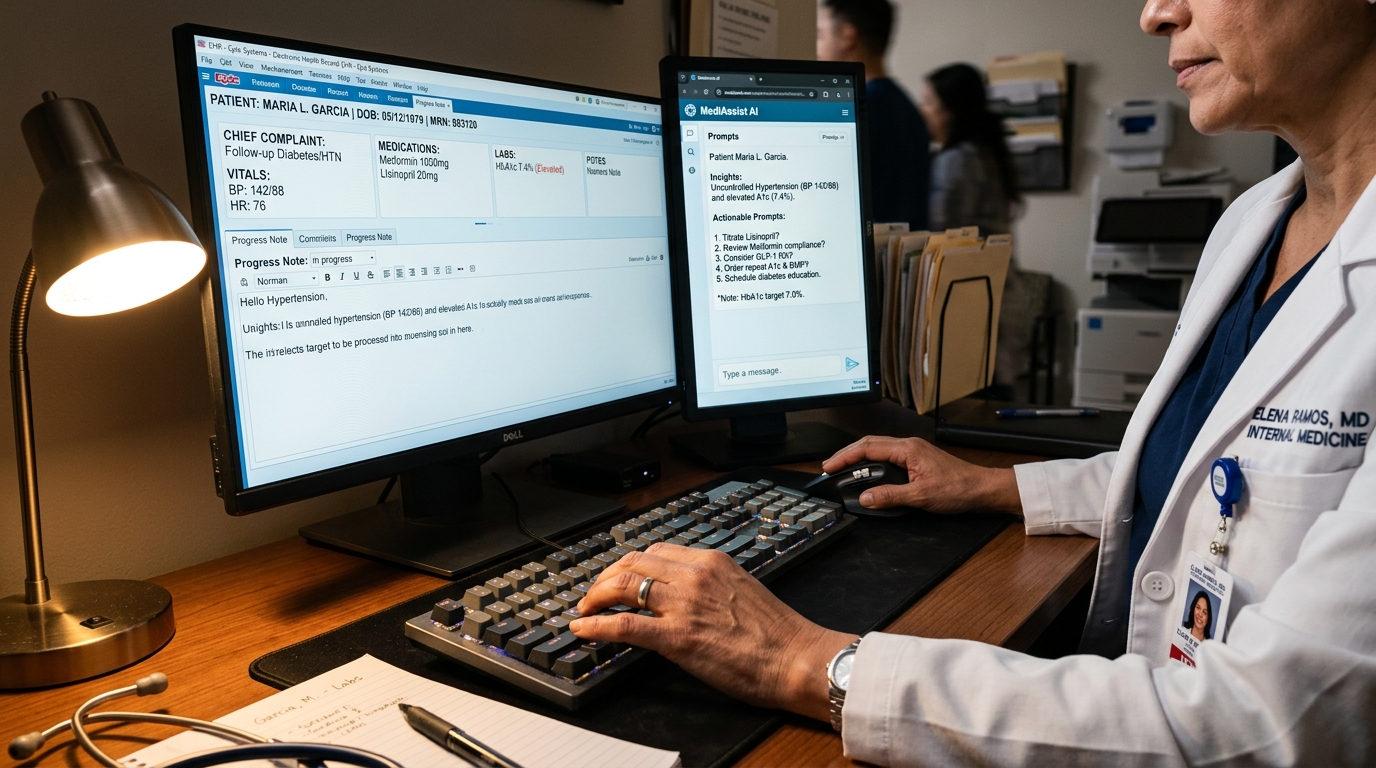
This matters because McKinsey's 2023 analysis on generative AI found that AI-assisted administrative workers complete repetitive data tasks 30–50% faster than unassisted peers. In a front-desk context, that speed difference directly translates to shorter patient wait times, fewer scheduling errors, and more capacity per receptionist — meaning your $2,500/month hire does the work of a role that would otherwise require 1.5 local FTEs.
"The administrative burden on clinical support staff is one of the most underestimated drivers of physician burnout — when front-desk operations run smoothly, providers see the difference immediately in their own energy levels." — Christine Sinsky, MD, Vice President of Professional Satisfaction at the American Medical Association (2023)
The AI copilot isn't a replacement for the receptionist — it's an accelerant. Your live-streaming receptionist brings the human judgment, the empathetic patient interaction, and the real-time decision-making. The AI brings instant data retrieval and workflow prompting. The combination is what makes a single nearshore hire punch well above the output of an undertrained local hire working without tools. You can learn more about how this model works across the full Rose AI Advantage program here.
How to Get Started With a Nearshore Live-Streaming Receptionist in 2026
Most practices are surprised by how fast the placement process moves when working with a managed nearshore agency. There's no multi-month job posting cycle, no benefits enrollment paperwork, and no 90-day probation period where you're holding your breath. Here's the typical sequence:
Intake Call (Day 1)
You describe your practice size, EHR stack, patient volume, and hours. The agency builds a candidate profile specific to your workflow — not a generic receptionist brief.
Candidate Matching (Days 2–5)
Rose vets candidates on English proficiency (8/10+ floor), EHR familiarity, live-video presence, and HIPAA awareness. You receive 1–2 pre-vetted profiles to review.
Interview and Selection (Days 5–7)
You meet your candidate on video — the same medium they'll work in — and confirm fit. Most practices select on the first introduction.
Tech Setup and AI Copilot Training (Days 7–10)
Your receptionist gets access to your EHR, video platform, and AI copilot. Rose handles the onboarding coordination; you provide system credentials.
Go Live (Day 10–14)
Your receptionist appears on the front-desk screen on day one of operations. Ongoing HR, payroll, and management stay with Rose — you manage the work, not the employment relationship.
Rose's pricing is $2,500/month, flat — recruiting, vetting, payroll, HR, and ongoing management are all included. The engagement is month-to-month with no long-term contract; if your receptionist isn't the right fit, Rose replaces them at no additional cost. Practices that also need help beyond the front desk — billing support, chiropractic admin workflows (see how a chiropractic office virtual assistant handles specialty-specific tasks), or bookkeeping — can explore additional placements through the same managed model. You can review the full service scope at the Rose getting started page.
Is a Live-Streaming Medical Receptionist Right for Your Practice in 2026?
The model works best for practices that have at least one physical location with a front desk area where a screen can be mounted, a patient volume that justifies a full-time front-desk role, and an EHR that supports remote access (which is essentially every major platform in 2026). Single-provider practices, multi-location groups, urgent care centers, and specialty clinics — dermatology, chiropractic, physical therapy, behavioral health — are all strong fits.
Strong Fit For
- Practices spending $4,000–$6,500/month on a local receptionist plus benefits
- Locations with high receptionist turnover (US average: ~50% annually)
- Multi-location groups who want consistent front-desk coverage across sites
- Practices on Athenahealth, Kareo, or eClinicalWorks (AI copilot is pre-trained)
- Clinics that need bilingual (English/Spanish) patient-facing capability
Less Ideal For
- Practices with zero physical waiting room (fully telehealth-only)
- Clinics that process only paper-based records with no EHR
- Settings requiring the receptionist to physically hand over forms or badges
According to Gallup's workplace research, engaged employees — those who feel connected to their role and properly supported — produce 23% higher profitability for the organizations they work within. A well-managed nearshore receptionist, supported by an AI copilot and stable employment conditions, consistently outperforms a burned-out, underpaid local front-desk hire on every engagement metric that matters to patient retention. The front desk is the first and last impression your practice makes — it's worth getting right. If you're ready to explore a placement, the Rose intake process starts here.