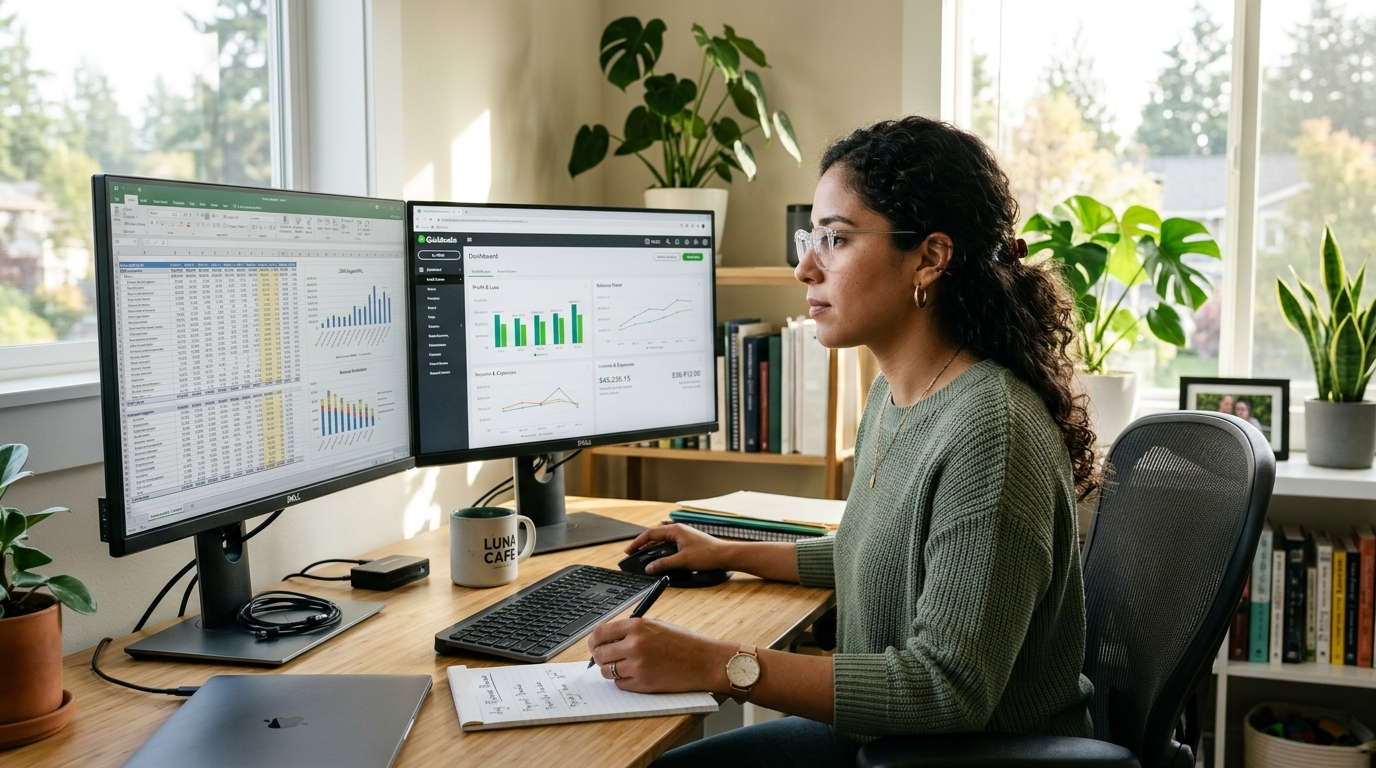
Nearshore live bookkeepers are reshaping how small and mid-sized businesses handle their finances in 2026. Unlike offshore alternatives or automated software add-ons, a nearshore professional works your business hours, communicates in fluent English, and builds institutional knowledge of your accounts over time. If you've been patching together spreadsheets or relying on a once-a-month catch-up, this guide will show you exactly what a live bookkeeper does, what it costs, and how to choose the right option for your business.
What Is a Live Bookkeeper in 2026?
A live bookkeeper is a real, credentialed human being who manages your financial records on an ongoing basis — not an AI tool, not a quarterly accountant, and not a self-service software dashboard. The word "live" distinguishes this person from automated categorization engines like QuickBooks's rule-based features or bank feeds that require constant manual correction.
Live bookkeepers categorize transactions daily, reconcile bank and credit card statements monthly, flag discrepancies before they compound, and produce profit-and-loss reports your leadership team can actually read. Many also handle accounts payable, accounts receivable aging, and payroll data entry. The scope depends on your business size and the arrangement you choose.
According to the U.S. Bureau of Labor Statistics (2024), there are approximately 1.7 million bookkeeping, accounting, and auditing clerks employed in the United States — a role that remains in consistent demand despite automation because human judgment in financial classification is still irreplaceable.
How Much Does a Live Bookkeeper Cost in 2026?
Cost is the first question every business owner asks — and the range is wider than most people expect. A local, in-house bookkeeper in a major U.S. metro earns a median salary of roughly $47,000–$55,000 per year, which translates to $3,900–$4,600 per month before you add payroll taxes, benefits, software licenses, and office overhead. That total cost of employment frequently lands above $60,000 annually, according to SHRM's Total Rewards research (2024).
Software-bundled services like QuickBooks Live sit at a lower price point for very small businesses, but the trade-offs matter. If you've ever wondered whether QuickBooks Live bookkeeping is actually worth what it costs, the short answer is: it depends entirely on how complex your chart of accounts is and how much direct access you need to your bookkeeper.
Dedicated nearshore bookkeepers — full-time professionals based in Latin America, working U.S. business hours — typically cost a flat $2,500 per month through a staffing partner like Rose Talent Solutions. That rate includes recruiting, vetting, payroll, HR administration, and ongoing management. No hidden markups for software or onboarding.

How Do the Main Live Bookkeeper Options Compare in 2026?
The market in 2026 gives you four realistic options: a local in-house hire, a freelance bookkeeper, a software-bundled service (QuickBooks Live, Bench, Pilot), or a dedicated nearshore professional through a staffing agency. Each has a different cost structure, availability model, and risk profile. The table below maps them out side by side.
| Option | Monthly Cost (est.) | Hours Available | Software Depth | Flexibility | Replacement if Not a Fit |
|---|---|---|---|---|---|
| Local In-House Hire | $3,900–$5,000+ | Business hours, your timezone | Varies by candidate | Low — termination costs, severance | Full rehire cost (~$4,000–$6,000) |
| Freelance Bookkeeper | $500–$2,500 (part-time) | Inconsistent, often part-time | Varies widely | Medium — but no dedicated hours | Start over from scratch |
| Software-Bundled Service (e.g., QuickBooks Live) |
$200–$700 | Limited async support | Platform-specific only | High — cancel anytime | Reassignment, not guaranteed |
| Nearshore VA Bookkeeper (Rose Talent Solutions) |
$2,500 flat | 40 hrs/week, your timezone | QuickBooks, Xero, Buildium, more | High — month-to-month, no long-term contract | Free replacement if not a fit |
What Does a Live Bookkeeper Actually Do Day to Day?
The day-to-day work of a live bookkeeper is less glamorous than CFO-level strategy and more valuable than most business owners realize until it's missing. Here's what a full-time, dedicated live bookkeeper handles on a typical week:
- Daily transaction categorization — Every bank transaction, credit card charge, and invoice is coded to the correct account in your chart of accounts. This is where errors compound fastest when neglected.
- Bank and credit card reconciliation — Weekly or monthly, your bookkeeper confirms that your books match your actual bank statements down to the cent.
- Accounts payable management — Vendor bills are logged, scheduled, and tracked so you never accidentally pay twice or miss a due date.
- Accounts receivable aging — Outstanding invoices are monitored and flagged so you can follow up before cash flow becomes a problem.
- Monthly financial reporting — Profit-and-loss statements, balance sheets, and cash flow summaries are prepared for your review or your accountant's tax prep.
- Software maintenance — Your bookkeeper keeps your QuickBooks, Xero, or industry-specific platform updated and clean, so your accountant doesn't charge you extra cleanup fees at year-end.
Many businesses that use a Xero virtual bookkeeper find that the software itself becomes dramatically more useful when a human is actively maintaining the data quality — automated rules only work as well as the person who set them up and reviews them weekly.
According to Intuit QuickBooks research (2023), 60% of small business owners say they don't feel confident in their knowledge of accounting and finance — which means the person maintaining your books isn't just a data entry function. They are actively protecting your ability to make informed decisions.
The real cost of bad bookkeeping isn't the cleanup invoice from your CPA — it's the decisions you made in the meantime based on inaccurate numbers. A live bookkeeper eliminates that blind spot in real time, not retroactively.
How AI-Augmented Bookkeepers Work Better in 2026
One of the genuine changes in 2026 is that the best live bookkeepers don't work alone — they work alongside AI copilots trained on the specific software your business uses. At Rose Talent Solutions, every placed bookkeeper ships with a role-specific AI copilot calibrated for their tools, whether that's QuickBooks Online, Xero, Buildium, AppFolio, or another platform in your stack.
This matters in practice because it compresses ramp time. Instead of a new bookkeeper spending two to three weeks learning where things live in your system, they arrive with deep familiarity baked in. The AI copilot surfaces the right workflows, flags anomalies for human review, and helps the bookkeeper produce cleaner reports faster. You can read more about how this works across the full finance function on the Rose AI Advantage page.
According to McKinsey's research on generative AI (2023), finance and accounting functions are among the highest-value areas for AI-assisted productivity gains — with automation augmentation (human + AI, not AI replacing human) showing the strongest results in accuracy-sensitive roles.
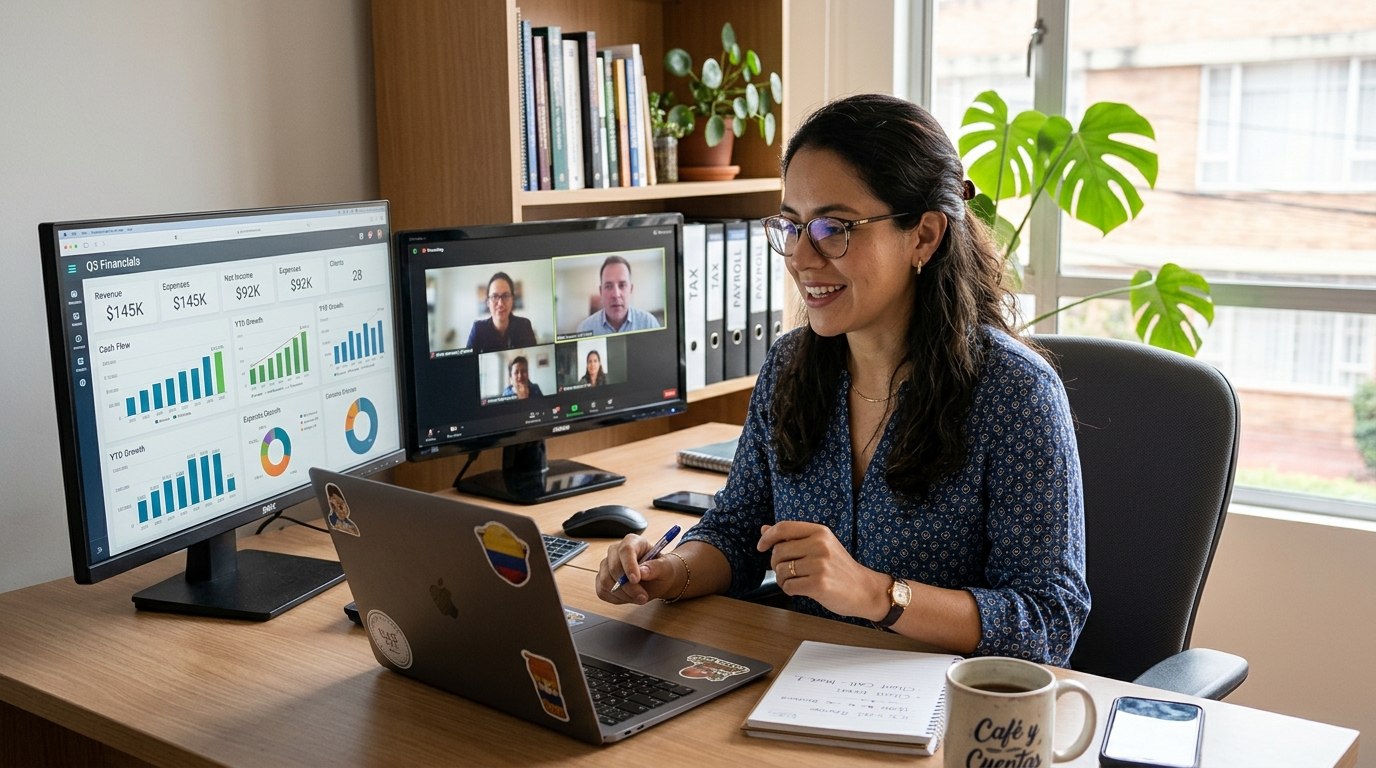
"Generative AI will not eliminate the bookkeeper — it will eliminate the bookkeeper who doesn't use it. The human judgment layer in financial classification is non-negotiable for businesses with any complexity." — Donny Shimamoto, CPA.CITP, Founder at IntrapriseTechKnowlogies (2024)
How to Hire a Live Bookkeeper Through Rose Talent Solutions in 2026
If you've compared the options above and a dedicated nearshore bookkeeper is the right fit, the process is faster than most business owners expect. Rose's matching and onboarding sequence runs in roughly five to seven business days from your first conversation to a placed professional working in your systems.
Discovery Call
You tell Rose your software stack, volume of monthly transactions, and any specialist knowledge you need (real estate, e-commerce, construction, etc.). This shapes the matching criteria before a single candidate is sourced.
Candidate Matching
Rose's recruiting team identifies candidates from their Latin America network who meet your technical requirements and pass an 8/10+ English proficiency screen. You receive a shortlist — typically two to three vetted profiles.
Interview and Selection
You interview candidates directly. No intermediary scripted questions — you run the conversation the same way you'd hire any team member, because that's exactly what this is.
AI Copilot Configuration
Your placed bookkeeper's role-specific AI copilot is configured for your software environment before day one. They arrive ready to work in your systems, not learning them from scratch.
Month-to-Month Engagement Begins
You pay $2,500/month flat — all-in, no long-term contract. If the placement isn't a fit for any reason, Rose replaces them at no additional cost.
You can explore role-specific detail for bookkeeping and accounting placements on the Rose bookkeeping and accounting staffing page, or go straight to get started with a placement if you already know what you need.
Nearshore vs. Offshore Live Bookkeepers: Why Location Still Matters in 2026
The word "virtual" sometimes leads business owners to assume that geography is irrelevant. It isn't — especially for bookkeeping, where your team member needs to be reachable during your business day, not leaving you voicemails at 3 a.m. your time.
Nearshore means Latin America — Colombia, Mexico, Costa Rica, Argentina, and similar countries in the same or adjacent time zones to U.S. cities. Offshore typically means the Philippines or India, where the time difference ranges from 9 to 13 hours behind the U.S. East Coast. That gap doesn't just affect communication speed; it affects how quickly errors get caught, how fast client questions get answered, and how well your bookkeeper integrates with the rest of your team on video calls.
Many business owners who've explored whether a virtual bookkeeper can fully replace QuickBooks Live find that the answer often comes down to access — not software capability, but human access during working hours. A bookkeeper who answers your Slack message at 10 a.m. your time is structurally more useful than one who responds at 2 a.m.
According to Gallup's workplace engagement research (2022), responsiveness and communication are among the top drivers of team integration and productivity — a finding that applies directly to virtual team members who need to feel embedded in your operations to perform at their best.
Nearshore Live Bookkeeper — Pros
- Works your business hours — same timezone or close
- Fluent English communication (8/10+ screen)
- Strong overlap with U.S. financial and tax conventions
- Real-time Slack, email, and video call availability
- Cultural alignment with U.S. business norms
Offshore Live Bookkeeper — Cons
- 9–13 hour timezone lag with U.S. East Coast
- Async-only communication for most of your day
- Higher error correction lag — issues surface a day later
- Variable English fluency without formal screening
- Less familiarity with U.S. GAAP and state tax nuances
If you're evaluating whether a live bookkeeper makes sense for your business — or whether a software-only approach is enough — it's worth reading a candid breakdown of whether QuickBooks Live bookkeeping is worth the cost at your business's current size and complexity. For companies processing more than 150 transactions per month, the case for a dedicated human almost always wins.
The right live bookkeeper isn't a cost center — they're the person who keeps your financials clean enough that every other business decision you make is grounded in accurate data. In 2026, the question isn't whether you need one. It's whether you're paying the right price for the right level of access.