
Nearshore virtual paralegals are quietly replacing the traditional front-desk intake coordinator at law firms of every size — and the economics are hard to argue with. A Latin America-based paralegal working your exact US business hours can handle client intake from first contact through signed retainer, opening the matter in Clio or MyCase before a full-time in-house hire has finished their morning coffee. This post breaks down exactly how a virtual paralegal handles client intake, step by step, so you know precisely what to hand off and what to keep.
If you're evaluating whether a virtual legal assistant is the right fit before committing to a full paralegal scope, the decision framework for hiring a virtual legal assistant for your law firm is a useful starting point. But if intake specifically is your bottleneck — the thing eating 10-15 attorney hours a week — understanding how a virtual paralegal handles client intake end to end is what you need right now.
That single statistic explains why intake speed is a revenue issue, not just an operations issue. Every hour a new inquiry sits unanswered is a potential client walking to your competitor. When a virtual paralegal handles client intake in real time — monitoring web forms, email, phone, and live chat simultaneously during US business hours — that gap disappears without adding a full salary, benefits package, or office overhead.
What Is a Virtual Paralegal and What Makes "Nearshore" Different in 2026?
A virtual paralegal is a trained legal professional who performs paralegal-level work remotely — intake, document drafting, deadline tracking, research, and client communication — under attorney supervision. The "virtual" label simply means they work from a home or co-working office rather than yours.
"Nearshore" means they are based in Latin America (countries like Colombia, Mexico, Costa Rica, or Argentina) and work in alignment with US time zones, typically 9 a.m. to 6 p.m. EST or CST. This is the critical distinction from offshore staffing, where a paralegal in the Philippines or India may be 9-13 hours ahead, handling your Monday morning intake inquiries on Tuesday night.
Rose Talent Solutions places nearshore paralegals with an English proficiency floor of 8/10 on standardized screening — the same bar applied to every placement. Each team member also ships with a role-specific AI copilot trained on the legal software your firm already uses, from Clio and MyCase to Filevine and PracticePanther. That combination — real-time timezone overlap, fluent English, and day-one software readiness — is what makes nearshore the default choice for US firms in 2026. Learn more about how the technology layer works on the AI advantage page.
How Does a Virtual Paralegal Handle the First Point of Client Contact?
Understanding how a virtual paralegal handles client intake starts at the very first touchpoint. The moment a prospective client reaches out — whether by web form, phone, email, or live chat — a trained virtual paralegal is monitoring all four channels simultaneously during business hours. This is not a chatbot or an answering service. It is a human professional who can ask clarifying questions, gauge emotional urgency (critical in family law or personal injury), and begin building rapport on your behalf.
Once contact is made, the paralegal follows a firm-specific intake script you define during onboarding. Typical first-contact tasks include: confirming the practice area match, collecting the prospective client's full name and contact information, identifying the opposing party for conflict-check purposes, and booking a consultation on the attorney's calendar. All of this happens before the attorney is looped in — and it is the foundation of how a virtual paralegal handles client intake efficiently at scale.

According to the U.S. Bureau of Labor Statistics (2024), the median annual wage for a paralegal in the United States is $61,400 — roughly $5,100 per month before benefits, office space, and recruiting costs. A nearshore virtual paralegal at $2,500/month all-in represents a cost reduction of more than 50%, with zero sacrifice in business-hours availability.
How Does the Conflict Check and Lead Qualification Step Work in 2026?
After the first contact, the virtual paralegal runs a conflict check using your firm's case management system. In Clio, for example, this means searching the new contact's name and the opposing party's name against all existing and former matters. If a conflict is flagged, the paralegal follows your firm's protocol — typically a templated declination letter sent within the hour. If no conflict exists, the matter moves forward to qualification.
"The intake bottleneck is almost always a staffing problem disguised as a process problem. When you add a dedicated person whose only job is intake, the conversion rate from inquiry to signed client typically jumps 20-30% within 90 days." — Joshua Lenon, Lawyer in Residence at Clio (2023)
Qualification follows conflict clearance. The paralegal applies your screening criteria — minimum case value, geographic jurisdiction, statute of limitations status, liability threshold, or whatever your practice area requires — and categorizes each lead as qualified, unqualified, or needs-attorney-review. Unqualified leads receive a referral or a polite declination. Qualified leads move to the next step: the engagement packet.
This is also where the AI copilot earns its keep. Rose's paralegals use a role-specific AI layer trained on your firm's intake criteria, so the paralegal can process a lead checklist faster and flag edge cases for attorney review without spending 20 minutes manually cross-referencing intake rules.
| Factor | Nearshore VA (Latin America) | Offshore VA (Philippines/India) | Onshore VA (US-based) |
|---|---|---|---|
| Monthly cost (full-time) | $2,500 flat | $800–$1,500 | $4,500–$7,000+ |
| Timezone overlap with US hours | Full overlap (same time zone or ±1 hr) | Minimal (9-13 hrs ahead) | Full overlap |
| English proficiency | 8/10+ screened | Varies widely (4–8/10) | Native |
| Real-time client intake response | Yes — live during US hours | No — batched or overnight | Yes |
| Software readiness (Clio, MyCase) | AI copilot included at hire | Self-trained, inconsistent | Varies by candidate |
| Recruiting & HR included | Yes (all-in pricing) | Rarely | Rarely |
| Contract terms | Month-to-month, 30 days notice | Varies | Varies |
How Does a Virtual Paralegal Handle the Engagement Packet and Retainer Step?
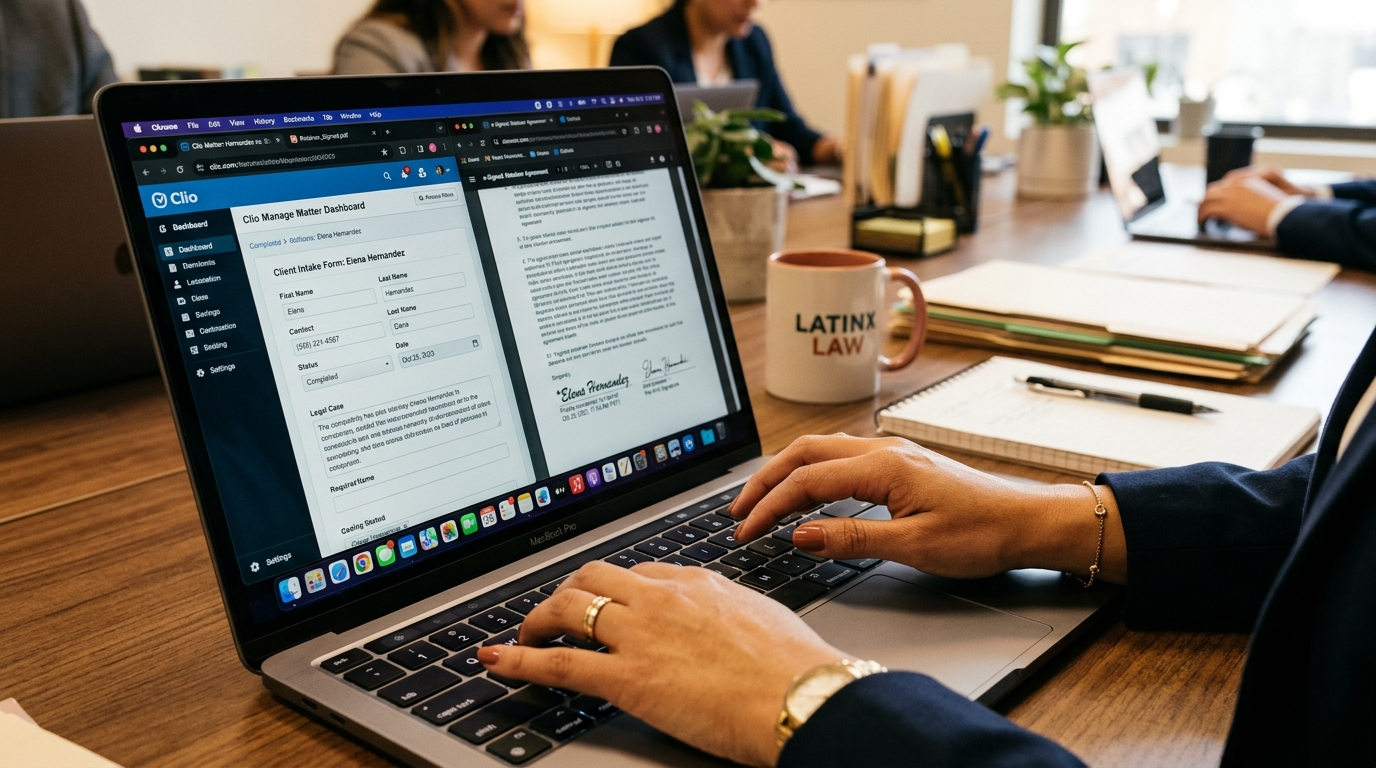
Once a lead is qualified, the paralegal prepares and sends the engagement packet. This typically includes the retainer agreement, a HIPAA or privacy authorization (depending on practice area), a fee disclosure, and a detailed intake questionnaire. In most firms this is templated — the paralegal pulls the correct version for the matter type, populates the client's name and matter details, and sends it via your e-signature platform (DocuSign, Adobe Sign, or the native Clio tool).
The engagement packet step is where most in-house intake processes stall. When a virtual paralegal handles client intake end to end, the packet goes out within minutes of qualification — not the next business day — and automated follow-up triggers at 24 and 48 hours if the client hasn't signed. That follow-up cadence alone recovers an estimated 15-25% of leads that would otherwise go cold.
According to a 2023 survey by LawPay, 41% of legal clients say they abandoned a firm during onboarding because the paperwork process was too slow or confusing. A virtual paralegal who handles client intake end to end — sending a clean, pre-populated packet and following up within 24 hours — eliminates that friction point entirely.
After the signed retainer is returned, the paralegal opens the matter in your case management system, populates all client and case data fields, assigns the appropriate matter template (deadlines, task list, document folders), and sends the client a welcome email confirming next steps. At this point the attorney receives a fully prepped file — not a raw inquiry.
For solo and small-firm attorneys who want a detailed breakdown of which paralegal service models work best at this scale, the 2026 guide to virtual paralegal services for solo attorneys covers pricing structures, scope of work, and vetting criteria side by side.
What Tasks Does a Virtual Paralegal Handle After Client Intake Is Complete in 2026?
Intake is the entry point, but a well-deployed virtual paralegal doesn't stop there. Once the matter is open, the same team member typically takes on the ongoing client communication and administrative layer of the case — scheduling, document collection, status updates, and deadline reminders. This is where the real leverage is: the attorney stays in the high-judgment lane while the paralegal handles everything that doesn't require a bar license.
A Gallup (2023) analysis of professional service firms found that employees who spend more than 20% of their time on administrative tasks report 31% lower engagement scores — a signal that administrative overload isn't just a cost problem, it's a talent retention problem. Offloading that layer to a virtual paralegal protects both attorney productivity and firm culture.
Common post-intake tasks handled by nearshore virtual paralegals at Rose include:
- Drafting demand letters, discovery requests, and correspondence from attorney-reviewed templates
- Maintaining the case timeline and flagging upcoming court deadlines in the case management system
- Coordinating with opposing counsel's office for scheduling and document exchange
- Requesting medical records, police reports, and third-party documents
- Preparing hearing binders and exhibit lists under attorney direction
- Running weekly client status calls to reduce inbound "where is my case?" inquiries
If your firm also needs help on the financial side — trust accounting reconciliation, invoice tracking, or IOLTA ledger management — Rose's virtual bookkeeping and accounting staff can work alongside your paralegal as a coordinated nearshore team, rather than requiring a second vendor.
How to Onboard a Virtual Paralegal for Client Intake in 2026
The onboarding sequence for a nearshore virtual paralegal at Rose is structured to get you to a live, handling-intake-independently state within the first two weeks. Here is exactly how it works:
Intake Call with Rose (Day 0)
You describe your practice area, intake volume, software stack, and the specific tasks you want covered. Rose uses this to match you with a paralegal whose background aligns to your matter types — family law, PI, immigration, estate planning, etc.
Candidate Matching (Days 1-5)
Rose presents one to three vetted candidates. You interview and select. The paralegal has already passed English proficiency screening (8/10+), legal workflow assessment, and a background check before you see their profile.
Software Access and Script Setup (Days 5-7)
Your paralegal gets access to Clio, MyCase, or whichever system you use. Rose's AI copilot is configured to your intake criteria. You walk through your intake script, conflict-check protocol, and engagement packet templates in a single recorded session.
Shadowed Intake (Days 8-10)
The paralegal handles real inquiries with you monitoring. Questions get resolved in real time. By day 10, most firms report the virtual paralegal is handling standard client intake independently.
Full Handoff (Day 14+)
You review a weekly intake report — leads received, qualified, declined, converted to signed retainer — and step in only for edge cases that need attorney judgment. Rose's management layer handles HR, payroll, and performance oversight.
The terms are month-to-month with 30 days written notice — no long-term contract. If the paralegal isn't the right fit, Rose replaces them at no additional cost. You can review the full placement process and get started at the Rose Talent Solutions start page.
Why Nearshore Virtual Paralegals Win for Client Intake
- Real-time response — live during your exact US business hours, not batched overnight
- Flat $2,500/month covers recruiting, HR, payroll, and management — no hidden fees
- AI copilot trained on Clio, MyCase, or Filevine from day one — no ramp-up lag
- Month-to-month terms — no long-term contract locking you in
- Free replacement if the placement isn't the right fit
What to Plan For
- Two-week onboarding investment to document your intake script and templates
- Attorney must approve final intake protocols before full handoff
- State bar ethics rules vary — confirm your jurisdiction's rules on paralegal supervision before delegating conflict checks
According to SHRM's workforce research (2024), the average cost to replace a single employee is 50-200% of their annual salary. For a paralegal earning $60,000/year, that's $30,000-$120,000 per turnover event. A nearshore model with a free replacement guarantee eliminates that financial risk from your cost model entirely.
For firms evaluating the full virtual legal staffing landscape beyond how a virtual paralegal handles client intake and day-to-day paralegal support, Rose's operations staffing overview provides a broader view of how nearshore teams are structured across service verticals.