
Nearshore virtual assistants trained on Kareo are quietly replacing in-house billing coordinators at independent medical practices across the US—and the numbers make it easy to see why. A full-time, Kareo-fluent billing specialist hired through a nearshore staffing model costs a fraction of what you'd pay a domestic employee, works your exact business hours, and can be onboarded in under two weeks. If your practice is still paying $55,000–$70,000 per year in salary plus benefits for a billing coordinator who spends half the day on hold with payers, keep reading.
Medical billing is one of the highest-leverage tasks you can delegate. Claims submission, denial follow-up, ERA posting, and eligibility verification are rules-based, software-driven workflows—exactly the kind of work a well-trained remote specialist handles without supervision. When that specialist already knows Kareo's interface, charge entry screens, and reporting dashboards before their first day, the ramp time collapses from months to days.
According to the Centers for Medicare & Medicaid Services (2023), administrative waste—including billing errors, claim rework, and manual follow-up—accounts for hundreds of billions in unnecessary healthcare spend every year. The practices that recover fastest are the ones that systematize their billing operations. A dedicated Kareo VA is how you systematize without hiring.
What Is a Kareo Virtual Assistant for Medical Billing?
A Kareo virtual assistant for medical billing is a remote billing specialist who operates entirely inside the Kareo (now Tebra) platform to manage the end-to-end revenue cycle for a medical practice. This is not a generalist VA who learns Kareo on the job—a trained Kareo billing VA arrives familiar with charge entry, claim scrubbing, payer rules, ERA/EOB posting, patient statements, and the denial workflow inside the platform.
Unlike an offshore VA working from the Philippines or India with a 10–12 hour time gap, a nearshore VA based in Latin America works in your timezone—EST, CST, MST, or PST—so they're available when your front desk calls with a coding question and when a payer's provider line is actually open. Rose Talent Solutions screens every candidate to an 8/10 or higher English proficiency floor, so communication with patients, payers, and your clinical team is seamless.
If your practice uses a different EHR alongside Kareo, it's worth exploring how a DrChrono-trained billing VA compares—the workflows differ by platform, and matching the VA to your specific software matters more than most practices realize.
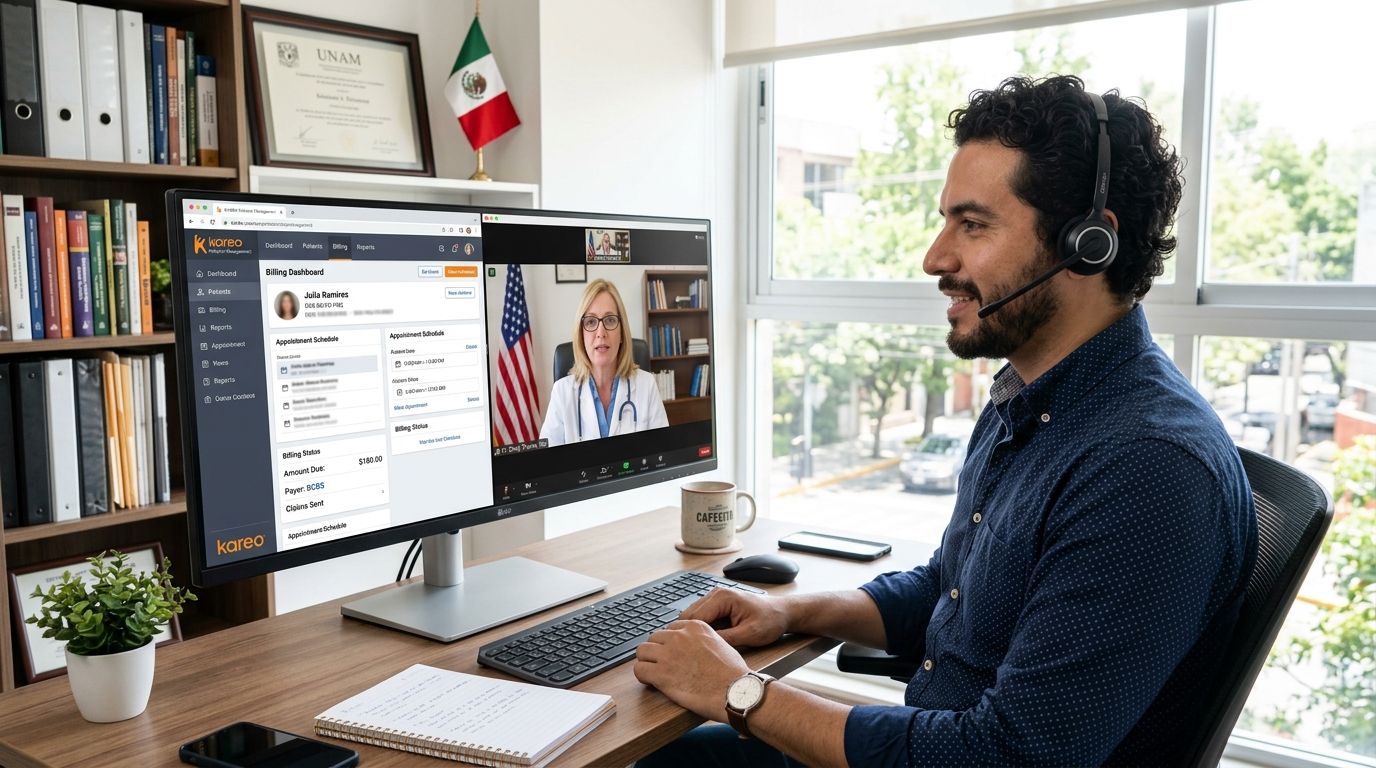
How a Kareo VA Handles Your Revenue Cycle in 2026
The revenue cycle in a small-to-mid-size practice touches a dozen daily tasks that rarely get full attention from a clinical team stretched across patient care. A dedicated Kareo billing VA takes ownership of each stage so nothing falls through the cracks. Here is exactly what that looks like in practice:
Charge Entry & Claim Scrubbing
The VA reviews superbills or encounter notes, enters charges into Kareo with correct CPT and ICD-10 codes, and runs the built-in claim scrubber to catch errors before submission—stopping denials before they start.
Electronic Claim Submission
Clean claims are submitted electronically through Kareo's clearinghouse. The VA monitors acceptance reports and resolves any rejections same-day, keeping your cash flow on a consistent weekly rhythm.
ERA/EOB Posting & Reconciliation
When payer remittances arrive, the VA posts ERA files in Kareo, reconciles payment-to-expected amounts, and flags underpayments for appeal—a task that often gets skipped in busy practices.
Denial Management & Appeals
The VA works the denial queue daily: identifying root causes, correcting claims, writing appeal letters, and tracking outcomes—typically recovering 15–25% of initially denied revenue that practices leave on the table.
Patient Statements & Collections Follow-Up
The VA generates and sends patient statements through Kareo, fields billing questions by phone and portal message, and manages payment plan setup—reducing your front desk burden and improving patient satisfaction.
According to MGMA (2023), denial rates at independent practices average 5–10% of submitted claims, and fewer than half of denied claims are ever appealed. A full-time Kareo VA focused on denial management alone can materially move that number. Many practices also rely on an insurance verification VA working in parallel to catch eligibility issues before the claim is even created—eliminating a major source of front-end denials.
Nearshore vs. Offshore vs. In-House: Which Is Right for Kareo Billing in 2026?
Not all remote billing help is equal. The table below cuts through the noise and compares the three most common staffing options practices are choosing from in 2026.
| Factor | Nearshore VA (Latin America) | Offshore VA (Philippines/India) | In-House Billing Coordinator |
|---|---|---|---|
| Monthly Cost | ~$2,500 flat (all-in) | $800–$1,500 (hidden costs add up) | $4,500–$6,500+ (salary + benefits) |
| Timezone Overlap | Full US hours (EST–PST) | Partial or overnight only | Full US hours |
| English Proficiency | 8/10+ screened | Varies widely; often 5–7/10 | Native / near-native |
| Kareo Platform Training | Role-specific AI copilot included | Self-trained, inconsistent | Requires employer-funded training |
| Ramp Time | 3–7 days to productive | 2–6 weeks (timezone friction) | 4–8 weeks |
| Contract Terms | Month-to-month, no long-term contract | Often 3–6 month minimums | At-will but severance risk |
| Replacement if Not a Fit | Free replacement included | Rarely offered | Full rehire cost ($5K–$15K) |
The offshore price tag looks attractive until you factor in the real costs: timezone friction, rework from miscommunication, and denial queues that sit untouched overnight. Nearshore closes that gap entirely. For specialty practices—chiropractic, dental, behavioral health—the same model applies. A chiropractic office virtual assistant working the same hours as your front desk is a fundamentally different product than an offshore VA handling billing from 12 time zones away.
How Rose's AI Copilot Makes Kareo Billing VAs Faster Than In-House Hires
Every Rose Talent Solutions team member is paired with a role-specific AI copilot trained on their software stack. For Kareo billing VAs, that means the AI is pre-loaded with Kareo's workflow logic, common denial codes, payer-specific rules, and claim correction templates. This is not a generic ChatGPT wrapper—it's a purpose-built assistant that knows what a CO-4 denial means in Kareo and how to route it.
"AI-augmented billing staff are processing claims 40% faster than their non-augmented counterparts, and first-pass claim acceptance rates are climbing as a direct result." — Shahid Shah, Healthcare IT Analyst and Editor at Netspective (2024)
The productivity impact is measurable. According to Healthcare IT News (2024), AI-assisted revenue cycle tools reduce claim rework rates by up to 30% compared to manual-only workflows. When a VA arrives already trained on those tools, you skip the three-month learning curve entirely.
The AI copilot isn't a bonus feature—it's why a nearshore Kareo billing VA from Rose can outperform a six-month domestic hire on first-pass acceptance rates within the first week. The copilot surfaces the right Kareo screen, the correct modifier, and the payer-specific rule before the VA has to ask anyone.
Rose's onboarding process pairs the AI copilot configuration with a practice-specific intake—your fee schedule, top payers, common denial patterns, and internal workflows are loaded into the VA's tools before day one. The same AI-augmented approach scales across other medical office functions; if you're managing a dental practice, see how dental office virtual assistant services use the same model to cover scheduling, billing, and patient communication.

What Does a Kareo Medical Billing VA Cost in 2026—and Is It Worth It?
Rose Talent Solutions charges a flat $2,500 per month for a full-time (40 hours/week) nearshore VA. That rate is all-inclusive: recruiting, vetting, payroll, HR compliance, ongoing management, and the AI copilot. There are no add-on fees for replacement if a placement isn't a fit—that's covered. The engagement is month-to-month with 30 days written notice to cancel, so you're not locked into a long-term contract.
To put that in context: the Bureau of Labor Statistics (2024) puts the median annual wage for medical billing and coding specialists in the US at $48,780—roughly $4,065/month before you add employer payroll taxes, health insurance, PTO, and recruiting costs. The all-in cost of a domestic billing coordinator typically runs $5,500–$7,000/month for a small practice. The nearshore model at $2,500/month delivers the same dedicated, full-time labor at less than half that cost, with faster onboarding and built-in replacement coverage.
Why Practices Choose a Kareo Nearshore VA
- Full US timezone coverage—available when payers are open
- Kareo-specific workflow training from day one
- Flat $2,500/month with no hidden HR costs
- Free replacement if the match isn't right
- Month-to-month terms, no long-term contract
- AI copilot accelerates first-pass claim accuracy
When It Might Not Be the Right Fit
- Practice needs someone physically on-site for paper chart handling
- Billing volume is fewer than 50 claims/week (part-time may suffice)
- EHR is highly custom and requires proprietary in-person training
According to SHRM (2023), the average cost to recruit and onboard a single administrative hire in the US is $4,700—before the first paycheck clears. A nearshore VA through Rose eliminates that sunk cost entirely; if the placement isn't right, you get a replacement at no additional charge.
For practices managing multiple administrative functions, Rose's model extends beyond billing. The same flat-rate structure covers bookkeeping and accounting VAs trained on QuickBooks or other platforms—useful for practice managers who want to consolidate their administrative outsourcing under one provider.