
Nearshore virtual assistants — based in Latin America, working US business hours — have quietly closed the gap between "coordinator-level budget" and "technical-level output," and in 2026 that gap is essentially gone. If you've been assuming that hiring someone who can genuinely operate AppFolio, build a Zapier workflow, or reconcile books in QuickBooks requires a $55,000 salary line, this post will reframe how you think about staffing. A full-time, technically capable virtual assistant based in Latin America now costs $2,500 per month flat — all-in, no long-term contract. That's not a compromise. That's a structural advantage most of your competitors haven't found yet.
This guide is written for business owners and operators — particularly those running property management companies, e-commerce operations, or professional services firms — who need real technical help but are working with a coordinator-sized budget. We'll walk through what a technical VA actually is, how nearshore compares to other hiring models, how the matching and onboarding process works, and what to look for when you're evaluating providers.
What Is a Technical VA — and How Is One Different from a Regular VA in 2026?
A technical virtual assistant is a remote team member whose core value is software fluency and process execution, not just scheduling and inbox management. A standard VA handles administrative tasks: booking appointments, managing email, data entry. A technical VA operates the actual platforms your business runs on — property management software, CRMs, accounting tools, API-connected automations, and no-code workflows.
The distinction matters because the hiring market treats them differently. A domestic technical coordinator with AppFolio or Buildium experience commands $45,000–$60,000 per year, according to the U.S. Bureau of Labor Statistics (2024). A nearshore technical VA with the same software depth costs a fraction of that — and with the right provider, ships with a role-specific AI copilot already trained on that software on day one.
If your operation uses tools like Airtable for project tracking, you may already know how steep the learning curve is for untrained hires. A dedicated Airtable virtual assistant who already knows the platform's relational database logic, views, and automations can contribute in week one rather than month three.

How Nearshore Compares to Offshore and Onshore in 2026: The Real Numbers
The phrase "virtual assistant" covers a wide range of actual experiences. Offshore VAs hired through low-cost platforms at $8–$12/hour may have solid general admin skills, but timezone misalignment — often 10–13 hours off US Eastern — means real-time collaboration is functionally impossible. You end up leaving instructions at night and reviewing results in the morning. For technical work that requires back-and-forth problem-solving, that rhythm breaks down fast. Rose team members are based exclusively in Latin America — never routed through Asia or any other offshore region.
Nearshore VAs based in Latin America work on US business hours — same timezone or within one to two hours. English proficiency is screened to an 8/10 floor. They participate in your Slack, your standups, your Zoom calls. That presence is what separates coordination from execution.
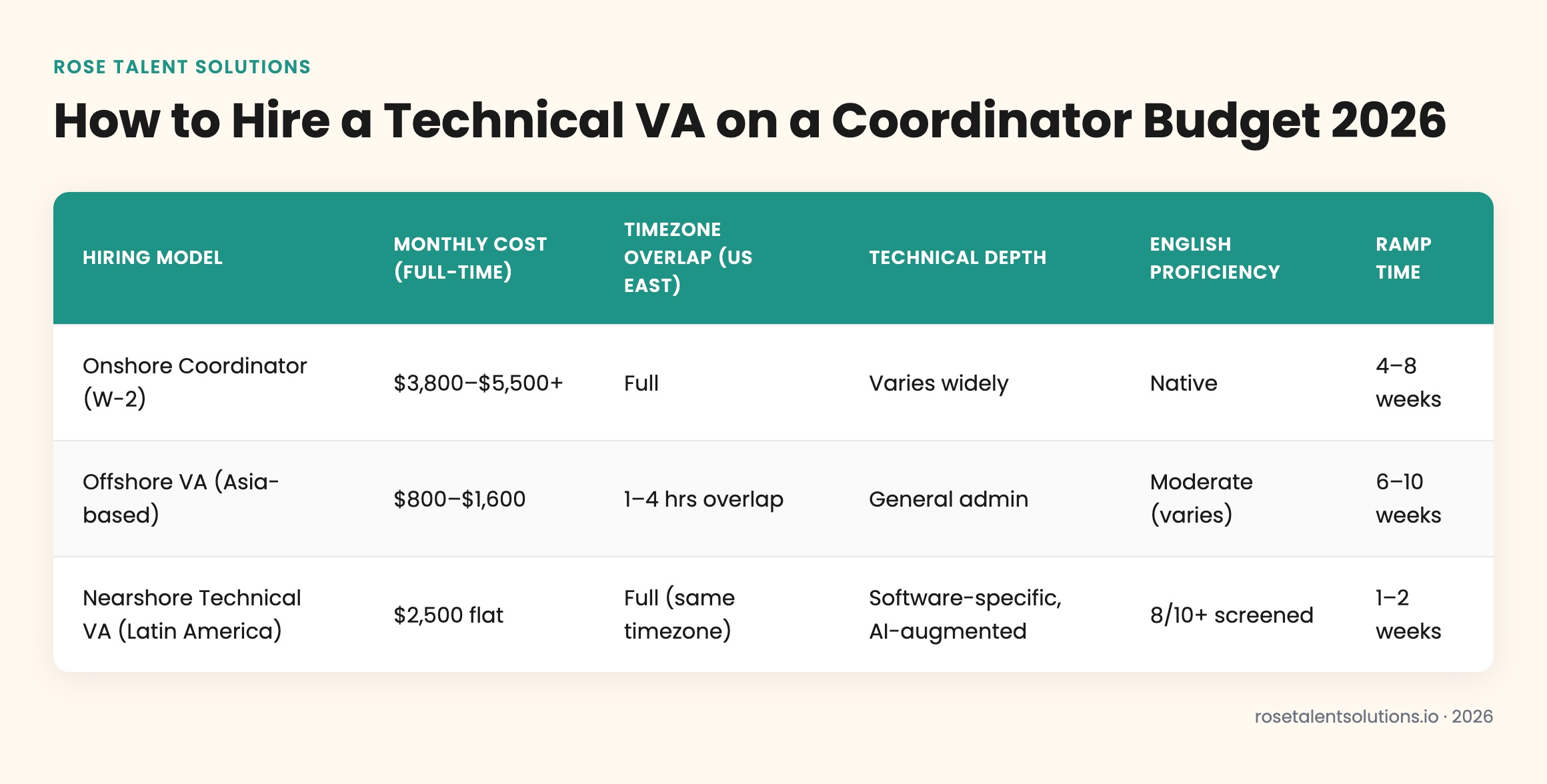
| Hiring Model | Monthly Cost (Full-Time) | Timezone Overlap (US East) | Technical Depth | English Proficiency | Ramp Time |
|---|---|---|---|---|---|
| Onshore Coordinator (W-2) | $3,800–$5,500+ | Full | Varies widely | Native | 4–8 weeks |
| Offshore VA (Asia-based) | $800–$1,600 | 1–4 hrs overlap | General admin | Moderate (varies) | 6–10 weeks |
| Nearshore Technical VA (Latin America) | $2,500 flat | Full (same timezone) | Software-specific, AI-augmented | 8/10+ screened | 1–2 weeks |
"Hiring managers consistently underestimate the hidden costs of timezone-misaligned outsourcing — delayed decisions, rework cycles, and management overhead often erase the apparent hourly savings within 90 days." — Johnny C. Taylor Jr., President & CEO at SHRM (2024)
What Technical Tasks Can a Nearshore VA Actually Own in 2026?
This is where most buyers get it wrong. They assume "VA" means support tasks only. A properly vetted nearshore technical VA can own entire workflows — not just assist with them. Here's what that looks like in practice across common verticals:
- Property management: AppFolio or Buildium work order triage, lease renewal tracking, tenant communication queues, maintenance vendor coordination, owner report generation. Explore the full scope at Rose's property management VA page.
- Finance and accounting: QuickBooks reconciliation, accounts payable processing, invoice management, expense categorization, month-end close support. See how this works at the bookkeeping and accounting VA page.
- Operations and automation: Building and maintaining Zapier or Make.com workflows, connecting tools via webhook or lightweight API calls. If your stack has integration gaps, a VA who understands API integration tasks can close them without hiring a developer.
- Project and data management: Airtable base management, CRM hygiene, pipeline reporting, task tracking across tools like ClickUp, Notion, or Monday.com.
- No-code development support: Building internal tools, automating client onboarding sequences, maintaining forms and approval workflows. A no-code virtual assistant can handle projects that previously required a freelance developer.
Each Rose team member ships with a role-specific AI copilot trained on their assigned software stack. That means your AppFolio coordinator isn't figuring out the platform from scratch — they arrive with AI-assisted workflows already mapped to your most common task types. You can learn more about how that works on the AI advantage page.
The hidden cost of hiring a general VA for technical work isn't the monthly rate — it's the 6–10 week ramp to basic competency, plus the compounding errors that happen while they're learning software your business depends on daily. Software-pre-trained nearshore VAs from Latin America cut that ramp to under two weeks.
How the Hiring Process Works: From Brief to First Day in 2026
One of the reasons businesses default to job boards for technical hires is familiarity — post a role, review applications, interview, hire. The nearshore VA model through a staffing agency like Rose works differently, and faster. Here's the sequence:
Role Brief
You describe the software stack, task types, hours, and communication style you need. Rose maps this to a candidate profile — no generic job description required.
Vetting and Matching
Candidates are screened for English proficiency (8/10+ floor), software fluency, and culture fit. You receive 1–2 matched profiles, not a stack of 40 resumes.
Interview and Selection
You interview the finalist(s) on video. Most clients select in one round. Average time from brief to placement is 7 days.
AI Copilot Activation
Your team member's role-specific AI copilot is configured for your software stack before their first day. They arrive ready to work in your tools, not learning them.
Ongoing HR and Management
Rose handles payroll, compliance, and HR. If the placement isn't the right fit, you get a free replacement at no additional cost — that's the sole risk reversal, and it's meaningful.
The flat $2,500/month covers all of it: recruiting, vetting, payroll, HR, and ongoing management. You don't pay a separate placement fee. You don't manage a foreign payroll entity. You don't sign a multi-year contract. It's month-to-month with 30 days written notice to cancel. Ready to scope a role? Start here.

How to Evaluate Any Technical VA Provider Before You Commit in 2026
Not all nearshore staffing agencies are built the same. Before you sign with any provider, run through this checklist to make sure you're getting genuine technical depth — not a rebranded general admin service with a "nearshore" label slapped on it.
Green Flags in a Technical VA Provider
- Software-specific vetting — they test AppFolio, QuickBooks, or Airtable competency, not just "computer skills"
- English proficiency scored on a standardized scale, with a documented floor (Rose's is 8/10+)
- Candidates based exclusively in Latin America, working US business hours — never routed through Asia or presented under a misleading geographic label
- Flat, all-in pricing with no hidden placement or management fees
- Free replacement guarantee if the hire isn't a fit — no additional cost
- Month-to-month terms — no long-term contract required
- AI-augmented onboarding so the VA arrives productive, not starting from scratch
Red Flags to Watch For
- Hourly billing with no monthly cap — costs balloon as task volume grows
- No software vetting — "tech savvy" listed as a qualification with no specifics
- Asia-based team members marketed as "nearshore" — that label applies to Latin America for US businesses, not trans-Pacific placements
- Long-term contracts with steep cancellation penalties
- Vague replacement policies — "we'll try to find someone" is not a guarantee
- No AI tooling — in 2026, any technical VA provider without an AI augmentation layer is already behind
Technical VA hiring is also maturing fast on the buyer side. According to Gallup's Future of the Workplace research (2024), 58% of US knowledge workers now perform work that could be partially or fully delegated to a trained remote specialist — yet most small business owners haven't restructured their teams to reflect that reality. The ones who have are compressing their labor cost per output unit by 30–45%.
The remote work data backs this up structurally. McKinsey Global Institute (2023) found that roles requiring digital tool fluency — not just computer access — are among the fastest-growing job categories globally, yet domestic supply lags demand significantly. That gap is exactly where nearshore technical VAs based in Latin America operate.
From a software-specific lens, Buildium's State of the Property Management Industry Report (2024) found that 67% of property management companies cite operational bottlenecks tied to understaffing in administrative and coordinator-level roles — not strategic positions. A nearshore technical VA addresses that exact gap at a price point that doesn't require headcount approval from a board.
For businesses already using SHRM-benchmarked compensation data to set salary bands, the math is stark. SHRM's benchmarking surveys (2024) peg total compensation for a US-based administrative coordinator with technical skills at $52,000–$68,000 annually — before benefits, payroll tax, and recruiting costs. At $2,500/month, a nearshore technical VA is $30,000/year. The difference funds another hire, a software upgrade, or simply stays in margin.