
Nearshore virtual paralegals have quietly become the most practical hire a solo attorney can make in 2026. While offshore providers pitch low hourly rates and domestic legal staffing firms charge partner-level salaries, a third path has matured: full-time, English-fluent, Latin America-based legal support working in real time on your schedule — at a price a solo practice can actually sustain. If you've been doing your own intake, drafting your own demand letters, and chasing your own deadline calendar, this post is a direct answer to the question of how to stop doing all three.
According to the American Bar Association's 2023 Profile of the Legal Profession, more than 49% of all practicing attorneys in the United States work in solo or two-person firms. The vast majority of those attorneys report that administrative overload is the single largest threat to profitability — not caseload, not client acquisition. The problem is operational, and the best virtual paralegal services for solo attorneys address it directly.
What Is a Nearshore Virtual Paralegal — and Why Does It Matter in 2026?
A nearshore virtual paralegal is a trained legal support professional based in Latin America who works remotely for a US, Canadian, or UK attorney during that attorney's normal business hours. Unlike offshore paralegals based in the Philippines or India — who typically operate 8 to 14 hours ahead of US Eastern time — nearshore team members are 0 to 3 hours offset from New York, meaning real-time collaboration is the default, not the exception. They answer your client's intake call at 10am your time. They catch your 4pm file update. They don't batch their communications overnight.
The distinction matters for legal work specifically because attorney-client deadlines don't pause for time zones. A statute of limitations doesn't care that your support team is offline. A deposition prep call scheduled for tomorrow morning needs a paralegal who can pull the right documents tonight, in your evening, not their morning. Solo attorneys searching for the best virtual paralegal services in 2026 consistently cite timezone alignment as the factor that determines whether a remote paralegal is genuinely useful or merely cheap.
How Virtual Paralegals Actually Free Up Attorney Time in 2026
The honest answer to "what does a virtual paralegal do?" is: everything that keeps you from practicing law. That list is longer than most solo attorneys admit. Intake coordination, client status updates, court deadline tracking, document drafting from templates, e-filing prep, billing entry, correspondence management, medical records requests, and discovery organization — these tasks consume 40 to 60% of a solo attorney's working week, according to research published by Cornell Law School's Law, Policy and Technology program.
A dedicated virtual paralegal reclaims that time. Not fractionally — entirely. When one person owns intake, deadline calendaring, and client communication, you get to own your casework. That's the core value proposition behind every top-ranked virtual paralegal service for solo attorneys in 2026.

How to Compare Virtual Paralegal Services in 2026: Nearshore vs. Offshore vs. Domestic Freelance
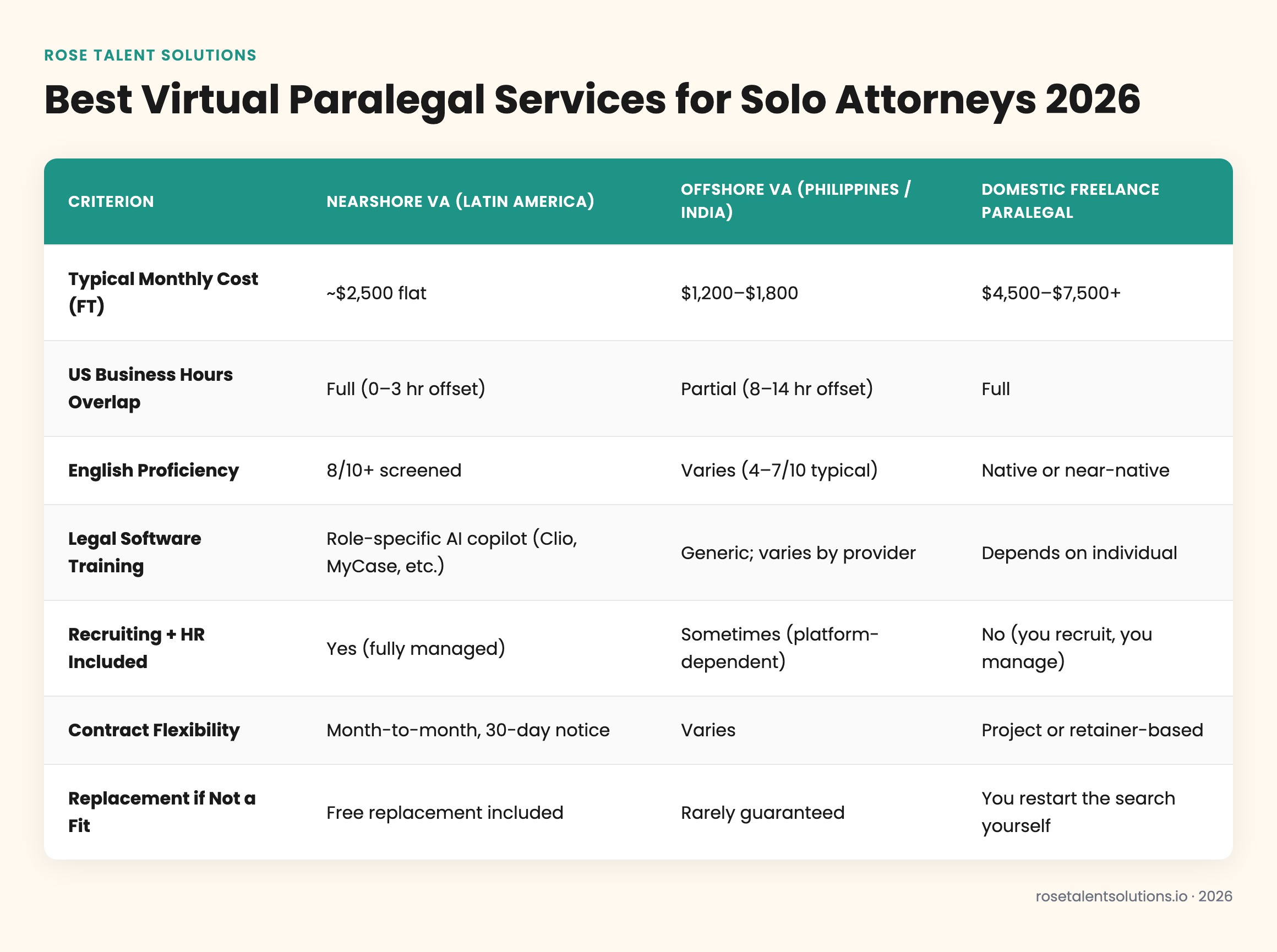
Not all virtual paralegal services are built the same. The three main models you'll encounter as a solo attorney each make different tradeoffs on cost, availability, legal software training, and continuity. The table below compares them directly on the criteria that matter most for a one-person practice.
| Criterion | Nearshore VA (Latin America) | Offshore VA (Philippines / India) | Domestic Freelance Paralegal |
|---|---|---|---|
| Typical Monthly Cost (FT) | ~$2,500 flat | $1,200–$1,800 | $4,500–$7,500+ |
| US Business Hours Overlap | Full (0–3 hr offset) | Partial (8–14 hr offset) | Full |
| English Proficiency | 8/10+ screened | Varies (4–7/10 typical) | Native or near-native |
| Legal Software Training | Role-specific AI copilot (Clio, MyCase, etc.) | Generic; varies by provider | Depends on individual |
| Recruiting + HR Included | Yes (fully managed) | Sometimes (platform-dependent) | No (you recruit, you manage) |
| Contract Flexibility | Month-to-month, 30-day notice | Varies | Project or retainer-based |
| Replacement if Not a Fit | Free replacement included | Rarely guaranteed | You restart the search yourself |
"Solo practitioners are running lean practices where every hour of attorney time spent on administrative tasks is an hour of billable work lost. The firms that scale are the ones that systematize support functions first." — Carolyn Elefant, Founder of MyShingle.com and author of Solo by Choice (2023)
What Tasks Can a Virtual Paralegal Handle for a Solo Attorney in 2026?
The practical scope of a virtual paralegal depends heavily on your practice area, but most solo attorneys are surprised by how much can be delegated safely. Below is a representative task list across common solo practice verticals.
- Client intake coordination: Screening calls, conflict checks, intake forms, CRM entry in tools like Clio or MyCase
- Document preparation: Drafting demand letters, contracts, discovery requests, and correspondence from attorney-approved templates
- Court deadline calendaring: Monitoring docket entries and maintaining a real-time deadline calendar in your practice management software
- Medical records and third-party requests: Submitting, tracking, and organizing medical records in personal injury and workers' comp matters
- E-filing preparation: Organizing exhibits, formatting documents to court specs, and queuing filings in your jurisdiction's e-file portal
- Billing entry and invoice preparation: Time-entry cleanup, draft invoice generation, and accounts receivable follow-up in tools like QuickBooks or Clio Billing
- Client status communications: Sending templated case status updates, scheduling calls, and managing your client-facing inbox
What a virtual paralegal does not do is provide legal advice, represent clients, or sign documents — those obligations stay with you, the attorney of record. The line is clear, and a well-trained paralegal understands it by default. Rose's AI copilot system reinforces that boundary by training each team member specifically on the software and workflows of their assigned practice area, not generic assistant tasks.

The hidden cost of an offshore paralegal isn't the hourly rate — it's the 8–14 hour timezone gap that means every client callback, every urgent document request, and every court deadline question sits unanswered until the next business morning. For solo attorneys evaluating the best virtual paralegal services in 2026, that lag is a malpractice risk, not just an inconvenience.
How Rose Talent Solutions Matches Virtual Paralegals to Solo Attorneys in 2026
Rose Talent Solutions is a nearshore staffing agency placing full-time virtual professionals for US, Canadian, and UK businesses. The model is straightforward: one flat rate of $2,500 per month covers a full-time (40 hours/week) dedicated team member, plus recruiting, vetting, payroll, HR, and ongoing management. There is no long-term contract — the arrangement runs month-to-month with 30 days' written notice to cancel. If a placement isn't the right fit, Rose replaces the team member at no additional cost.
Every team member is placed with a role-specific AI copilot trained on the software they'll use in your practice — whether that's Clio, MyCase, PracticePanther, or QuickBooks for trust accounting. This isn't a chatbot bolted onto a generic VA; it's a system trained on the specific workflows of legal support. Learn how the AI copilot works here.
The staffing process is built for speed. Most solo attorneys are operational with a placed paralegal within the first week of onboarding.
Discovery Call
Rose's team maps your practice area, caseload volume, software stack, and communication preferences — typically a 30-minute conversation that drives the entire match process.
Candidate Matching
Rose pre-screens candidates against your specific role requirements, including English proficiency (8/10+ floor), legal software familiarity, and practice area background. You review a shortlist — not a haystack.
AI Copilot Activation
Before day one, your team member's role-specific AI copilot is configured for your tools — Clio, MyCase, QuickBooks, or whichever stack you run. They arrive trained, not trainable.
Week-One Onboarding
Your paralegal integrates into your communication channels, learns your case workflow, and begins handling delegable tasks — typically within the first two to three days.
Ongoing Management
Rose handles HR, payroll, and performance oversight on the backend. You manage the work. If something isn't working, Rose fixes it — including replacement at no additional cost.
What Does a Virtual Paralegal Cost in 2026 — And Is $2,500/Month Defensible?
The fully loaded cost of a domestic paralegal in a US metro area runs $55,000 to $75,000 annually in salary alone, before benefits, payroll taxes, office overhead, and recruiting fees, according to the U.S. Bureau of Labor Statistics Occupational Employment and Wage Statistics (2024). At $2,500 per month, a full-time nearshore virtual paralegal comes in at $30,000 annually — a 45 to 60% reduction in labor cost, with recruiting and HR already included in that number.
That math changes the economics of a solo practice materially. If you bill at $250/hour and a paralegal frees even 10 hours of your week from administrative work, the ROI on the hire is realized in the first month. According to SHRM's workforce research, the average cost of replacing a full-time employee is 6 to 9 months of their salary — a risk that Rose's free replacement guarantee eliminates entirely from the solo attorney's perspective.
Nearshore Virtual Paralegal — Pros
- Full US business-hours availability with 0–3 hour timezone offset
- 8/10+ English proficiency floor — client-facing capable
- Legal software-trained via role-specific AI copilot (Clio, MyCase, etc.)
- $2,500/month all-in — recruiting, HR, payroll included
- Month-to-month terms; free replacement if not a fit
- No long-term contract commitment
Nearshore Virtual Paralegal — Considerations
- Not a licensed attorney — cannot give legal advice or sign filings
- Remote-only; no physical presence in your office
- Requires initial onboarding investment (typically 2–5 days)
- Best fit for attorneys comfortable with async-hybrid communication tools
For solo attorneys considering whether to get started with a virtual paralegal placement, the practical breakeven question is simple: how many billable hours per month do you currently lose to tasks a trained paralegal could own? If the answer is more than 12, the hire pays for itself at standard solo billing rates.
Remote work adoption in professional services has continued to accelerate: Gallup's 2023 State of the Global Workplace found that remote-capable workers who operate in hybrid or fully remote arrangements report 18% higher productivity on focused task work than fully in-office counterparts — a dynamic that extends directly to legal support roles. Virtual paralegals aren't a compromise; they're a structural upgrade for a practice built around concentrated attorney work.
The legal industry is also responding to broader workforce cost pressure. A 2024 report from McKinsey Global Institute identified legal support and document processing as among the highest-value functions for AI-augmented remote staffing — precisely the task set that a well-trained virtual paralegal handles daily. The combination of human legal knowledge and AI-assisted document workflows is not a future state; it is available today through providers who build that infrastructure into the placement model. Rose's AI copilot approach is built on exactly this premise.
If your practice also involves bookkeeping, trust accounting, or IOLTA ledger management, Rose places dedicated virtual bookkeeping and accounting staff as a complementary hire — many solo attorneys run both roles simultaneously once the first placement proves out.