
What Are Cost Savings Benchmarks for Virtual Assistants in 2026?
Nearshore virtual assistants represent one of the most measurable cost-reduction levers available to small and mid-sized businesses right now. A cost savings benchmark is a standardized reference point — expressed in dollars, percentages, or hours — that lets you compare what you're currently spending against a realistic alternative. For businesses evaluating virtual staffing, benchmarks typically cover base compensation, employer taxes, benefits, recruiting fees, and management overhead.
In 2026, the benchmark that matters most is the all-in cost per full-time employee. According to the U.S. Bureau of Labor Statistics Employer Costs for Employee Compensation report (2024), the average civilian worker costs employers $46.14 per hour in total compensation — meaning wages plus benefits. At 2,080 annual work hours, that's roughly $96,000 per year before you even consider recruiting or onboarding costs.
Compare that to a nearshore VA at $2,500/month — $30,000 per year, all-in, with recruiting, vetting, payroll, HR, and ongoing management included. The gross savings before productivity adjustments: roughly $66,000 per year per role. That's the benchmark floor. The rest of this post stress-tests it category by category.
How 2026 Hiring Costs Break Down: Onshore vs. Nearshore vs. Offshore
To build an honest cost savings benchmark, you need to separate sticker price from true cost. A $22/hour offshore VA looks cheap until you account for the 6-to-8-hour timezone gap, revision loops on asynchronous tasks, and the hidden management hours your team absorbs. A $28/hour US-based coordinator looks "just a little more" until you add FICA, state unemployment insurance, health insurance contributions, PTO accrual, and the average recruiter fee of 15–20% of first-year salary.
According to SHRM's HR Benchmarking data (2023), the average cost-per-hire in the United States is $4,683, and the average time-to-fill is 44 days — a productivity gap you're paying for even before the new hire starts. When you work with a nearshore staffing partner, recruiting and replacement are already priced into the flat monthly rate.
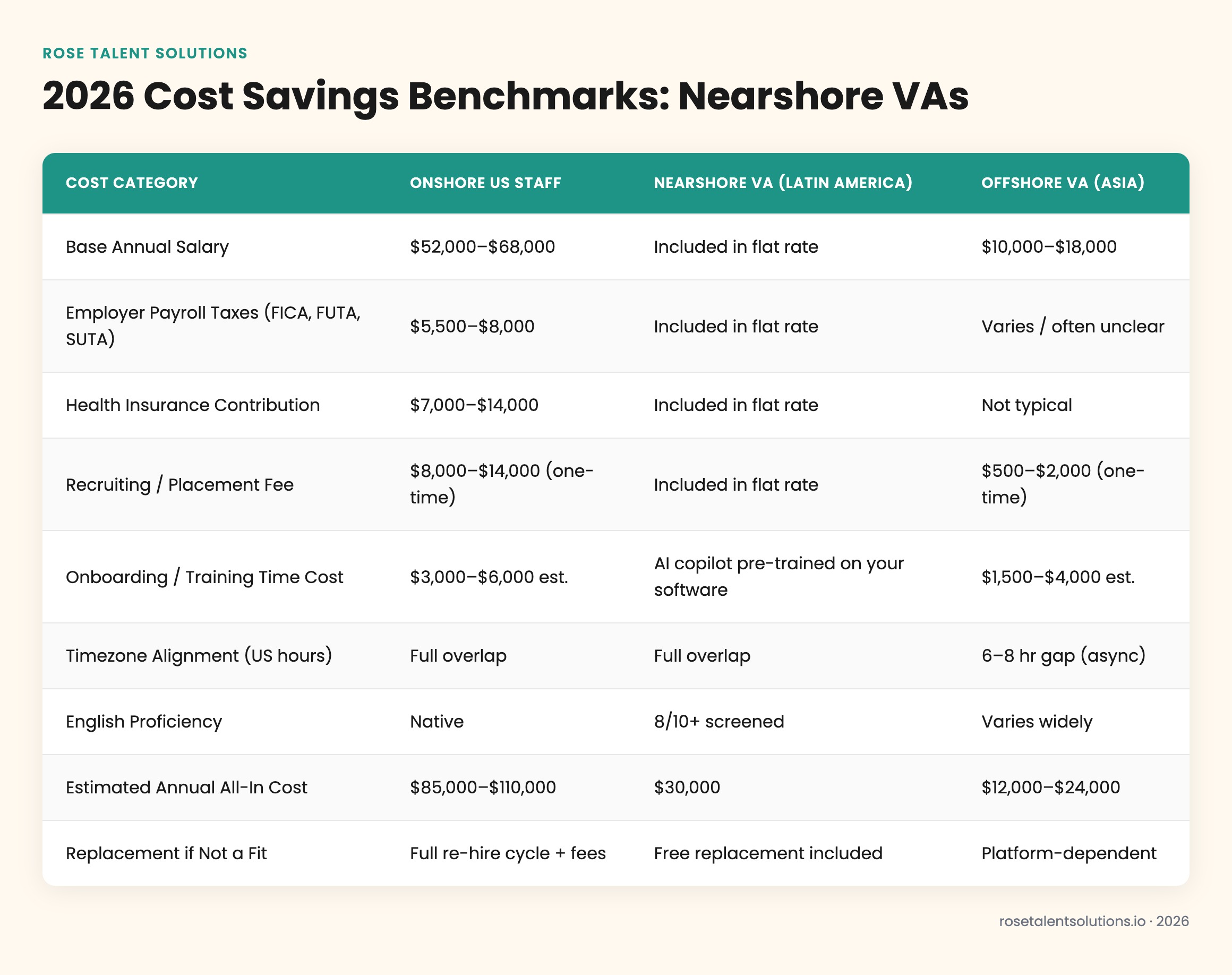
The table below lays out the full 2026 benchmark comparison across all three staffing models. Numbers use BLS compensation data for onshore, Rose Talent Solutions published pricing for nearshore, and aggregated marketplace data for offshore platforms.
| Cost Category | Onshore US Staff | Nearshore VA (Latin America) | Offshore VA (Asia) |
|---|---|---|---|
| Base Annual Salary | $52,000–$68,000 | Included in flat rate | $10,000–$18,000 |
| Employer Payroll Taxes (FICA, FUTA, SUTA) | $5,500–$8,000 | Included in flat rate | Varies / often unclear |
| Health Insurance Contribution | $7,000–$14,000 | Included in flat rate | Not typical |
| Recruiting / Placement Fee | $8,000–$14,000 (one-time) | Included in flat rate | $500–$2,000 (one-time) |
| Onboarding / Training Time Cost | $3,000–$6,000 est. | AI copilot pre-trained on your software | $1,500–$4,000 est. |
| Timezone Alignment (US hours) | Full overlap | Full overlap | 6–8 hr gap (async) |
| English Proficiency | Native | 8/10+ screened | Varies widely |
| Estimated Annual All-In Cost | $85,000–$110,000 | $30,000 | $12,000–$24,000 |
| Replacement if Not a Fit | Full re-hire cycle + fees | Free replacement included | Platform-dependent |
For a deeper look at how the nearshore model stacks up on a line-by-line basis, the nearshore vs. offshore vs. onshore virtual assistant complete comparison breaks every variable down in granular detail — including compliance risk and communication latency costs most buyers ignore.

How the $2,500 Flat Rate Compares to Real 2026 Employer Costs
Let's stress-test the benchmark with a specific role: a full-time bookkeeping and accounts-payable coordinator. According to the BLS Occupational Outlook Handbook (2024), the median annual wage for bookkeeping, accounting, and auditing clerks in the US is $47,440. Add 30–35% for benefits and employer taxes — a standard employer burden estimate — and you're at $61,672–$64,044 per year before recruiting.
A nearshore bookkeeping and accounting VA through Rose Talent Solutions runs $2,500/month — $30,000/year. That's a 51–53% reduction on the loaded cost of the same role, using government wage data as the baseline. And unlike a direct hire, the flat rate already includes payroll processing, HR compliance, and an AI copilot pre-trained on QuickBooks or whichever accounting platform you use.
"Businesses that leverage global talent pools strategically — not just for cost, but for skill alignment and timezone fit — are seeing 40 to 60 percent reductions in support function costs without sacrificing output quality." — Anastasia Nelen, Research Lead at McKinsey & Company, People & Organizational Performance (2023)
The savings multiply quickly when you scale. Two nearshore VAs cost $60,000/year all-in. Two equivalent US-based coordinators cost $170,000–$220,000. That delta — $110,000–$160,000 per year — is a real P&L line item, not a projection. If you want to see how Latin America-specific wage structures create this gap, the breakdown of Latin America virtual assistant cost explains the underlying economics without the sales gloss.
The 51–53% cost savings benchmark for a nearshore bookkeeping VA versus a US hire is calculated on loaded employer cost (wages + benefits + taxes), not just base salary. Using base salary alone understates the true savings by 15–20 percentage points. Always benchmark all-in.
What 2026 Research Says About Remote Work and Productivity Benchmarks
Cost savings benchmarks only tell half the story if the cheaper option underperforms. The good news: the data on nearshore and remote work productivity is increasingly favorable. According to Gallup's State of the Global Workplace report (2023), fully remote employees report higher engagement scores on focused, task-based work compared to their in-office peers — particularly for roles centered on structured, repeatable workflows like scheduling, data entry, tenant communication, and accounts payable.
Stanford economist Nicholas Bloom's widely cited research, published through the Stanford Graduate School of Business (2023), found that remote workers showed a 13% performance increase over their in-office counterparts in task-based roles — driven by fewer interruptions and reduced commute fatigue. For roles like leasing coordination or bookkeeping, where output is measurable and repeatable, that productivity lift directly improves your effective cost-per-unit-of-work, strengthening the savings benchmark further.
Rose's nearshore team members work US business hours and pass an English proficiency screen at 8/10 or higher — the same bar Rose publishes in its hiring criteria. That means no overnight batch-processing of tenant requests, no next-morning reply to a leasing inquiry, and no phone call that goes to voicemail because your coordinator is asleep. For property management operations, real-time responsiveness isn't a soft benefit — it's a retention metric.

Every Rose team member also ships with a role-specific AI copilot — trained on the software stack the client already uses, whether that's AppFolio, Buildium, QuickBooks, or another platform. Visit the AI advantage page to see how this works in practice. The AI layer means ramp time is measured in days, not months — a secondary benchmark that affects your true cost-per-productive-hour in the first quarter of a placement.
How to Calculate Your Own Cost Savings Benchmark in 5 Steps
Generic industry benchmarks are useful reference points, but your actual savings depend on the specific role you're replacing or augmenting. Here's the framework to run your own calculation before you make a staffing decision. According to Deloitte's Global Workforce Trends research (2023), companies that perform structured cost benchmarking before outsourcing decisions achieve 22% better cost outcomes than those relying on vendor estimates alone — making this five-step process worth the 30 minutes it takes.
Identify the loaded cost of your current role
Take the base salary, add 30–35% for benefits and employer taxes, then add any annual recruiting or turnover cost amortized over the average tenure in that role (the SHRM average tenure for administrative roles is 3.2 years).
Isolate tasks that don't require physical presence
Most coordination, communication, data entry, scheduling, bookkeeping, and intake work is location-agnostic. Document what percentage of the role falls into this category — in most admin and ops roles, it's 70–90%.
Price the nearshore equivalent
Use the $2,500/month all-in figure as your baseline. If you need a specialized skill set (AppFolio admin, bilingual tenant communication, QuickBooks reconciliation), confirm the VA profile covers it before benchmarking.
Apply a productivity adjustment factor
Conservative benchmark: 85–90% output equivalency for a well-matched nearshore VA in a task-based role. Apply this to your loaded cost comparison to get a risk-adjusted savings number.
Calculate net annual savings and payback period
Subtract the nearshore annual cost ($30,000) from your adjusted onshore cost. The difference is your projected annual saving. Divide by 12 to see monthly cash flow impact — most businesses reach positive ROI in month one.
For businesses exploring a Latin America staffing agency for the first time, the full context on how these agencies price, vet, and manage placements is covered in the Latin America staffing agency guide — including what to watch for in contracts and how management fees are typically structured across providers.
Nearshore vs. Offshore in 2026: The Pros and Cons That Affect Your Real Savings
The offshore vs. nearshore decision isn't just about rate cards. It's about the downstream costs that don't show up in a vendor's pricing page. Timezone misalignment, communication friction, and compliance ambiguity all have dollar values — they just show up in your team's overtime, your manager's calendar, and your customer satisfaction scores instead of a line item invoice. Research from Pew Research Center's Digital Work survey (2023) found that 41% of workers say slow or delayed communication is the single biggest driver of lost productivity in distributed teams — a friction point nearshore timezone alignment eliminates entirely.
Nearshore VA (Latin America)
- Works US business hours — real-time collaboration, no async lag
- English proficiency screened at 8/10 or higher
- All-in flat rate — no surprise employer tax or benefits exposure
- Free replacement if the placement isn't a fit
- AI copilot pre-trained on your software stack from day one
- No long-term contract — month-to-month with 30 days written notice
Offshore VA (Asia-based platforms)
- 6–8 hour timezone gap creates async-only workflows for US businesses
- English proficiency highly variable — often unscreened
- Hourly rates look low but management overhead adds 10–20% to real cost
- Replacement policies vary widely — often not included in base price
- Software familiarity not guaranteed; ramp time measured in weeks
- Compliance and payroll responsibility may fall back on the client
The no long-term contract structure matters more than most buyers initially realize. When you're benchmarking staffing options, the ability to cancel with 30 days written notice means your savings are real — you're not locked into a 12-month commitment to prove ROI. For a full breakdown of how nearshore pricing compares month-to-month, the nearshore virtual assistant cost guide covers what's typically included, excluded, and negotiable across providers.
If you've run your own benchmark and want to see a matched placement in action, the fastest next step is to get started with Rose — the intake process takes about 15 minutes and placements typically happen within a week of role confirmation.