
Nearshore chiropractic virtual assistants are quietly transforming how busy clinics operate in 2026. While your in-office staff focuses on patient experience and hands-on care, a nearshore VA handles the administrative avalanche — scheduling, insurance verification, billing follow-up, patient reminders, and more — all during your business hours, in fluent English, from Latin America. If you've ever watched your front desk drown in phone calls while a patient waits at the window, this post is for you.
Chiropractic practices face a specific administrative pressure that most healthcare verticals don't talk about openly: high visit frequency. The average chiropractic patient attends 12–18 visits per treatment episode, according to the American Chiropractic Association (ACA). That means 12–18 appointment confirmations, 12–18 insurance eligibility checks, and potentially 12–18 billing touchpoints — per patient. Multiply that across a 200-patient active roster and the administrative load becomes enormous.
That 35% isn't just a productivity leak — it's also a revenue leak. Every hour a clinician or trained staff member spends on hold with an insurance company is an hour they're not treating a patient. Delegating those tasks to a dedicated chiropractic virtual assistant is one of the highest-leverage moves a clinic owner can make in 2026.
What Does a Chiropractic Virtual Assistant Actually Do in 2026?
A chiropractic virtual assistant is a remote team member specifically trained to support chiropractic clinic operations. Unlike a generic administrative VA, a chiropractic-focused hire understands CPT codes common to chiropractic billing (98940, 98941, 98942), knows how to navigate insurance portals for musculoskeletal benefits, and can speak fluently with patients about care plans. They are not a clinician — they don't provide medical advice — but they make your clinical team dramatically more effective.
Core responsibilities typically fall into five buckets:
- Appointment scheduling and recall: Booking new patients, managing cancellations, and running re-activation campaigns for lapsed patients. A well-run patient scheduling virtual assistant can reduce no-show rates by keeping confirmation sequences tight.
- Insurance verification and eligibility: Checking benefits before the first visit so neither you nor the patient gets surprised at checkout. This task alone can consume 2–3 hours of in-office staff time per day in a busy clinic — a dedicated insurance verification virtual assistant handles it without pulling anyone away from the front desk.
- Prior authorization tracking: Some payers require pre-auth for extended chiropractic care. Managing those submissions, follow-ups, and denials is exactly the kind of repetitive, detail-oriented work where a dedicated prior authorization virtual assistant excels.
- Billing support and claim follow-up: Submitting claims, tracking rejections, and escalating denials to your billing company or biller.
- Patient communication: Answering inbound calls, responding to patient portal messages, sending intake forms, and managing online review requests.

How Nearshore VAs Outperform Offshore for Chiropractic Clinics in 2026
The phrase "virtual assistant" gets applied to wildly different things depending on which company you're reading. An offshore VA working from the Philippines or India at 11 PM their time is a fundamentally different resource than a nearshore VA in Colombia or Mexico working 9 AM–5 PM Eastern alongside your team. For chiropractic clinics, that timezone overlap isn't a luxury — it's a clinical necessity.
When a patient calls at 8:45 AM to ask whether their Blue Cross plan covers chiropractic adjustments, they need an answer before their 9:00 AM appointment — not a callback the next morning. Nearshore VAs handle that call in real time. Offshore teams batch those calls overnight, which means your front desk handles them anyway. You've paid twice for the same problem.
"The administrative burden in healthcare is not just an efficiency problem — it's a patient experience problem. When staff are overwhelmed with paperwork and phone queues, patients feel it." — Dr. Robert Pearl, Former CEO at The Permanente Medical Group, writing in Forbes (2023)
English proficiency is the second critical differentiator. Rose's published minimum is 8/10 on English proficiency screens for every team member. Chiropractic patients are often older adults dealing with pain and anxiety — they need clear, calm, professional communication, not a strained conversation across a language gap. According to SHRM's research on workforce communication, communication skills consistently rank as the top attribute employers prioritize when evaluating remote hires — a bar Rose's screening process is designed to meet.
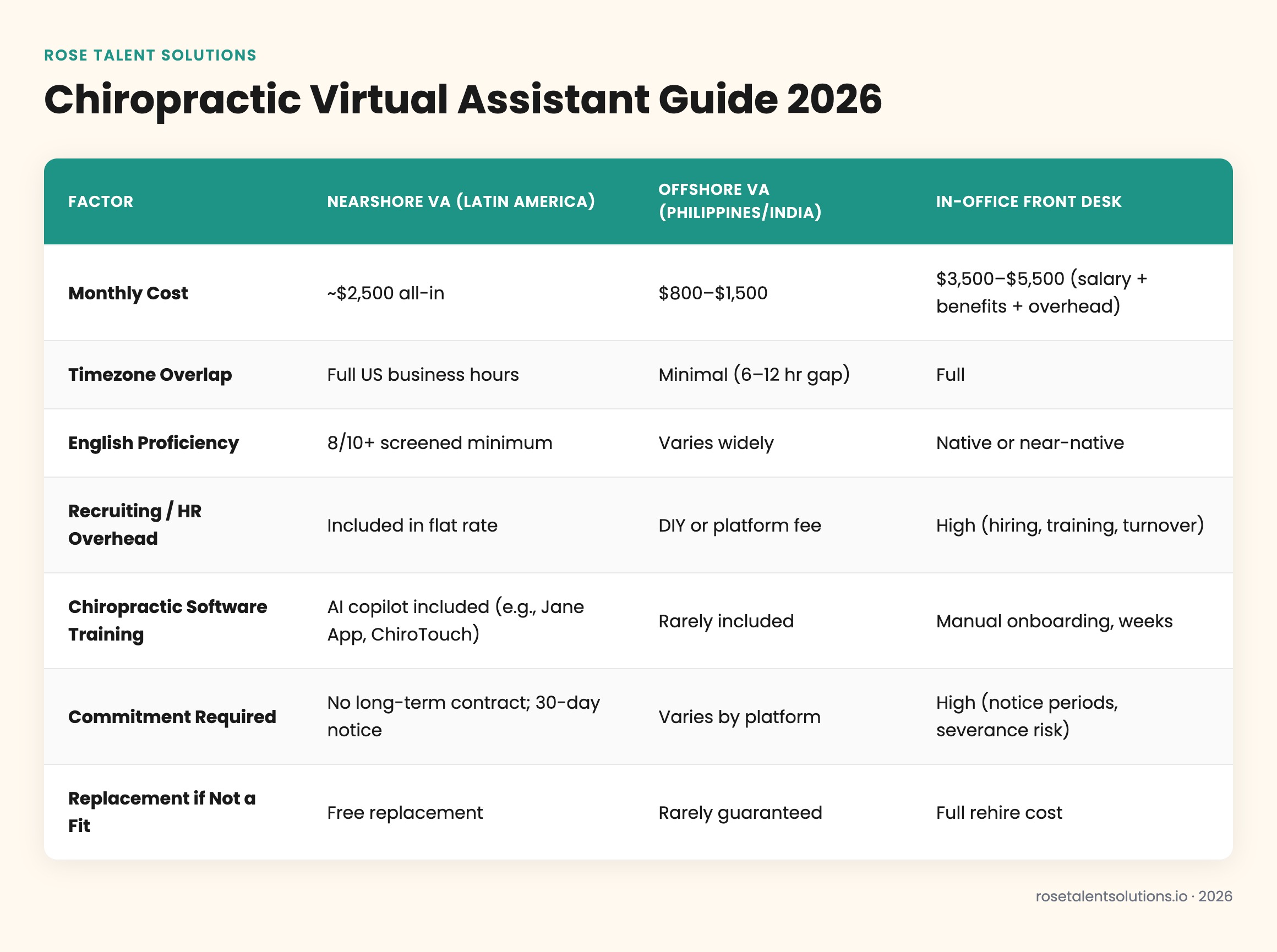
The comparison below lays out the practical differences across the three staffing options chiropractic clinic owners actually consider:
| Factor | Nearshore VA (Latin America) | Offshore VA (Philippines/India) | In-Office Front Desk |
|---|---|---|---|
| Monthly Cost | ~$2,500 all-in | $800–$1,500 | $3,500–$5,500 (salary + benefits + overhead) |
| Timezone Overlap | Full US business hours | Minimal (6–12 hr gap) | Full |
| English Proficiency | 8/10+ screened minimum | Varies widely | Native or near-native |
| Recruiting / HR Overhead | Included in flat rate | DIY or platform fee | High (hiring, training, turnover) |
| Chiropractic Software Training | AI copilot included (e.g., Jane App, ChiroTouch) | Rarely included | Manual onboarding, weeks |
| Commitment Required | No long-term contract; 30-day notice | Varies by platform | High (notice periods, severance risk) |
| Replacement if Not a Fit | Free replacement | Rarely guaranteed | Full rehire cost |
How the AI Copilot Advantage Speeds Up Chiropractic VA Onboarding
One of the most common objections clinic owners raise when considering a virtual assistant is onboarding time. "It'll take months to train someone on our systems." That was true in 2022. It's much less true in 2026. Every Rose team member ships with a role-specific AI copilot trained on the software stack relevant to their function.
For a chiropractic virtual assistant, that means pre-loaded familiarity with platforms like Jane App, ChiroTouch, Eclipse, and AdvancedMD — the four most widely used chiropractic practice management systems. The AI copilot guides the VA through common workflows: how to create a SOAP note template, how to submit a claim through a specific clearinghouse, how to read an Explanation of Benefits (EOB) for a chiropractic denial code. They're not starting from zero on day one.
The real onboarding bottleneck for chiropractic VAs isn't software — it's clinic-specific SOPs and provider preferences. Document those in a shared Google Doc or Notion wiki, and a nearshore VA with an AI copilot can be handling real patient calls within a week of starting.
Administrative workload in US healthcare has grown substantially. According to the Centers for Medicare & Medicaid Services (CMS), US healthcare administrative costs consumed over $500 billion annually as of 2023 estimates — a figure driven heavily by insurance-related paperwork that VAs are now well-positioned to absorb. For a chiropractic clinic specifically, the bulk of that burden is front-end: eligibility verification, pre-auth, and claim submission — all VA-appropriate tasks.
If you're also considering broader virtual assistant support for your chiropractic office beyond just scheduling and billing — things like social media management, review responses, referral coordinator work, or even credentialing support — the role can expand significantly while staying within the same flat monthly rate.

What Does It Cost to Hire a Chiropractic Virtual Assistant in 2026?
Let's talk numbers plainly. The average in-office chiropractic front desk coordinator in the United States earns between $36,000 and $48,000 per year in base salary alone, according to the U.S. Bureau of Labor Statistics (BLS). Add employer payroll taxes (7.65%), health benefits (often $5,000–$8,000/year per employee), paid time off, and the physical overhead of a desk, computer, and phone line — and the all-in cost lands closer to $55,000–$70,000 per year.
A nearshore chiropractic virtual assistant through Rose costs $2,500/month flat — $30,000/year, all-in. That rate includes recruiting, vetting, payroll processing, HR management, and ongoing performance oversight. There are no add-on fees for the AI copilot, no separate recruiting retainer, and no long-term contract commitment. If the team member isn't a fit for your clinic, Rose replaces them at no additional cost.
That's a potential savings of $25,000–$40,000 per year compared to a fully-loaded in-office hire — without sacrificing coverage hours, English fluency, or software competency. According to Gallup's research on employee burnout, workload and time pressure are two of the top five drivers of burnout — the exact pressures that overwhelmed front desk staff face in high-volume chiropractic practices. Offloading administrative volume to a dedicated VA directly reduces that pressure on your in-office team.
For clinics exploring broader operational support, Rose also supports bookkeeping and accounting functions — useful for practice owners who want to consolidate remote administrative and financial support under one vendor relationship.
How to Get Started with a Nearshore Chiropractic VA in 5 Steps
Define the Role Scope
Before you talk to anyone, list the top 5–10 tasks eating your front desk's time. Scheduling? Insurance verification? Claim follow-up? The clearer your scope, the faster your VA can ramp.
Match with a Vetted Candidate
Rose screens for English proficiency (8/10+ minimum), chiropractic or healthcare admin experience, and software familiarity before you see a single profile. Expect your first placement within about 7 days of kickoff.
Activate the AI Copilot
Your VA arrives with a role-specific AI copilot pre-configured for chiropractic workflows — Jane App, ChiroTouch, eligibility portals, and common CPT code reference. No generic onboarding from scratch.
Run a Shadowing Week
Have your VA shadow your current front desk workflows via screen share for the first 3–5 days. By day 5, they're typically handling live calls and scheduling independently with light supervision.
Hand Off and Scale
Once your VA owns scheduling and insurance verification, layer in additional tasks — billing follow-up, recall campaigns, review management. The role grows as your confidence in the team member grows.
If you're ready to move past the research phase, the fastest next step is to start the matching process at Rose — the intake form takes under five minutes and triggers a same-day callback from a staffing advisor who specializes in healthcare practice placements.
Is a Chiropractic Virtual Assistant Right for Your Practice? Pros and Cons
A chiropractic VA isn't the right fit for every clinic at every stage. If you're a solo practitioner seeing 15 patients per week, you may not yet have enough administrative volume to justify a full-time remote hire. But if your front desk is a bottleneck — if scheduling calls are going to voicemail, insurance verifications are being done the morning of the visit, or your billing follow-up is more than 30 days behind — a dedicated VA will pay for itself quickly.
Remote and hybrid work arrangements have demonstrated measurable productivity gains across knowledge-work roles. According to Pew Research Center's 2023 report on remote work, workers in remote roles consistently report higher task completion rates for structured, process-driven work — exactly the category that chiropractic front-desk administration falls into. That data supports what clinic operators are already experiencing: a well-scoped remote VA often outperforms a distracted in-office hire on repeatable administrative tasks.
Pros of a Chiropractic VA
- Eliminates front-desk bottlenecks without adding physical headcount
- Works full US business hours — real-time patient communication
- Flat monthly cost with no long-term contract and free replacement guarantee
- AI copilot accelerates ramp time on chiropractic software
- Scales easily as your patient volume grows
Considerations to Plan For
- Requires documented SOPs for your clinic-specific workflows
- Not suitable if your current patient volume is very low (fewer than 20 visits/week)
- HIPAA compliance protocols must be extended to cover remote team members (Rose advises on this)
- Initial shadowing week requires in-office staff time investment
For clinics on the fence, the no long-term contract structure removes most of the risk. You're not signing a 12-month staffing agreement — you're committing to 30 days at a time. If the placement isn't right, you get a free replacement. If the model isn't right for your practice at this stage, you cancel with 30 days' written notice and owe nothing further.
To explore how Rose structures dedicated virtual staffing for service-based businesses more broadly — including healthcare-adjacent practices — the service overview page has the full breakdown of what's included in the flat monthly rate.