
Nearshore virtual managers are quietly replacing the traditional chiropractic front-desk coordinator — and the numbers make the case fast. A full-time, in-office office manager in the United States costs between $45,000 and $60,000 per year in salary alone, before you add payroll taxes, benefits, PTO, and turnover costs, according to the U.S. Bureau of Labor Statistics (2024). A nearshore chiropractic office virtual manager — based in Latin America, working your exact business hours, and fluent in English — runs $2,500 per month flat. That's $30,000 per year, all-in, with recruiting, vetting, payroll, HR, and ongoing management included.
This guide explains exactly what a chiropractic office virtual manager does, how to evaluate your options in 2026, and how to get one running inside your practice without the usual hiring headaches.
What Is a Chiropractic Office Virtual Manager in 2026?
A chiropractic office virtual manager is a dedicated, full-time remote professional who owns the administrative backbone of your clinic. This is not a part-time contractor you share with a pool of other clients — it is a single person assigned exclusively to your practice, working 40 hours per week during your business hours. They handle everything a traditional front-desk office manager would, minus the physical presence.
The role typically covers: patient scheduling and appointment reminders, insurance verification and eligibility checks, billing follow-up, new patient intake coordination, provider credentialing support, and internal team communication. Some virtual managers also layer in prior authorization management, which alone can consume 15+ hours per week at a busy chiropractic clinic.
The key distinction between a virtual manager and a generic virtual assistant is scope. A VA executes tasks. A virtual manager owns outcomes — they track KPIs, flag scheduling gaps, follow up on outstanding claims, and proactively solve problems before you notice them. Think of it as the difference between a data-entry clerk and an office director who happens to work remotely.

How a Nearshore Virtual Manager Outperforms Offshore Alternatives in 2026
The offshore vs. nearshore debate comes down to one practical reality: time zones determine response time, and in a chiropractic clinic, slow response time costs you booked appointments. A virtual manager based in the Philippines or India operates 10–13 hours ahead of U.S. Eastern time. By the time a patient's voicemail from 4:30 PM gets answered, it's the next business day. A nearshore VA in Colombia, Mexico, or Costa Rica works in real time — same morning, same afternoon, same urgency.
"Timezone alignment is the single most underrated factor in remote healthcare staffing. A billing coordinator who works your hours will catch a denied claim the same day it posts — an offshore hire catches it tomorrow, and by then the deadline window has narrowed." — Janelle Benitez, Director of Operations at a multi-location chiropractic group, Healthcare Admin Insider (2024)
Rose Talent Solutions publishes an 8/10+ English proficiency floor for every team member placed — verified through structured screening calls before any candidate reaches you. That bar matters in chiropractic offices where patient-facing phone communication and insurance company calls require clear, professional English with no friction.
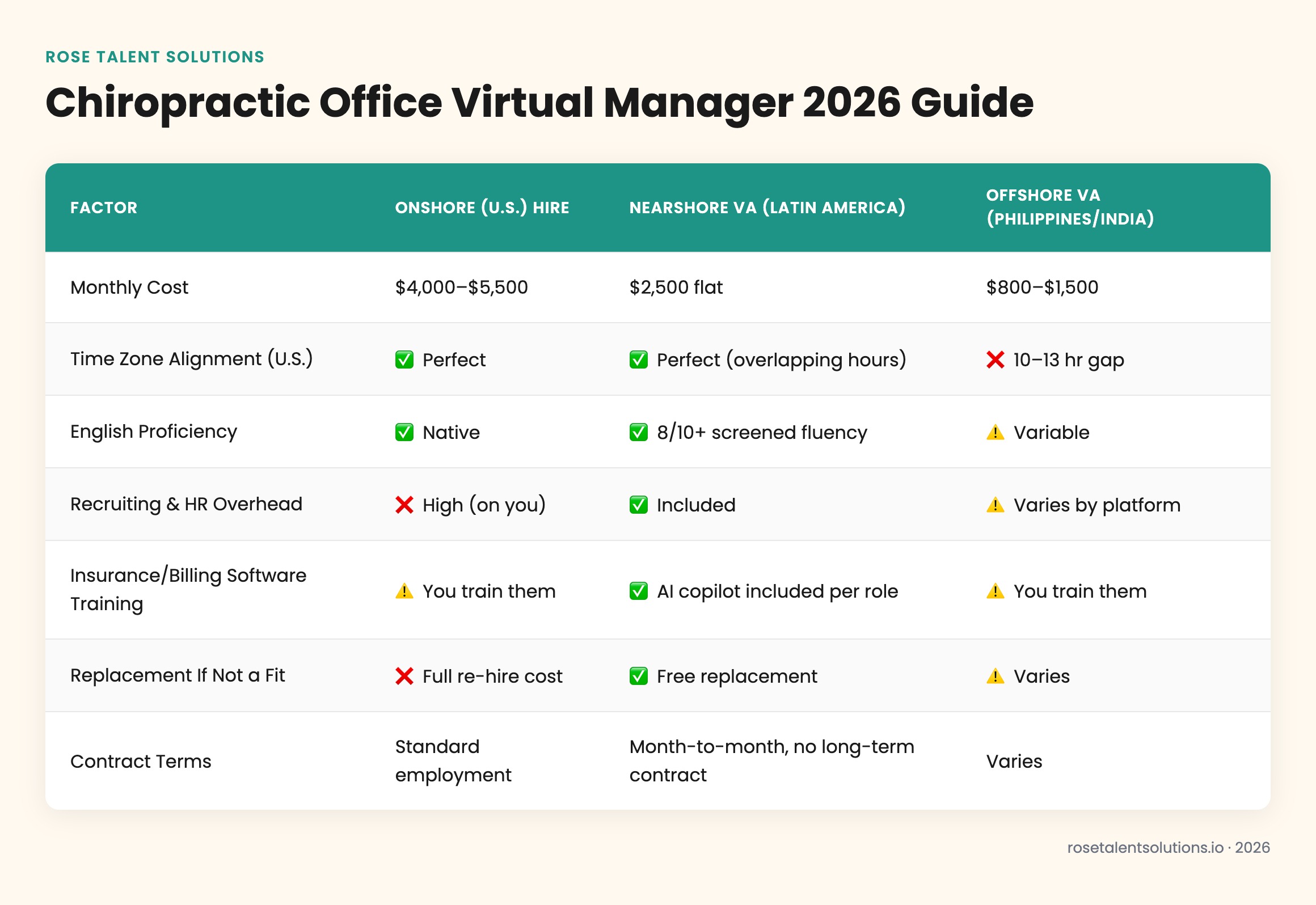
| Factor | Onshore (U.S.) Hire | Nearshore VA (Latin America) | Offshore VA (Philippines/India) |
|---|---|---|---|
| Monthly Cost | $4,000–$5,500 | $2,500 flat | $800–$1,500 |
| Time Zone Alignment (U.S.) | ✅ Perfect | ✅ Perfect (overlapping hours) | ❌ 10–13 hr gap |
| English Proficiency | ✅ Native | ✅ 8/10+ screened fluency | ⚠️ Variable |
| Recruiting & HR Overhead | ❌ High (on you) | ✅ Included | ⚠️ Varies by platform |
| Insurance/Billing Software Training | ⚠️ You train them | ✅ AI copilot included per role | ⚠️ You train them |
| Replacement If Not a Fit | ❌ Full re-hire cost | ✅ Free replacement | ⚠️ Varies |
| Contract Terms | Standard employment | Month-to-month, no long-term contract | Varies |
What Does a Chiropractic Office Virtual Manager Actually Do Day-to-Day?
The daily workload of a chiropractic office virtual manager mirrors what your busiest in-office coordinator handles — minus the breaks, the no-shows, and the turnover. A well-matched virtual manager typically opens the clinic's scheduling software at 8:00 AM your time, reviews overnight form submissions, confirms appointments for the day, and begins working the insurance verification queue for next-day patients.
Scheduling is the highest-volume task. According to the American Chiropractic Association (2024), a typical chiropractic clinic sees 80–120 patient visits per week. Each visit requires an appointment slot, a reminder touchpoint, and often a benefits check — three discrete admin tasks per patient, per visit. That math alone justifies a dedicated role. If you want a deeper look at how a patient scheduling virtual assistant structures that workflow, Rose's published breakdown covers the full process.
Beyond scheduling, a virtual manager fields inbound patient calls, handles rescheduling requests, follows up on outstanding balances, coordinates with billing clearinghouses, and escalates clinical questions to the provider. They also run internal coordination — ordering supplies, updating SOPs, onboarding new front-desk staff, and keeping the provider's calendar clean.
The difference between a task-level VA and a true virtual manager is ownership. A VA completes what you assign. A virtual manager tracks what hasn't been done yet — unfilled appointment slots, outstanding claim denials, unsigned intake forms — and resolves them without being asked. That proactive posture is what moves the revenue needle.
Every Rose virtual manager in a healthcare-adjacent role ships with a role-specific AI copilot trained on the software your clinic actually uses. For chiropractic offices, that typically means ChiroTouch, Jane App, or similar practice management platforms. The AI layer means your virtual manager isn't spending hour one figuring out your software — they're already accelerating on day one. You can explore the full AI advantage built into every placement on the Rose site.

How to Hire a Chiropractic Office Virtual Manager in 2026: The Rose Process
The hiring process for a nearshore virtual manager should take days, not months. The typical chiropractic practice operator doesn't have time to post on Indeed, screen 40 applications, run three interview rounds, negotiate salary, and then onboard someone who leaves in six months. Rose's model compresses that entire timeline. According to SHRM's Benchmarking Report (2023), the average time-to-fill for an administrative role in the U.S. is 36 days. Rose's average placement is 7 days.
Discovery Call (Day 1)
You walk Rose through your clinic's workflow, software, and the specific pain points you need solved — scheduling backlog, billing follow-up, insurance verification, or all three.
Candidate Matching (Days 2–5)
Rose's recruitment team sources from its Latin America talent pool, screens for English fluency (8/10+ minimum), runs background checks, and verifies relevant healthcare admin experience before you see a single profile.
Your Interview (Day 5–6)
You interview the shortlisted candidate — typically one to two — and make your selection. No sifting through dozens of unqualified applicants.
Onboarding & AI Copilot Setup (Day 7)
Your virtual manager starts with a role-specific AI copilot already configured for your practice management software, so ramp time is measured in hours, not weeks.
Ongoing Management (Month-to-Month)
Rose handles payroll, HR compliance, performance oversight, and replacement logistics. You manage the work output. Cancel with 30 days written notice — no long-term contract.
If the placement isn't the right fit for your clinic, Rose replaces the team member at no additional cost. That's the only risk reversal you need to make the decision low-stakes. To see how the broader chiropractic virtual assistant role compares to a virtual manager specifically, Rose's published post on that topic breaks down the scope difference clearly.
Is a Chiropractic Office Virtual Manager Right for Your Practice in 2026?
Not every clinic needs a virtual manager on day one. The clearest signal that you're ready: your provider is touching administrative tasks. If the chiropractor is checking the schedule, returning patient calls, or chasing insurance denials — that's billable time being eaten by $15/hour work. According to Gallup's Employee Burnout research (2023), burnout in small healthcare practices correlates most strongly with role overlap — providers doing admin, admin staff doing clinical intake. A virtual manager draws a clean line.
Strong Fit For
- Solo or small-group chiropractic practices (1–5 providers)
- Clinics where the front desk is a bottleneck for new patient conversion
- Practices processing 50+ insurance claims per week
- Providers spending personal time on admin tasks after hours
- Offices with high front-desk turnover (2+ hires in 12 months)
Less Urgent If
- You already have a high-performing, stable in-office team
- Volume is below 30 patient visits per week
- You operate cash-pay only with no insurance billing complexity
- You have a dedicated billing company already managing claims
The $2,500/month flat rate includes everything — no hidden recruiting fees, no per-hire charges, no payroll tax surprises. For a clinic billing even $150,000 per year in collections, diverting 20% more provider time toward patient care rather than admin tasks more than offsets the cost. The math almost always works in the clinic's favor within the first 60 days.
If your practice also handles complex bookkeeping tasks — accounts receivable reconciliation, expense categorization, or provider compensation tracking — Rose's bookkeeping and accounting virtual staff can pair with your virtual manager to cover the full financial back-office. And when you're ready to move forward, the fastest path is the start page on the Rose site, which walks you through the intake in under five minutes.
According to McKinsey's healthcare workforce analysis (2023), administrative labor is the fastest-growing cost center in outpatient clinical settings — and the one with the most addressable remote-staffing opportunity. Chiropractic offices are no exception. The practices that move early on nearshore virtual management build a structural cost advantage that compounds every year their in-office competitors keep paying for in-person admin overhead.