
Nearshore virtual medical scribes — staffed from Latin America and working full US business hours — are quietly solving one of the most stubborn problems in US healthcare: physician burnout driven by documentation overload. If you're evaluating the best virtual medical scribe services in 2026, the difference between a good hire and a costly mistake often comes down to three things — timezone alignment, EHR fluency, and consistent quality control. This post breaks down exactly what to look for, what to avoid, and how the nearshore model stacks up against alternatives.
What Is a Virtual Medical Scribe — and Why Does the Definition Matter in 2026?
A virtual medical scribe is a trained documentation specialist who joins a physician's patient encounters remotely — typically via a secure audio or video connection — and transcribes the encounter into the EHR in real time. The physician reviews, edits, and signs the note, but the cognitive burden of structuring and entering data shifts almost entirely to the scribe. This is meaningfully different from medical transcription, which processes recorded audio after the fact, or from AI ambient documentation tools, which still require human review and correction.
In 2026, the role has expanded. The best virtual scribes also manage pre-charting, pull prior notes, update problem lists, enter orders for physician approval, and handle after-visit summaries. They are embedded support staff, not data-entry clerks.
Physician burnout tied to administrative work is a documented crisis. More than 62% of physicians report burnout, with excessive documentation consistently ranked as the top contributor, according to the Medscape Physician Burnout & Lifestyle Report (2024). A skilled virtual scribe removes 2–3 hours of daily documentation from a provider's plate — directly addressing the root cause.
How Nearshore Latin American Scribes Outperform Distant Offshore Models in 2026
Some offshore scribing services route work through contractors in regions 10–13 time zones away from the US. That gap creates a structural flaw that becomes painfully obvious once you're actually running clinical operations: real-time encounter documentation is logistically impossible when your scribe is working through their night to cover your day shift. You either keep someone up through the night or batch documentation after the fact — which defeats the entire purpose.
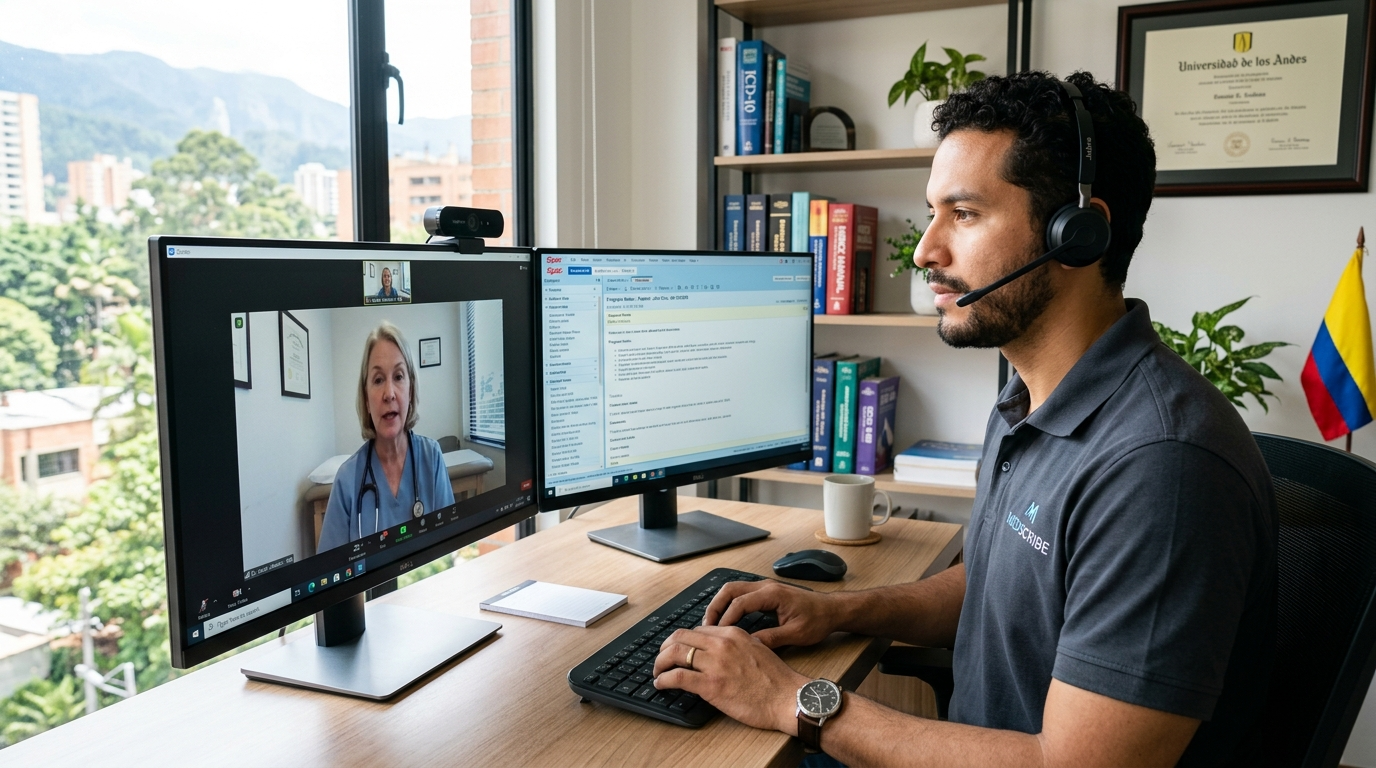
Nearshore scribes based in Latin America — countries like Colombia, Mexico, and Costa Rica — work during US business hours by design. A scribe working from Medellín or Mexico City is on the same shift as your clinical team, logging in at 9 AM EST and closing out charts before your last provider leaves the building. That synchronicity is the operational backbone of effective medical scribing.
The hidden cost of distant offshore scribing isn't the hourly rate — it's the timezone misalignment that forces after-the-fact documentation, negating the real-time accuracy benefit that justifies hiring a scribe in the first place.
English proficiency is the second differentiator. Medical documentation requires precise clinical language — terms like "dysarthria," "diaphoresis," or "hemodynamically stable" used correctly in context. Rose Talent Solutions screens every candidate to an 8/10 or higher English proficiency floor, verified through structured assessments. That's a measurable bar, not a vague claim about "fluent English speakers."
If you're also evaluating support for the billing side of your practice, the companion piece on the best medical billing virtual assistant services in 2026 walks through how nearshore billing VAs close the loop between clinical documentation and clean claims.
How the Top Virtual Medical Scribe Services Compare in 2026
Not all virtual scribe services operate on the same model. Some are staffing agencies placing individual contractors. Others are SaaS platforms that layer AI transcription with human review. A few, like Rose Talent Solutions, operate as fully managed nearshore staffing with embedded AI tools. The table below compares the three dominant models across the criteria that matter most for a medical practice making a 2026 decision.
| Criteria | Nearshore Managed Staffing (Rose) | Distant Offshore Agency | Domestic/Onshore Scribing |
|---|---|---|---|
| Monthly Cost (Full-Time) | $2,500 flat, all-in | $1,200–$1,800 (variable, coordination costs extra) | $5,000–$8,000+ (W2 or agency premium) |
| Timezone Alignment | Full US business hours overlap | Partial or overnight shift required | Full alignment |
| English Proficiency | 8/10+ screened floor | Variable; typically unscored | Native speakers standard |
| EHR-Specific Training | Role-specific AI copilot (Epic, Athena, eCW) | General training; EHR varies | Training provided; varies by vendor |
| Recruiting & HR Included | Yes — all-in management | Partial; often contractor-only | Yes, but expensive |
| Contract Terms | Month-to-month, 30-day notice | Varies; often 3–6 month minimums | Often 6–12 month contracts |
| Replacement Guarantee | Free replacement if not a fit | Rarely included | Agency-dependent |
"The administrative burden on physicians has become untenable. Tools that restore time — real-time scribes, AI-assisted charting — are no longer optional; they're a retention strategy." — Christine Sinsky, MD, Vice President of Professional Satisfaction at the American Medical Association (2023)
What EHR Systems Do the Best Virtual Scribes Know in 2026?
EHR fluency is the single biggest predictor of a virtual scribe's ramp time. A scribe who has never used Epic can still learn it, but you absorb 4–6 weeks of productivity loss while they do. The best services in 2026 pre-train scribes on the specific platform your practice uses before day one.
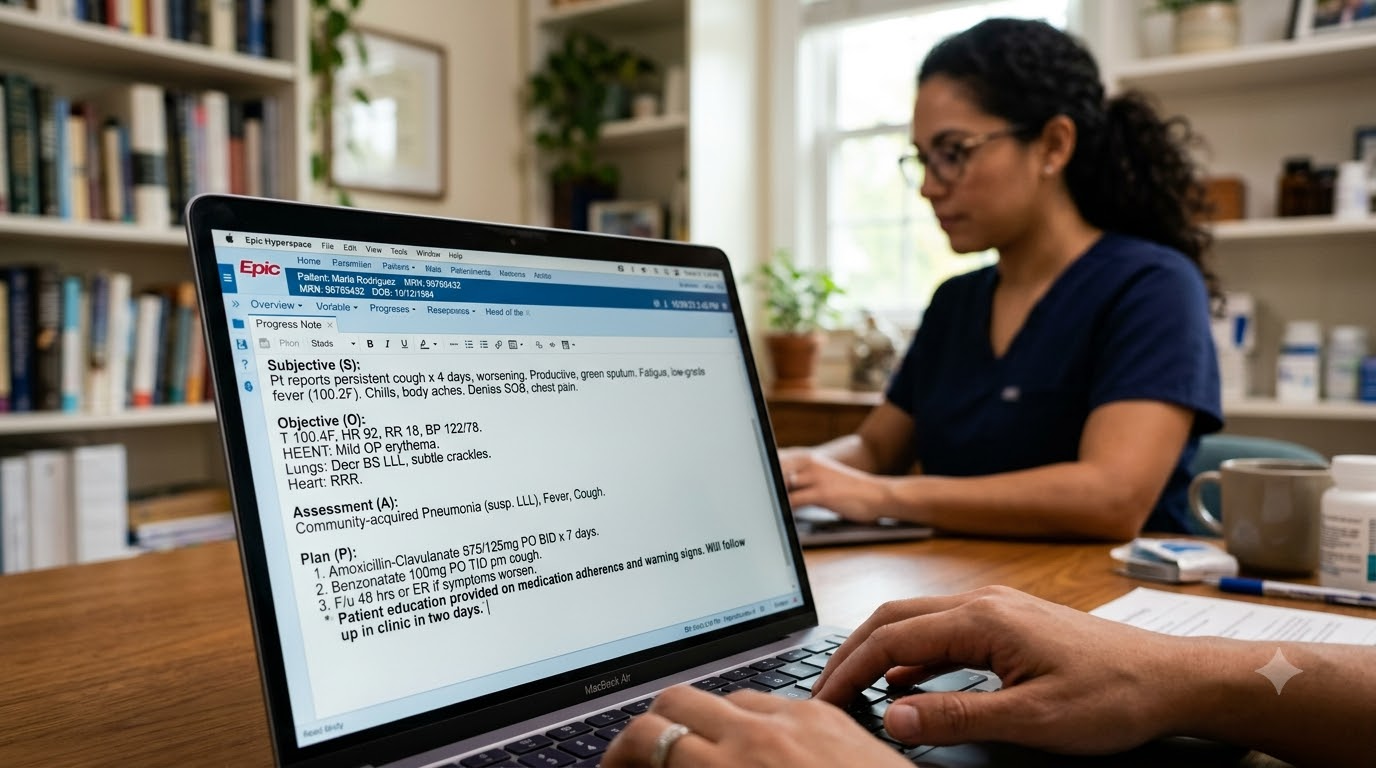
Rose Talent Solutions pairs every virtual team member with a role-specific AI copilot trained on their assigned software — whether that's Epic, Athena, eClinicalWorks, Kareo, or another system. This isn't a generic orientation video; it's an embedded AI layer that surfaces the right templates, shortcuts, and workflow steps for that scribe's exact role. You can read more about how this works on the Rose AI advantage page.
The EHR market itself is consolidating. Epic now holds over 38% of the US hospital EHR market, according to Healthcare IT News (2024), meaning scribe training on Epic is no longer optional for practices in larger health systems. Athenahealth is the dominant platform for independent practices, and if you're running Athena, the post on Athenahealth virtual billing assistant services is a useful companion read — the scribe and billing functions frequently overlap in smaller practices.
How Rose Talent Solutions Onboards a Virtual Medical Scribe in 2026
The question most practice managers ask is: "How long until they're actually useful?" The honest answer with Rose is typically 5–7 business days to placement, and most scribes are performing at a functional level by the end of week two — faster than most internal hires who spend the first two weeks in HR orientation.
Intake Call
Rose's team maps your EHR, specialty, documentation style, and volume. This scopes the role before recruiting begins, so you aren't filtered through generic candidates.
Candidate Matching
Rose recruits, vets, and scores candidates from Latin America on English proficiency, medical terminology, and EHR familiarity. You receive a shortlist — typically within 5–7 business days.
AI Copilot Activation
Before the scribe's first shift, they're equipped with a role-specific AI copilot trained on your EHR. Templates, workflows, and shortcut libraries are pre-loaded for your specific platform.
Live Integration
Your scribe joins their first encounter via your secure connection protocol. Rose handles ongoing HR, payroll, and performance management — you manage the work, not the employment relationship.
Free Replacement if Needed
If the scribe isn't the right fit for your practice, Rose replaces them at no additional cost. No re-recruitment fee, no restart charge — covered at the standard flat rate.
For practices dealing with aging AR or denied claims downstream of documentation issues, the post on accounts receivable follow-up and medical billing outsourcing explains how a scribe-plus-billing-VA pairing closes the full revenue cycle gap.
Is a Virtual Medical Scribe Worth It? The Numbers for 2026
The ROI calculation for a virtual scribe is more straightforward than most healthcare staffing decisions. A physician billing $300–$500 per encounter, seeing 20 patients a day, and spending 2 hours less on documentation can theoretically see 3–4 additional patients per day. At even the conservative end, that's $900 in additional revenue daily — or roughly $18,000/month against a $2,500 scribe cost.
But the harder-to-quantify benefit is retention. Physician turnover costs a practice an estimated $500,000–$1,000,000 per departing provider when you account for recruitment, onboarding, and lost revenue, according to the Society for Human Resource Management (SHRM). If a $2,500/month scribe extends a physician's tenure by even one year, the math is obvious.
The Bureau of Labor Statistics (2024) projects physician and surgeon employment to grow 3% through 2032, but demand growth is outpacing supply — meaning the practices that keep their current physicians productive and satisfied will have a structural competitive advantage over those that don't.
Pros of Nearshore Virtual Scribes
- Same-timezone real-time documentation — no batch processing
- Flat $2,500/month all-in — no surprise payroll or HR costs
- EHR-trained before day one with role-specific AI copilot
- Month-to-month terms — no long-term contract required
- Free replacement if the fit isn't right
- English proficiency at 8/10+ screened floor
Tradeoffs to Consider
- Not an in-room physical presence — audio/video only
- HIPAA BAA required (Rose provides; you must execute)
- Some specialties (e.g., surgery) have limited scribe utility during procedures
- 2-week ramp period before peak efficiency, even with pre-training
Ready to stop losing hours to documentation? Visit the Rose Talent Solutions start page to scope your role and get a shortlist of EHR-trained Latin American scribes matched to your specialty.