
Nearshore accounts receivable follow-up specialists — based in Latin America, working your exact US business hours, fluent in English — are quietly replacing the overworked in-house biller that every small and mid-size medical practice depends on. If your days in AR keep creeping past 45, if your denial rate sits above 5%, or if you're writing off balances simply because no one had time to follow up, this article explains why accounts receivable follow-up medical billing outsourcing in 2026 is both the fastest and the most cost-effective fix available to you.
What Is Accounts Receivable Follow-Up in Medical Billing?
Accounts receivable follow-up in medical billing is the process of tracking every unpaid or underpaid insurance claim from the moment it is submitted until the balance is fully resolved. A follow-up specialist checks claim status with payers, interprets explanation of benefits (EOB) documents, identifies denial reason codes, corrects errors, and resubmits clean claims — often multiple times — until the practice is paid. Without dedicated follow-up, claims simply age out and become write-offs.
The AR follow-up function is distinct from initial claim submission. Submission is a one-time task. Follow-up is an ongoing, iterative workflow that demands persistence, payer-specific knowledge, and software fluency. According to MGMA (2023), the average physician practice loses between 5% and 11% of net revenue to billing inefficiencies — and aging AR is the single largest driver of that leakage.
When you outsource accounts receivable follow-up, you hand this entire pursuit workflow to a dedicated specialist whose only job is to get your claims paid. You don't share them with front-desk duties, patient scheduling, or EHR data entry. That focus is what produces results.
Why In-House AR Follow-Up Breaks Down in 2026
The structural problem with keeping AR follow-up in-house is simple: it is low-urgency until it becomes a crisis. An in-house biller juggling eligibility checks, charge entry, patient statements, and phone inquiries will always deprioritize the 90-day-old claim in favor of today's patient. By the time the claim is touched, the payer's timely-filing deadline may have lapsed.
Hiring a dedicated in-house AR specialist solves the focus problem but creates a cost problem. According to the U.S. Bureau of Labor Statistics (2024), the median annual salary for a medical billing specialist in the United States is $47,180 — and that figure excludes payroll taxes, benefits, PTO, and the recurring cost of training attrition. Fully-loaded, you are looking at $65,000–$75,000 per year for one specialist.

Turnover compounds the cost. The healthcare billing sector sees voluntary turnover rates above 20% annually, according to SHRM (2023). Every departure resets your AR workflow, introduces claim aging, and costs you another $8,000–$15,000 in recruiting and onboarding. Outsourcing to a managed nearshore team based in Latin America eliminates that attrition risk entirely — your provider handles replacement at no additional cost if a team member is not a fit.
How Nearshore Latin America Outsourcing Outperforms Offshore for AR Follow-Up in 2026
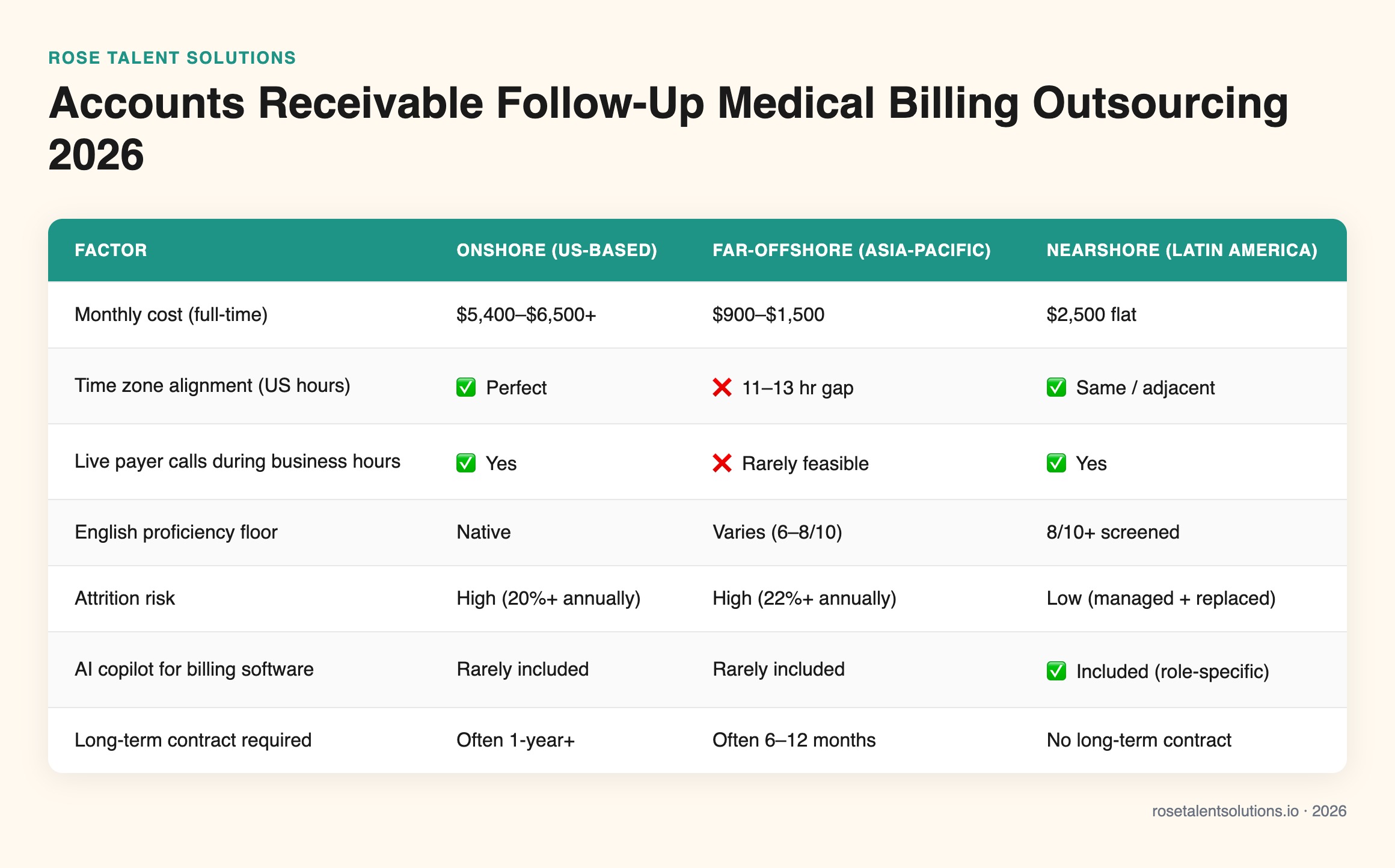
Not all outsourcing is equal. The decision between far-offshore staffing and nearshore Latin America has direct, measurable consequences for AR follow-up performance. The core issue is time zone alignment. Insurance payer call centers operate 8am–6pm Eastern or Central time. If your AR specialist is 11–13 hours ahead, they cannot call a payer's provider line during business hours without working a night shift. Calls get batched, delayed, or skipped. Claims age.
Nearshore specialists work your same business hours — Eastern, Central, Mountain, or Pacific — because Latin America sits in the same or adjacent time zones. A specialist in Bogotá, Medellín, Mexico City, or Buenos Aires starts their day when your practice opens. They can reach a UnitedHealthcare or Cigna provider relations line at 10am your time, not 10pm theirs.
| Factor | Onshore (US-Based) | Far-Offshore (Asia-Pacific) | Nearshore (Latin America) |
|---|---|---|---|
| Monthly cost (full-time) | $5,400–$6,500+ | $900–$1,500 | $2,500 flat |
| Time zone alignment (US hours) | ✅ Perfect | ❌ 11–13 hr gap | ✅ Same / adjacent |
| Live payer calls during business hours | ✅ Yes | ❌ Rarely feasible | ✅ Yes |
| English proficiency floor | Native | Varies (6–8/10) | 8/10+ screened |
| Attrition risk | High (20%+ annually) | High (22%+ annually) | Low (managed + replaced) |
| AI copilot for billing software | Rarely included | Rarely included | ✅ Included (role-specific) |
| Long-term contract required | Often 1-year+ | Often 6–12 months | No long-term contract |
How a Nearshore AR Specialist Is Trained for Medical Billing Software in 2026
Software fluency is not optional in AR follow-up. A specialist who logs into athenahealth, AdvancedMD, Kareo, or DrChrono for the first time on their start date will spend weeks learning the interface instead of working your claims. The best nearshore AR teams arrive paired with a role-specific AI copilot that surfaces the right workflow at the right moment.
At Rose Talent Solutions, every AR follow-up specialist ships with an AI copilot trained on their assigned billing platform. If your practice runs on Kareo, the copilot knows Kareo's denial management queue, batch remittance posting, and claim scrubbing screens. If you are on athenahealth, the copilot is trained on athenahealth's AR worklist and payer-specific rules. This accelerates ramp time from the industry average of 60–90 days to under 30 days for most placements.
"AI-augmented billing staff are the fastest-growing segment of the revenue cycle outsourcing market. Practices that combine human follow-up expertise with AI-assisted denial analysis are recovering 15–20% more revenue from the same claim volume." — Nitin Chhoda, Founder at International Billing Association (2024)
According to McKinsey & Company (2023), AI-enabled revenue cycle tools can reduce claim denial rates by up to 50% when combined with trained human follow-up. The combination — a specialist who knows the payer landscape and an AI that flags scrubbing errors before submission — is what converts a cost center into a revenue recovery engine.
The billing software your practice uses determines how fast an outsourced AR specialist can produce results. A specialist pre-trained on your exact platform — Kareo, athenahealth, AdvancedMD, or DrChrono — can begin working live claims in week one rather than spending month one in software orientation.

What Does Accounts Receivable Follow-Up Medical Billing Outsourcing Actually Cover?
When practices ask about outsourcing AR follow-up, they often assume it only means calling payers. In practice, a well-scoped nearshore AR specialist handles a much broader set of revenue cycle tasks. The exact scope depends on your practice's needs, but here is what a full-time dedicated specialist typically owns:
- Claim status checks — systematic review of submitted claims by payer, aging bucket (30/60/90/120+ days), and denial reason code
- Denial analysis and resubmission — identifying whether denials are due to eligibility, coding, authorization, or timely filing issues, then correcting and resubmitting
- Payer call follow-up — live phone calls to provider relations lines to dispute underpayments or request claim reconsideration
- EOB / ERA posting — posting remittance advice and reconciling payments against expected reimbursements
- Appeals drafting — writing and submitting formal appeal letters for denied high-value claims
- Patient balance follow-up — sending statements and fielding patient billing inquiries on outstanding balances after insurance adjudication
- AR reporting — weekly aging reports, denial trend analysis, and payer-specific collection rate tracking for practice leadership
This scope is equivalent to a full-time, experienced in-house biller — without the overhead, the attrition risk, or the long-term contract. You can learn more about how Rose structures billing and financial support roles at our bookkeeping and accounting staffing page.
How to Onboard a Nearshore AR Specialist in 2026: The 5-Step Process
Intake and role scoping
Rose collects your billing software, payer mix, current days-in-AR, denial rate, and claim volume — the spec determines exactly which skill profile to match, not a generic "biller" template.
Candidate match and vetting
Rose pre-screens candidates on English proficiency (8/10+ floor), medical billing software experience, and payer-specific knowledge before presenting your shortlist — typically within 5–7 business days.
AI copilot configuration
The specialist's role-specific AI copilot is configured for your billing platform and payer mix before day one, so the first week is spent on live claims, not software orientation.
Supervised ramp period
Rose's management layer monitors claim output, response time, and denial resolution rate during the first 30 days — you receive a performance summary at the end of the ramp period.
Steady-state and optimization
Once ramped, the specialist owns your AR workflow end-to-end — and if at any point they are not a fit, Rose replaces them at no additional cost. No disruption, no rehiring cycle.
Is Accounts Receivable Follow-Up Medical Billing Outsourcing Right for Your Practice in 2026?
The outsourcing decision comes down to one question: is your current AR follow-up process producing results, or is it just keeping up appearances? If your days in AR exceed 35, if your denial rate is above 5%, or if you have a 90-plus bucket larger than 15% of total AR, your current setup is costing you more than outsourcing would.
Small practices — solo physicians, group practices up to 10 providers — are often the biggest beneficiaries because they are the least likely to have a dedicated AR specialist in-house. They depend on a front-office generalist who is already stretched across scheduling, eligibility, and patient intake. According to HFMA (Healthcare Financial Management Association) (2023), practices that separate AR follow-up from general billing administration see a 23% average improvement in net collection rate within the first year.
Why practices outsource AR follow-up
- Dedicated focus — no competing front-office duties
- Real-time payer calls during US business hours
- Pre-trained on your billing software from day one
- $2,500/month vs. $65K+ fully-loaded in-house cost
- No long-term contract — cancel with 30 days written notice
- Free replacement if the specialist is not a fit
When to keep AR in-house instead
- Your practice has fewer than 50 claims per month — volume may not justify a full-time dedicated specialist
- You have a compliance requirement for on-site staff, which is rare but exists in some specialties
- Your current in-house biller is performing at or below 30 days in AR with a sub-3% denial rate — do not fix what is not broken
For practices that do qualify, the path forward is straightforward. Starting with Rose takes a single intake call — you describe your payer mix, billing platform, and current AR pain points, and the team matches a pre-vetted nearshore specialist from Latin America to your exact profile. There is no long-term contract and no complex procurement process.
The broader context: the US healthcare revenue cycle outsourcing market was valued at $16.7 billion in 2023 and is projected to reach $29.4 billion by 2030, according to Grand View Research (2024). Independent practices that act now — building a reliable, low-cost AR infrastructure with nearshore Latin America talent — will have a structural cost advantage over those who wait. You can explore how Rose approaches specialized nearshore staffing for other verticals to see the same model applied at scale.