
Nearshore recruiting has fundamentally changed how US, Canadian, and UK companies build engineering teams — and Latin America sits at the center of that shift. If you're searching for the best recruiting firms for hiring developers in Latin America, you're not short on options. You are, however, short on time, and a bad hire or a predatory contract can cost you six months and $30,000+ before you notice. This guide cuts through the noise so you can make the right call in 2026.
Latin America now produces over 1.5 million software developers annually, according to the Inter-American Development Bank (IDB) (2024). That pool is growing fast — and the best firms are competing hard to access it. Knowing what separates a great recruiting partner from an average one matters more than ever.
What Is a Nearshore Recruiting Firm — and Why Does the Definition Matter in 2026?
A nearshore recruiting firm sources talent from countries geographically and culturally proximate to the client's home country. For US businesses, that means Latin America — Mexico, Colombia, Argentina, Brazil, Costa Rica, and others. Nearshore is not a synonym for "offshore." Offshore typically means Philippines or India — 10 to 14 hours behind US Eastern time. Nearshore Latin America means 0 to 3 hours behind Eastern time, with team members working your business hours, not theirs.
This distinction matters enormously in practice. A developer in Bogotá joins your 9am standup. A developer in Manila joins your 9pm standup — if they join at all. The timezone overlap alone changes what kind of work is realistic to delegate, how fast code reviews happen, and how quickly bugs get resolved. If you want a deeper breakdown of how these models compare operationally, the complete nearshore vs. offshore vs. onshore comparison breaks it down model by model.
How the Top Recruiting Firms for Latin America Developers Are Structured in 2026
Not all recruiting firms operate the same way. Understanding the model behind the firm helps you predict how the relationship will actually go. There are three dominant models in the Latin America developer recruiting market right now.
Staffing agencies recruit, vet, and place candidates — then hand you the relationship. You manage payroll, HR compliance, equipment, and performance. Managed staffing firms like Rose Talent Solutions handle recruiting, vetting, payroll, HR, and ongoing team management under a single flat rate. Freelance marketplaces (Toptal, Upwork) give you access to a talent pool, but you own everything downstream of the search.

The model you choose determines your administrative burden, your legal exposure, and your exit options. Managed staffing firms typically include a no long-term contract arrangement — you're not locked into a 12-month commitment while you figure out whether the hire is a fit. That flexibility matters especially when you're hiring a developer for a role that might evolve quickly.
How to Evaluate Recruiting Firms for Latin America Developers: 2026 Criteria That Actually Predict Success
Dozens of firms claim to be the best recruiting firms for hiring developers in Latin America. Here's the short list of criteria that actually separate strong partners from average ones.
English proficiency standards. Ask every firm: "What's your minimum English score, and how do you measure it?" Vague answers ("we look for strong communicators") are a red flag. Rose Talent Solutions publishes its bar publicly: 8/10 or higher on English proficiency screens. Specific, published standards are a signal that the firm has built a repeatable vetting process — not just a Rolodex.
Technical vetting depth. Does the firm use live coding assessments, take-home projects, or just portfolio reviews? The best firms layer all three. A developer who looks great on paper but freezes on a whiteboard problem is a risk your US engineering lead will discover on week two.
Time-to-placement. The market moves fast. A firm that takes 60 days to present candidates is a liability. Top managed staffing firms aim for placements within 7 to 14 days of intake.
Replacement policy. What happens if the developer isn't a fit? This is where most firms get quiet. Rose Talent Solutions replaces your team member at no additional cost if they're not working out — no negotiation required. That's the risk reversal that matters.
"The Latin American tech talent market has matured dramatically. Companies that treat it like a cost arbitrage play will keep churning through developers. The ones winning are the ones investing in real vetting, real onboarding, and real management infrastructure." — Ariel Camus, CEO at Microverse (2024)
Comparing the Best Recruiting Firms for Hiring Developers in Latin America 2026
| Firm / Model | Pricing Model | Timezone Fit (US) | English Vetting Standard | Contract Flexibility | Post-Placement Management |
|---|---|---|---|---|---|
| Rose Talent Solutions (managed staffing) | $2,500/mo flat, all-in | 0–3 hrs behind Eastern | 8/10+ published floor | No long-term contract, 30-day notice | Full HR, payroll, ongoing management included |
| Toptal (freelance marketplace) | $2,000–$5,000+/mo per developer (varies) | Varies by developer location | Top 3% claim, methodology not fully public | Flexible but premium pricing | None — you manage the relationship |
| Andela (staffing platform) | Custom pricing, typically $3,000–$8,000+/mo | Africa-heavy pool, some LATAM | Proprietary assessment, Africa-first focus | Multi-month commitments standard | Partial — talent management support varies |
| Traditional Agency (placement only) | 15–25% of annual salary, one-time | Depends on candidate sourced | Varies widely by agency | Guarantee period only (60–90 days typical) | None after placement fee is paid |
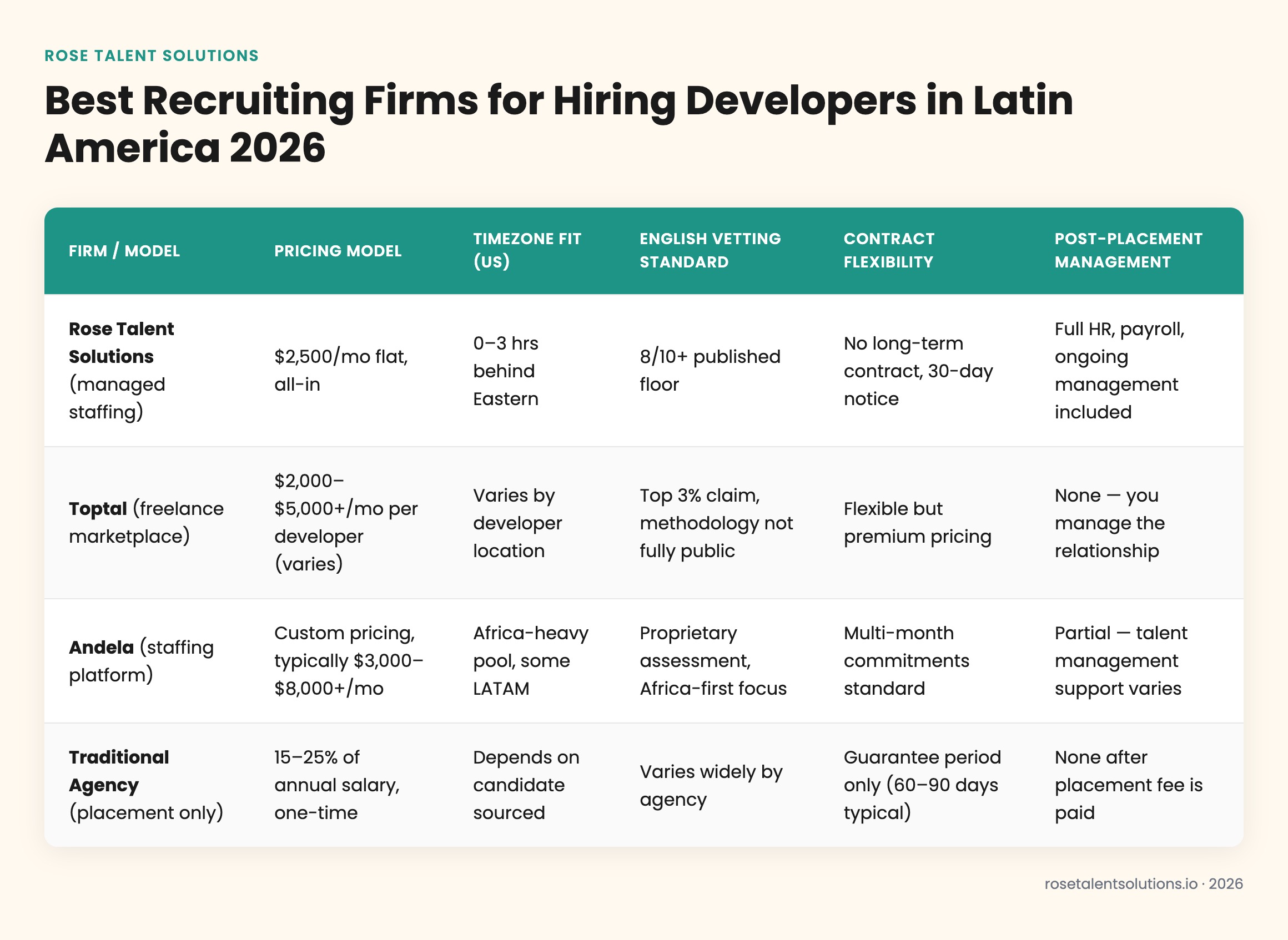
The table above reveals a structural pattern: the more you pay upfront with a traditional agency, the less support you get after placement. Managed staffing firms flip that — lower monthly cost, full ongoing support, and a replacement guarantee if things don't work out. For companies scaling an engineering team across multiple roles, that model compounds quickly. If you're also evaluating firms beyond developers — for administrative, finance, or ops roles — the top nearshore virtual assistant agencies for US businesses covers the broader staffing landscape.
How Latin America's Developer Talent Pool Has Changed What's Possible in 2026
Five years ago, US companies hiring in Latin America were largely picking up junior developers for cost reasons. That story is outdated. Senior and staff-level engineers across full-stack web, mobile, data engineering, and DevOps are now accessible through nearshore channels at a fraction of US market rates — without sacrificing quality.
Developer salaries in the US have continued to rise. According to the U.S. Bureau of Labor Statistics (BLS) (2024), the median annual wage for software developers in the United States exceeded $130,000. A comparable nearshore developer in Colombia or Mexico typically costs $40,000 to $65,000 fully loaded — a savings of 50 to 65% without the offshore timezone penalty.

The quality gap has closed because the ecosystem has matured. Bootcamps, university CS programs, and international remote work experience have all contributed. Countries like Argentina, Colombia, and Mexico now consistently rank in the top 20 globally on the HackerRank Developer Skills Report (2024) for algorithmic problem-solving and language proficiency. If you're specifically evaluating options for senior engineering roles, the best recruiting companies for senior developers in Latin America goes deeper on that specific talent tier.
The cost savings from nearshore Latin America hiring are real — but the hidden advantage is timezone alignment. A developer in Bogotá or Buenos Aires is on your Slack by 9am Eastern. That means daily standups, same-day code reviews, and real-time debugging — none of which are possible with an 11-hour offshore gap. Timezone overlap is the multiplier that makes nearshore ROI compound over time.
What the Best Recruiting Firms Do Differently: The 2026 Hiring Process Explained
The difference between a firm that fills a role and a firm that builds your team comes down to process. Here's how the best-in-class recruiting firms for Latin America developers structure an engagement from intake to placement.
Role Intake & Technical Profile
The firm runs a structured intake session to define not just the job description, but the team context, communication style, tech stack depth required, and growth trajectory of the role. Generic JD intake is a red flag.
Talent Pool Sourcing & First Screen
Top firms source from pre-vetted pools — not cold job boards. First screens filter for English proficiency, timezone availability, and baseline technical competency before any candidate reaches your desk.
Technical Assessment
Live coding sessions, architecture discussions, or take-home projects relevant to your actual codebase separate candidates who can talk the talk from those who can ship. The best firms use role-specific assessments, not generic LeetCode banks.
Client Presentation & Interview
You receive 2 to 3 curated profiles — not a shortlist of 15. The firm should be able to defend every candidate presented. You interview and select.
Onboarding & Ongoing Management
Managed firms handle payroll setup, HR compliance, and equipment logistics. They also check in during the first 30 and 90 days — and activate the replacement guarantee immediately if something isn't working.
Rose Talent Solutions follows this process for every placement, including developer roles managed through its onboarding flow. The all-in $2,500/month rate covers every step above — including the ongoing management layer that most staffing agencies charge separately or don't offer at all. For a broader look at how Latin America staffing agencies are structured across role types, the best staffing agencies for Latin America developers guide compares the landscape in detail.
Nearshore vs. Offshore Developer Recruiting: The 2026 Trade-offs You Need to Understand
Some companies still consider offshore (Philippines, India, Eastern Europe) for developer hiring because the hourly rates can appear lower. The trade-offs are real and worth naming directly before you make a decision.
Nearshore Latin America — Pros
- 0 to 3 hour timezone gap with US Eastern — real-time collaboration
- Cultural alignment with US business norms and communication styles
- English proficiency in top talent pools is consistently high
- No overnight batch delays on tickets, reviews, or standup updates
- Legal and compliance frameworks easier to navigate for US employers
Offshore (Philippines/India) — Trade-offs
- 10 to 14 hour timezone difference — asynchronous by necessity
- Coordination overhead increases for real-time debugging and standups
- Communication style differences can slow technical decision cycles
- Higher churn in some markets due to intense competition for local talent
- IP and data compliance can be more complex depending on jurisdiction
Talent retention is also a meaningful variable. According to SHRM's Employee Engagement Research (2024), team members who work in overlapping timezone environments with their managers report significantly higher engagement scores — which correlates directly with lower churn. A developer who can actually attend your planning meeting is more likely to feel like part of the team and stay. Explore Rose's full AI copilot advantage to see how every placed team member ships with tooling trained on your stack from day one.
The bottom line: nearshore is not just a geographic preference. It's a structural decision that affects how your team actually ships software. If real-time collaboration matters to your engineering culture — and it does in almost every modern agile team — nearshore Latin America is not just the better option. It's the only option that fits the workflow. For companies managing more than developers — including back-office, finance, or property operations roles — Rose's property management staffing and bookkeeping and accounting solutions use the same nearshore model with role-specific AI tooling built in.
According to McKinsey's Global Tech Trends Report (2024), companies that successfully integrate nearshore engineering teams report 30 to 40% faster feature delivery cycles compared to fully offshore alternatives — primarily because of real-time communication efficiency. That's not a marginal gain. For a growth-stage company, that's a competitive moat.