
Nearshore IT staffing in Latin America has fundamentally changed how US, Canadian, and UK companies hire engineers. Instead of waiting 12–18 months for a local hire or managing a 10-hour timezone gap with an offshore team in Asia, companies are tapping LATAM talent pools that work the same hours, speak fluent English, and cost a fraction of equivalent US salaries. If you're evaluating the best IT staffing agencies for LATAM engineers in 2026, this guide cuts through the noise and tells you exactly what to look for — and what most agencies won't admit.
Latin America produces over 500,000 STEM graduates per year, according to the Inter-American Development Bank (2023). That pipeline feeds a rapidly maturing nearshore ecosystem — one that now rivals Eastern Europe for technical depth while beating it on timezone fit for North American employers. The question isn't whether LATAM engineers are qualified. The question is which agency will actually find, vet, and retain the right one for your team.
What Makes an IT Staffing Agency "Nearshore" in 2026?
The term "nearshore" refers to hiring talent in a geographically and culturally proximate country — typically within one to three time zones of your headquarters. For US-based companies, nearshore IT staffing means sourcing engineers from Mexico, Colombia, Argentina, Brazil, Costa Rica, or Chile rather than India or the Philippines.
A true nearshore IT staffing agency does more than post jobs in Latin America. It maintains an active talent network in-region, runs rigorous language and technical screens, handles payroll compliance across multiple jurisdictions, and provides ongoing performance management. If an agency skips any of those steps, you're not getting nearshore staffing — you're getting a job board with an accent.
For a broader look at how nearshore compares to other hiring models, the complete nearshore vs. offshore vs. onshore comparison breaks down costs, risks, and performance benchmarks in detail.

How Top IT Staffing Agencies Vet LATAM Engineers in 2026
Vetting quality is the single biggest differentiator between agencies. Most platforms claiming to specialize in LATAM IT staffing run a resume screen and a 20-minute video call. The best agencies run structured technical assessments, asynchronous code challenges, English proficiency scoring (look for an 8/10 minimum floor), cultural alignment interviews, and reference checks with former US or Canadian employers.
English proficiency is non-negotiable for engineers embedded in US teams. Miscommunication in a sprint planning call doesn't just slow a ticket — it delays a release. Rose Talent Solutions screens every candidate to an 8/10 or higher on a structured English proficiency rubric before they ever reach a client's shortlist.
"The number one failure mode in nearshore engagements isn't technical skill — it's communication scaffolding. Teams that invest in language screening and timezone overlap at the hiring stage see 3× better retention at 12 months." — Ariel Camus, CEO at Microverse (2023)
Technical depth matters too. The best LATAM IT staffing agencies maintain pre-vetted benches across specific stacks — React, Node, Python, DevOps, QA automation — so they're matching you to an engineer who has shipped production code in your exact environment, not just someone who listed the framework on a resume.
According to SHRM's Talent Acquisition research (2024), the average cost of a bad technical hire is 50–200% of that employee's first-year salary. At senior engineer salaries, that's a $100,000–$300,000 mistake. A strong vetting process at the agency level is not overhead — it's risk mitigation.
Nearshore vs. Offshore vs. Onshore: 2026 IT Staffing Comparison
Not all staffing models perform equally for US tech companies. The table below compares the three primary hiring approaches across the five factors that matter most to engineering leads and CTOs.
| Factor | Nearshore LATAM | Offshore Asia-Pacific | Onshore US |
|---|---|---|---|
| Timezone Overlap | Full US business hours (EST–PST) | 2–4 hrs overlap or async only | Full overlap |
| English Proficiency | High (8/10+ screened) | Variable (3–7/10 typical) | Native |
| Fully Loaded Monthly Cost | $2,500–$6,000 | $800–$3,000 | $10,000–$20,000+ |
| Cultural Alignment | High (US media, work norms) | Low–Medium | Native |
| Time-to-Fill | 7–21 days (agency-managed) | 14–45 days | 45–120 days |
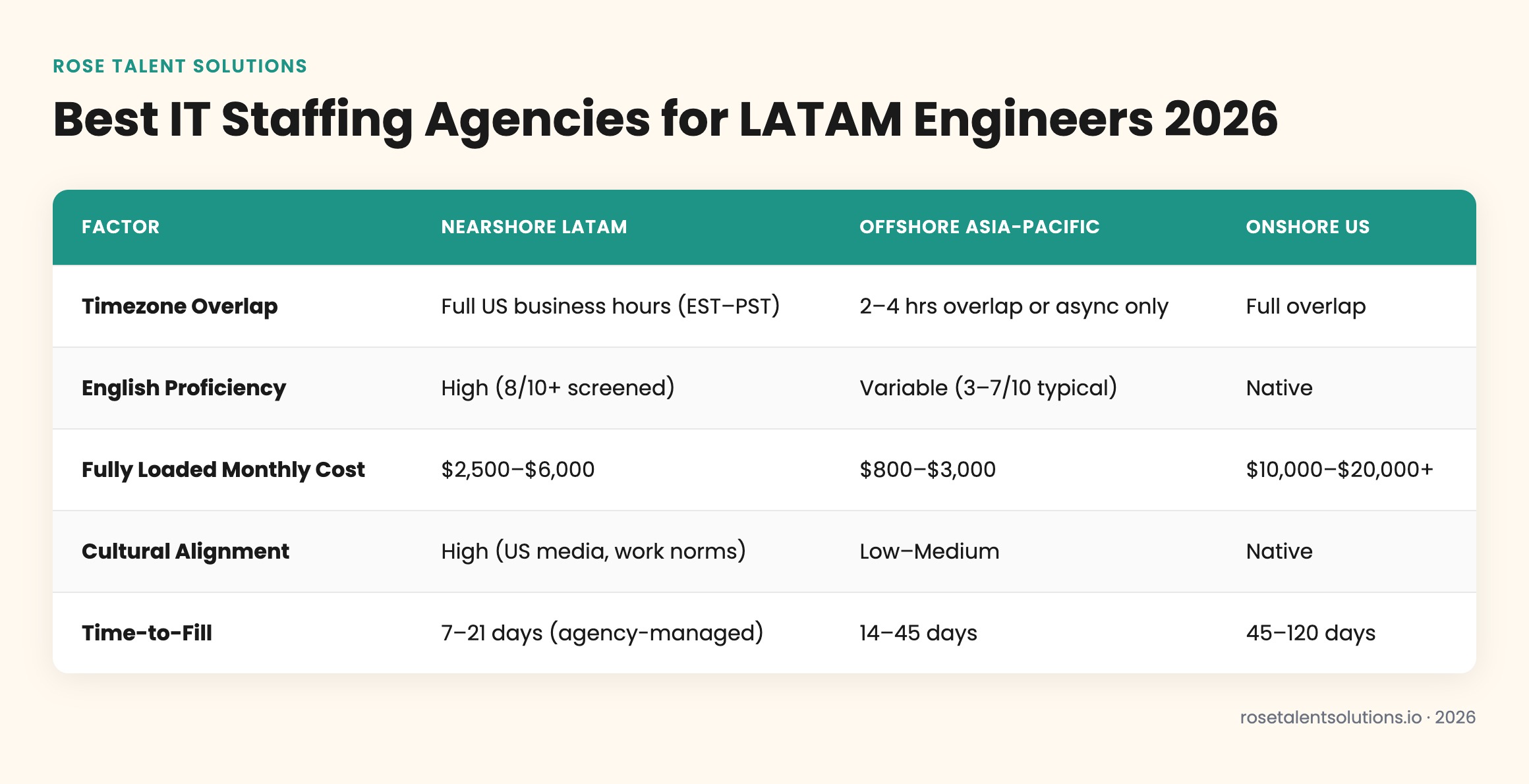
The cost gap between nearshore LATAM and onshore US is striking — but so is the gap between nearshore and offshore on communication quality. According to McKinsey's technology workforce research (2023), distributed teams with 6+ hour timezone gaps spend an average of 23% more calendar time on coordination overhead than teams within 2 hours of each other. That overhead compounds across every sprint.
How the AI Copilot Advantage Sets Modern LATAM Staffing Apart
The best IT staffing agencies in 2026 don't just place engineers — they place engineers who arrive ready to work inside your specific toolstack. Rose Talent Solutions equips every team member with a role-specific AI copilot trained on the software environment they'll be working in. For IT and operations roles, that means the engineer knows your project management platform, your CI/CD pipeline conventions, and your documentation standards from day one — not week four.
The hidden cost of a slow ramp isn't just lost productivity — it's the management overhead your senior engineers absorb while the new hire catches up. An AI-augmented nearshore engineer who arrives pre-trained on your stack saves 2–3 weeks of onboarding drag on your highest-cost internal team members.
This AI-augmentation model matters especially for roles where software fluency is table stakes — DevOps automation, QA engineering, data pipeline work, and API integrations. Gartner (2024) projects that more than 80% of enterprises will have deployed generative AI-enabled applications by 2026 — meaning every engineer you hire needs to be comfortable working alongside AI tooling, not intimidated by it.

For companies evaluating the top staffing agencies for Latin America developers, the AI copilot question is now a standard due-diligence item. Ask every agency: does your candidate arrive with any pre-training on our stack, or do they start from zero? The answer reveals whether the agency is running a people business or a placement business.
What to Look for in a LATAM IT Staffing Agency: 2026 Checklist
Not every agency that claims to specialize in LATAM IT talent actually has the infrastructure to deliver. Here's the operational checklist that separates real nearshore firms from brokers who've discovered a marketing trend.
In-Region Talent Infrastructure
The agency should maintain active recruiter relationships in at least 3–4 LATAM countries — not just one hub. Single-country agencies can't absorb demand spikes or find specialized skills quickly.
Structured Language Screening
Ask for the agency's English proficiency rubric and minimum score. If they can't name a specific score or methodology, they're not screening — they're guessing. Rose's floor is 8/10 on a structured assessment.
Technical Assessment Process
Top agencies run role-specific code challenges or technical interviews — not just portfolio reviews. Know whether the technical screen is conducted by the agency or outsourced to the client.
Payroll and Compliance Coverage
Multi-country LATAM payroll is complex. Confirm the agency handles all local employment compliance, tax withholding, and benefits — otherwise you inherit the legal exposure.
Replacement Guarantee
The best agencies stand behind their placements. Rose Talent Solutions replaces any team member who isn't a fit at no additional cost — that's the kind of accountability that filters serious agencies from resume forwarders.
Pricing transparency is another filter. Agencies that quote hourly rates without defining what's included almost always hide recruiting fees, HR management costs, or payroll overhead in later invoices. Rose's flat $2,500/month rate is all-in: recruiting, vetting, payroll, HR, and ongoing management. No long-term contract required — month-to-month with 30 days written notice.
If you're a startup evaluating budget options, the guide to nearshore staffing agencies for startups covers how to structure your first technical hire without overcommitting on cost or scope.
Nearshore LATAM IT Staffing: Pros and Cons for US Tech Teams
No model is perfect. Here's an honest breakdown of what nearshore LATAM IT staffing delivers — and where it has real limitations compared to onshore hiring.
Pros
- Full US business-hour coverage — real-time standups, Slack, and pair programming
- 60–75% cost savings vs. equivalent US salaries without sacrificing technical depth
- Faster time-to-fill than local recruitment (7–21 days vs. 45–120 days)
- High cultural alignment — US tech norms, Agile familiarity, English fluency
- No long-term contract obligation with top-tier agencies
Cons
- Smaller ultra-specialized talent pool (e.g., embedded systems, niche ML research) vs. global offshore markets
- Agency quality varies widely — vetting rigor is not standardized across the industry
- Some roles require security clearances or physical US presence that nearshore can't satisfy
According to the US Bureau of Labor Statistics (2024), software developer employment in the US is projected to grow 25% through 2032 — far outpacing domestic supply. That structural shortage is exactly why nearshore LATAM is no longer a cost-cutting tactic. It's a talent access strategy.
For companies wanting to benchmark LATAM agencies against the broader virtual staffing market, the roundup of the best nearshore virtual assistant agencies for US businesses covers the full spectrum from administrative to technical roles.
Ready to build your LATAM engineering team? Rose Talent Solutions places full-time nearshore engineers at a flat $2,500/month with a free replacement guarantee — get started today and have your first shortlist within days.