
Nearshore dental virtual assistants have quietly become one of the highest-ROI hires a dental practice can make — and the pricing landscape in 2026 is sharper than it's ever been. Whether you're running a single-location family practice or a multi-site DSO, the question is no longer whether to hire a remote dental VA — it's how much you should expect to pay, and what you get for that number. This guide breaks down the real average monthly cost for a remote dental virtual assistant, where the hidden fees live, and how to evaluate whether a flat-rate nearshore model or a pay-per-hour freelance arrangement actually serves your practice better.
Before we get into numbers: the dental front-desk function is not the same as generic admin work. A dental VA handles insurance verification, patient intake, appointment scheduling, reactivation campaigns, billing coordination, and often Dentrix or Eaglesoft navigation. That specificity matters when you're comparing price points. A $12/hour freelancer from a gig platform and a $2,500/month managed nearshore hire are not the same product — and treating them as equivalent will cost you more than the price difference.
What Does a Remote Dental Virtual Assistant Actually Do in 2026?
A remote dental virtual assistant is a full-time or part-time team member who handles the administrative and patient-communication layer of your practice — entirely off-site. The role typically covers new patient intake, insurance eligibility verification, appointment confirmations, recall and reactivation outreach, treatment plan follow-up, and front-desk phone coverage. More advanced dental VAs also support billing coordination and prior authorization requests.
What separates a dental VA from a generalist VA is software fluency. Dental practices run on specialized platforms — Dentrix, Eaglesoft, Open Dental, Curve Dental — and a VA who isn't already trained on your system will cost you weeks of onboarding time and patient experience errors. This is why software-specific vetting matters as much as English proficiency when you're evaluating what you're actually paying for. At Rose Talent Solutions, every team member ships with a role-specific AI copilot trained on their assigned dental software, which cuts ramp time dramatically compared to a cold hire. You can read more about how that works on the AI advantage page.
How 2026 Pricing Breaks Down Across Every Hiring Model
The average monthly cost for a remote dental virtual assistant in 2026 varies significantly by where the VA is based, how they're sourced, and what's bundled into the quoted price. Here's a direct comparison of the three primary models practices are choosing between:
| Hiring Model | Typical Monthly Cost | Hours/Week | What's Included | Key Risk |
|---|---|---|---|---|
| Onshore (US-based) VA | $4,000–$7,000+ | 40 hrs | Labor only — benefits, taxes, PTO extra | High cost; still requires full HR overhead |
| Offshore (non-US, distant timezone) VA | $800–$1,800 | 40 hrs | Labor only; recruiting and management not included | Timezone gap (8–12 hrs); variable English quality; no management layer |
| Freelance platform (Upwork/Fiverr) | $1,200–$2,800 | Variable | Hourly labor; zero vetting guarantee; no HR | High turnover; no dental software vetting; management burden falls on you |
| Nearshore Managed VA (Latin America) | $2,500 flat | 40 hrs | Recruiting, vetting, payroll, HR, management, AI copilot, free replacement if not a fit | Lowest — same timezone, English fluent, fully managed |
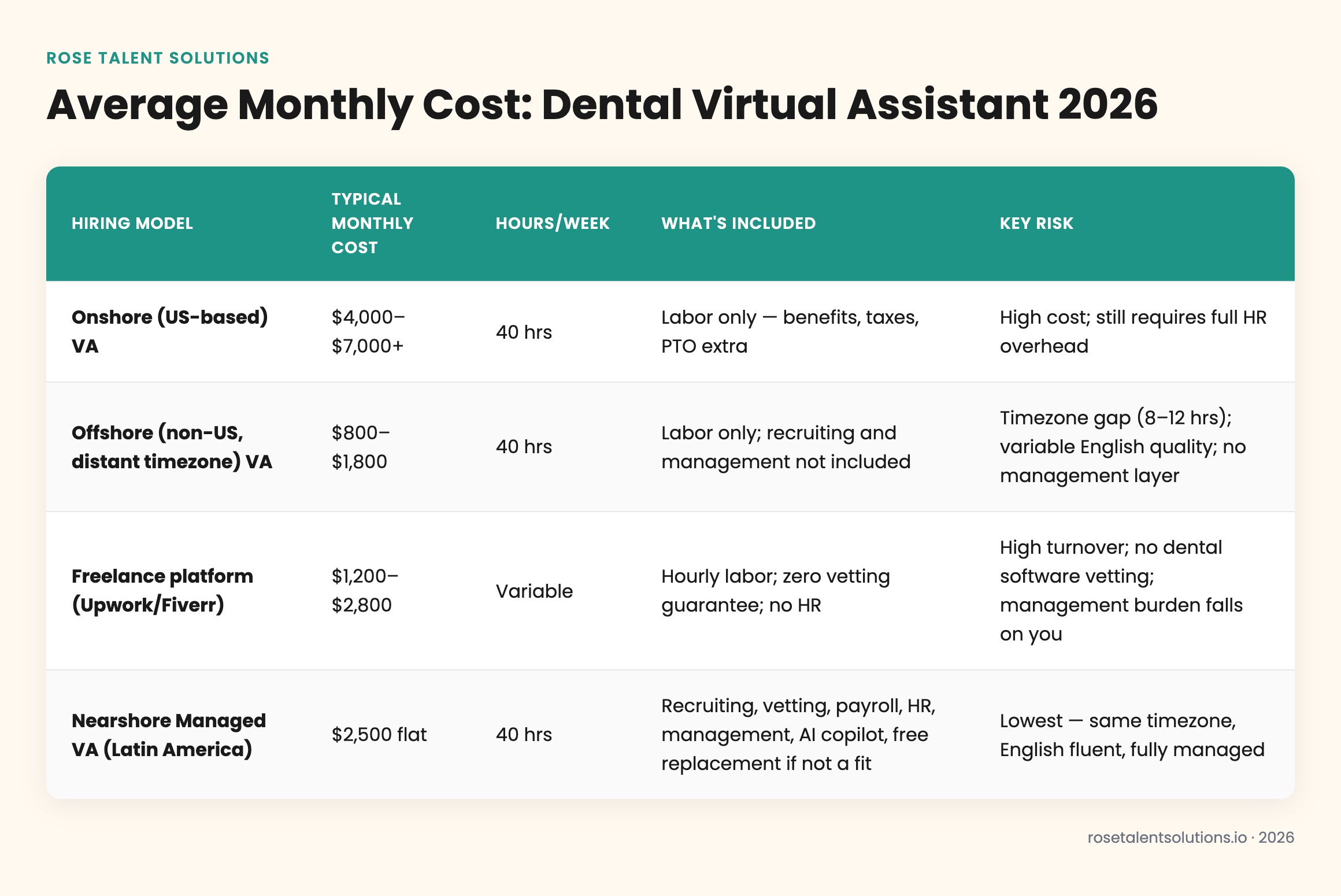
The lower-cost offshore number looks attractive until you account for what's missing. Platforms that advertise $10–$15/hour dental VAs almost never include recruiting costs (typically $500–$1,500 per placement), management overhead (which falls back on you or your office manager), or any replacement guarantee. When a $14/hour hire quits after six weeks, you've lost time, money, and patient continuity. According to SHRM (2023), the average cost to replace a single employee ranges from 50% to 200% of that person's annual salary — a number that compounds fast in a high-turnover role like front-desk admin.
How Nearshore Latin America VAs Outperform Distant-Timezone Hires in 2026
The word "nearshore" describes a staffing model where your remote team member is based in a country geographically and timezone-adjacent to your business. For US dental practices, that means Latin America — countries like Colombia, Mexico, Argentina, Costa Rica, and Peru. Nearshore VAs work US business hours natively, eliminating the 8–12 hour delay that defines arrangements with VAs in distant time zones.
That timezone alignment is not a minor perk — it's operationally critical for dental front-desk work. When a patient calls to confirm a same-day appointment, when an insurance rep needs to verify coverage before 3pm, when a no-show needs to be immediately backfilled — these are real-time functions. A VA batching callbacks at midnight your time fails the basic job requirement, regardless of how low the hourly rate is. If you want a full breakdown of how these models differ structurally, this complete nearshore vs. offshore vs. onshore comparison covers the tradeoffs in depth.
"Workforce trends in healthcare administration are moving unmistakably toward remote and hybrid models — but practices that hire without a clear vetting and management infrastructure end up spending more on turnover than they save on wages." — Dave Monahan, CEO at Weave (dental practice communication platform), 2023
English fluency is the other separator. Rose's published screening floor is 8/10 or higher on English proficiency assessments — equivalent to a professional working level. That standard rules out a significant portion of candidates who clear lower bars set by generic platforms. For dental front-desk work where patient communication quality directly affects your Google reviews and reappointment rate, this isn't negotiable. According to the U.S. Bureau of Labor Statistics (2024), medical secretaries and administrative assistants — the closest onshore equivalent to a dental VA — earn a median annual wage of $40,990, or roughly $3,400/month before benefits, taxes, and PTO.
A fully loaded onshore dental front-desk hire costs $4,500–$6,000/month when you factor in salary, employer payroll taxes (7.65% FICA), health benefits, PTO accrual, and recruiting fees. A nearshore managed VA at $2,500/month flat delivers the same coverage at roughly half the total cost — with recruiting, HR, and management already included.
What's Actually Included in a $2,500/Month Nearshore Dental VA?
Flat-rate pricing sounds simple, but the value is in what's bundled. When you compare the average monthly cost for a remote dental virtual assistant across models, the question to ask isn't just "what's the monthly number?" — it's "what does that number actually buy me?" Here's what a managed nearshore engagement at Rose Talent Solutions includes, end to end:
Role-Specific Recruiting
Rose sources and screens candidates specifically for dental VA roles — including software proficiency checks for Dentrix, Eaglesoft, or Open Dental, not just generic admin skills.
Multi-Layer Vetting
Every candidate clears English proficiency screening (8/10+ floor), background checks, skills assessments, and a structured interview before you see their profile.
Payroll & HR Management
Rose handles all payroll processing, local labor law compliance in the VA's country, and ongoing HR — you never touch a paycheck or an employment contract.
AI Copilot Deployment
Your VA starts with a role-specific AI assistant trained on their dental software stack, cutting ramp time and reducing errors on insurance verification and scheduling workflows.
Free Replacement Guarantee
If the team member isn't a fit for your practice, Rose replaces them at no additional cost — no re-recruiting fee, no gap in coverage longer than necessary.
The month-to-month terms mean you're never locked in. You can cancel with 30 days' written notice — there's no long-term contract trapping you in a placement that isn't working. That structure is worth something concrete: practices that sign 12-month agreements with VA agencies and then need to exit early often face penalties or simply eat the cost. If you want to understand how nearshore virtual assistant costs are structured beyond the headline number, that breakdown is worth reading before you compare quotes.
How to Evaluate Whether a Dental VA Price Is Actually Competitive in 2026
The dental VA market has no shortage of vendors quoting low numbers with fine print that shifts real costs back onto the practice. Here's a quick checklist for evaluating any quote you receive:
- Is recruiting included? Some platforms charge $500–$2,000 upfront per placement on top of monthly fees.
- Is management included? If you're expected to supervise the VA directly, that's overhead your office manager absorbs — real cost, rarely counted.
- What's the replacement policy? If a VA leaves, what does re-placement cost? How long is the gap?
- What are the contract terms? Annual contracts with early termination fees eliminate the flexibility that makes VA hiring attractive in the first place.
- What's the English proficiency standard? Ask for the specific screening methodology, not a marketing claim.
- What timezone do they work? A dental VA who works overnight your time is a scheduling coordinator in name only.
According to Gallup (2023), businesses that actively manage remote employee performance see 21% higher productivity than those that leave remote workers unsupervised — a finding that directly applies to whether a VA vendor includes active performance management or just drops a hire and disappears.
Remote work adoption itself continues to accelerate in healthcare administration. According to Pew Research Center (2023), 35% of workers who can do their jobs remotely are working from home all or most of the time — a baseline that's reshaped what dental practices expect from administrative staffing. The infrastructure for remote dental VAs is now mature enough that the risk is no longer "will this work remotely?" but "which vendor's model is actually managed well?"
For context on what Latin America-based VAs earn and why the $2,500 flat rate is structured the way it is, this breakdown of average Latin America virtual assistant salaries explains the underlying economics. Understanding what the VA earns — and what the agency takes for management — is the fastest way to spot whether a quoted rate is sustainable or a race to the bottom that will show up as turnover within 90 days.
Nearshore Managed Dental VA — Pros
- Same timezone as your US practice — real-time patient coverage
- All-in flat rate covers recruiting, payroll, HR, and management
- English proficiency at professional working level (8/10+ floor)
- Free replacement if placement isn't a fit
- Month-to-month terms — no long-term contract
- AI copilot speeds up dental software onboarding
DIY Distant-Timezone/Freelance Route — Cons
- 8–12 hour timezone gap makes real-time patient tasks impossible
- You absorb all recruiting, vetting, and management overhead
- No replacement guarantee — turnover costs restart the clock
- Variable English proficiency with no standardized screening
- Hidden fees (recruiting, re-placement) inflate the apparent low rate
- No AI tool deployment — ramp time is entirely on you
If you're evaluating a Latin America staffing agency for your dental practice, the quality of their vetting infrastructure — not the headline hourly rate — is the most predictive factor of whether the placement will still be working for you six months in. According to McKinsey (2023), organizations with structured onboarding and management processes retain new hires at a 50% higher rate than those without — a statistic that translates directly to whether your dental VA investment compounds or resets every quarter.
Ready to see what a dedicated dental VA looks like for your specific practice? The intake process at Rose starts with a role scoping call — no generic intake form, just a direct conversation about your software stack, patient volume, and scheduling coverage needs.