
Nearshore Amazon FBA virtual assistants are quietly becoming the competitive edge separating seven-figure sellers from sellers who are still doing everything themselves. If your FBA business is generating revenue but you're the one pulling inventory reports at 11pm, writing listing copy on weekends, and manually chasing reimbursements, you already know the real constraint isn't capital — it's time. This guide breaks down exactly what an Amazon FBA VA does, what you should pay in 2026, and why nearshore Latin American talent outperforms the offshore alternatives most sellers default to.
What Is an Amazon FBA Virtual Assistant?
An Amazon FBA virtual assistant is a remote specialist who manages the operational, marketing, and administrative tasks inside your Amazon Seller Central account. Unlike a general VA, an FBA-specific VA understands the Amazon ecosystem: how A9 ranks listings, how to read ACoS, how to file reimbursement claims, and how to stay compliant with Amazon's ever-shifting policies. Think of them as a remote operations coordinator for your entire Amazon channel — not just a task-executor, but someone who owns workflows.
The role typically covers listing optimization, inventory forecasting, PPC campaign management, customer messaging, return and reimbursement processing, and weekly performance reporting. Sellers who hire a dedicated Amazon Seller Central VA report reclaiming 20-30 hours per week that they can redirect toward sourcing, brand building, or launching new ASINs.
According to Jungle Scout's 2024 State of the Amazon Seller Report, 63% of third-party sellers cite day-to-day operational tasks as their primary growth bottleneck. Delegation isn't a luxury for these sellers — it's a prerequisite for scale.
What Tasks Does an Amazon FBA VA Handle in 2026?
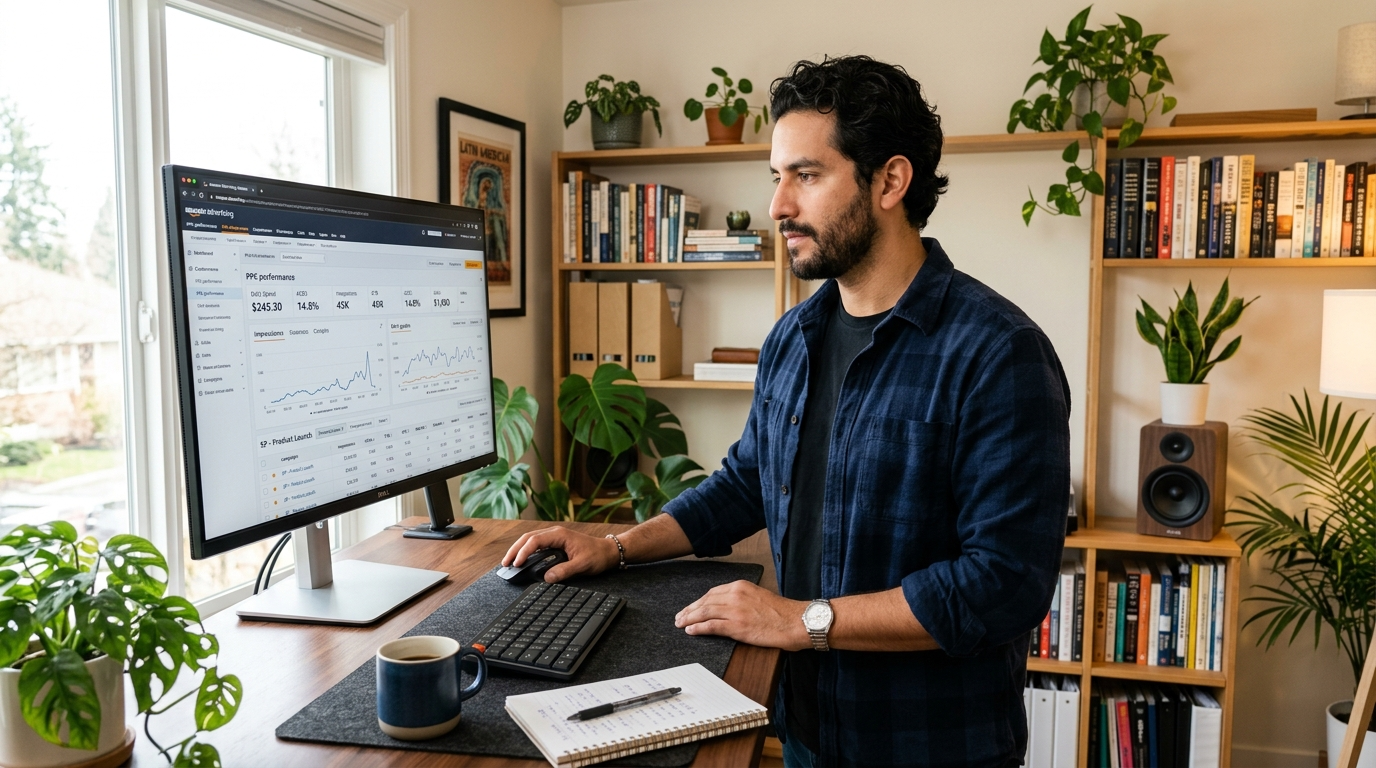
The scope of an FBA VA has expanded significantly as Amazon's platform has grown more complex. Here's what a full-time Amazon FBA virtual assistant realistically owns when they're properly onboarded:
- Listing creation and optimization — keyword research, bullet points, title structuring, backend search terms, and A+ content coordination
- Inventory management — monitoring stock levels, creating replenishment shipments, and flagging stranded or suppressed listings
- PPC campaign management — building and optimizing Sponsored Products, Sponsored Brands, and Sponsored Display campaigns
- Customer communication — responding to buyer messages within Amazon's 24-hour window, managing reviews, and escalating policy issues
- Reimbursement claims — auditing FBA fee discrepancies and filing claims for lost or damaged inventory
- Competitor and keyword research — tracking ASIN movements, pricing shifts, and search volume trends
- Reporting — weekly and monthly performance dashboards covering revenue, ACoS, refund rate, and Buy Box percentage
The global e-commerce market is projected to exceed $7.9 trillion by 2027, according to Statista's Global E-Commerce Revenue Forecast (2024) — which means the operational complexity of running an FBA channel will only increase. Building a VA infrastructure now positions sellers ahead of that curve.
If your FBA operation also involves customer escalations beyond standard messaging, you'll want to look at how sellers layer in a specialized Amazon customer service VA alongside their FBA coordinator — a split-role model that scales cleanly once you pass 500 monthly orders.
How Nearshore VAs Outperform Offshore for Amazon FBA in 2026
Most sellers who've tried offshore FBA VAs — typically from the Philippines or South Asia — share a common frustration: the 10-14 hour timezone gap. When a listing gets suppressed at 8am EST, you need someone who can act immediately, not someone who picks it up the next morning. Real-time availability isn't a nice-to-have for FBA — suppressed listings and hijacked Buy Boxes cost real money every hour they sit unresolved.
Nearshore VAs in Latin America work US business hours natively. They're online when you're online, able to join a Zoom call within minutes, and can execute on urgent tasks without a 24-hour feedback loop. Rose Talent Solutions recruits exclusively from Latin America, and every team member screens at 8/10 or above on English proficiency — meaning communication friction is close to zero. The result: faster ramp, fewer misunderstandings, and operational continuity that offshore simply can't replicate at the same price point.
| Attribute | Nearshore VA (Latin America) | Offshore VA (Philippines/India) | Onshore US VA |
|---|---|---|---|
| Typical monthly cost (full-time) | $2,500 flat (Rose) | $800–$1,500 | $4,000–$7,000+ |
| Timezone overlap (US hours) | Full overlap | 2–4 hrs overlap max | Full overlap |
| English proficiency | 8/10+ screened | Varies widely (5–8/10) | Native |
| Amazon platform training | Role-specific AI copilot included | Self-trained, varies | Varies by hire |
| Ramp time to productivity | 3–7 days | 2–4 weeks | 1–2 weeks |
| Recruiting & HR included | Yes (Rose handles all of it) | You handle or use freelance platform | You handle or use agency |
| Contract flexibility | Month-to-month, no long-term contract | Varies by platform | Typically 3–6 month minimums |
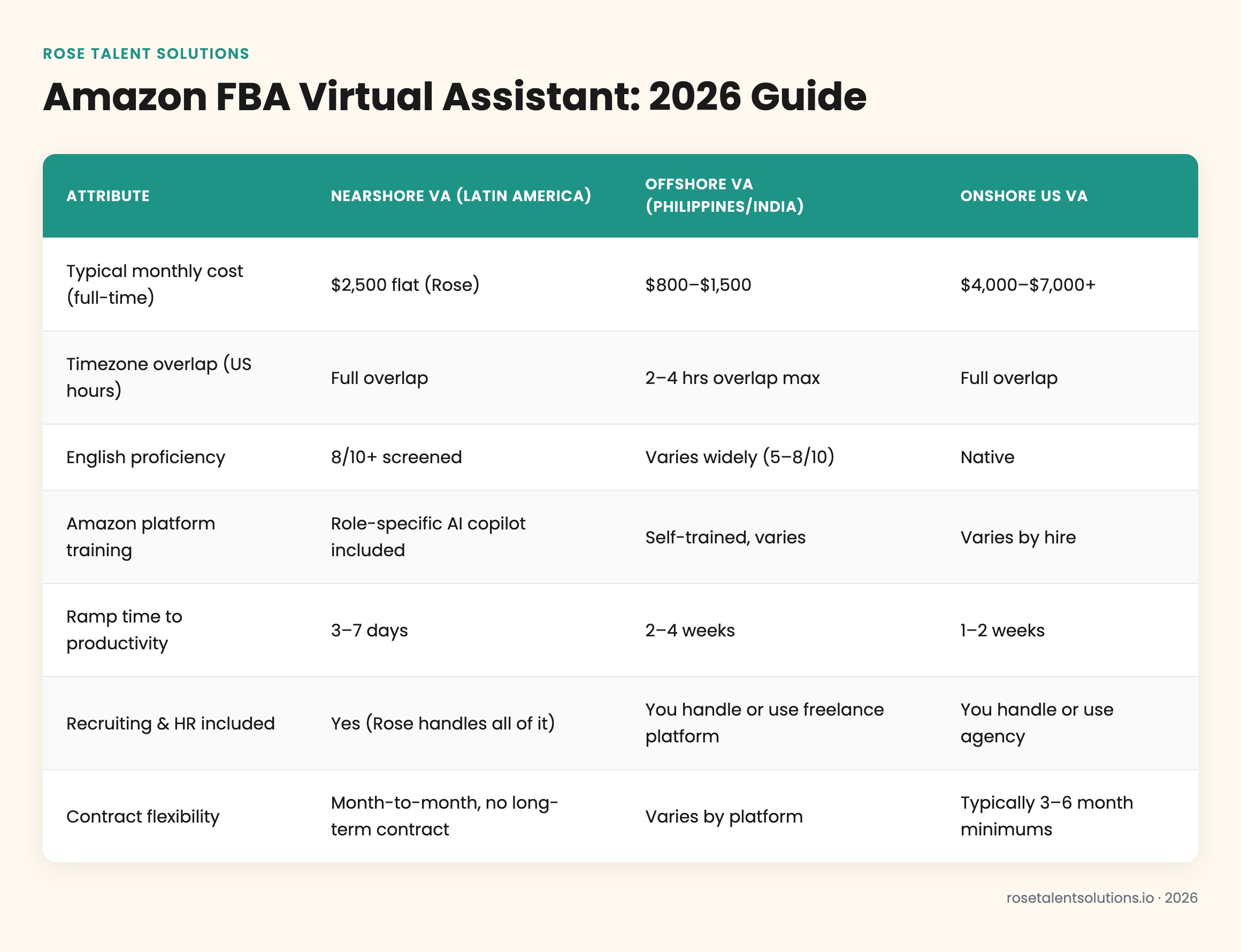
The price gap between nearshore and offshore has also narrowed considerably. According to the U.S. Bureau of Labor Statistics Occupational Outlook Handbook (2024), demand for business operations specialists — including remote coordinators — has grown 19% since 2020, pushing up rates across all geographies. At $2,500/month flat through Rose, you're not paying a premium for nearshore; you're getting a better product at a comparable price, with recruiting, vetting, payroll, HR, and ongoing management included.
"Sellers who treat their VA as a strategic hire — not just a task worker — are the ones who break through the revenue ceiling. The VA has to understand the business, not just the to-do list."
— Janelle Page, Director of Seller Success at Helium 10 (2024)
How the AI Copilot Makes an FBA VA More Effective in 2026
Every Rose team member ships with a role-specific AI copilot trained on the exact software and workflows they'll use in your account. For an Amazon FBA VA, that means the AI is pre-loaded with knowledge of Seller Central navigation, Helium 10 data interpretation, reimbursement claim formats, and Amazon's terms of service — not generic ChatGPT prompts, but a tool tuned to the FBA context.
The practical impact: your VA can cross-reference a reimbursement discrepancy, draft a policy-compliant appeal, and format it correctly in the time it would take an untrained hire to find the right Seller Central menu. According to McKinsey's report on the economic potential of generative AI (2023), AI-assisted workers complete complex tasks 40% faster on average than non-assisted counterparts — and that gap is wider in rule-heavy platforms like Amazon where policy knowledge is a constant bottleneck.
An AI copilot doesn't replace your FBA VA — it removes the ramp-up tax. Instead of spending weeks learning Seller Central edge cases, your VA starts executing at full capacity within days because the AI has already internalized the platform's logic.
This matters especially for sellers who've struggled with VA turnover. The copilot creates institutional consistency — if you ever need a replacement, Rose provides one at no additional cost, and the new team member inherits the same AI foundation. No starting from zero. If you're running a multi-channel ecommerce operation beyond Amazon, the same AI-assisted approach applies to how Rose staffs Shopify customer service VAs — the copilot model scales across platforms.

How to Start With a Nearshore Amazon FBA Virtual Assistant Through Rose
Most sellers spend more time deliberating about hiring a VA than the onboarding itself actually takes. Rose's placement process is designed to move fast — typically seven days from first call to your VA's first day. Here's exactly how it works:
Discovery Call
You spend 30 minutes with a Rose placement specialist outlining your FBA operation, current bottlenecks, software stack, and the tasks you want to hand off. No application, no paperwork — just a conversation.
Candidate Matching
Rose's recruiting team surfaces 2-3 pre-vetted candidates with verified Amazon Seller Central experience, 8/10+ English scores, and Latin American timezone alignment. You review profiles and choose — or Rose recommends the best fit based on your account type.
Onboarding & AI Copilot Setup
Your VA's role-specific AI copilot is configured for your account, your SOPs are loaded in, and your VA completes a structured first-week onboarding checklist covering your top 5 priority workflows.
Ongoing Management
Rose handles payroll, HR compliance, and performance check-ins. You manage the work; Rose manages the employment relationship. If the fit isn't right, Rose replaces your team member at no additional cost — no restarting the search, no downtime fees.
The flat rate is $2,500/month — all-in. Recruiting, vetting, payroll, HR, and ongoing management are included. There is no long-term contract, and you can cancel with 30 days written notice. The risk reversal is straightforward: if your VA isn't the right fit, Rose replaces them at no additional cost. Start the process here and you can have your first FBA VA in place within a week.
For sellers who need support beyond FBA operations — including product research to fuel the pipeline — it's worth understanding how a dedicated Amazon product research VA complements the FBA coordinator role. Most seven-figure sellers run both in parallel: one VA owning existing ASIN operations, another sourcing and validating the next product launch.
What Does an Amazon FBA Virtual Assistant Cost in 2026?
Pricing for Amazon FBA VAs in 2026 ranges widely depending on the hiring channel, geography, and experience level. Freelance platforms like Upwork and Fiverr list FBA VAs from $8–$25/hour — but that rate rarely includes recruiting overhead, replacement risk, or any quality guarantee. At 40 hours/week, a $12/hour Upwork hire costs roughly $2,000/month before you factor in the hours you'll spend screening candidates, managing payroll, and re-hiring when they churn.
According to SHRM's research on cost-per-hire (2023), the average cost to replace a single employee is 50-200% of their annual salary when you account for recruiting, onboarding, and lost productivity. For a $30,000/year VA role, that's $15,000–$60,000 in replacement cost — a risk that Rose eliminates entirely with its no-additional-cost replacement guarantee.
Remote work adoption has permanently expanded the talent pool available to US businesses. Pew Research Center's 2023 survey on American work attitudes found that 35% of workers who can do their jobs remotely now do so full-time — a structural shift that has normalized the distributed team model and made employers more comfortable managing remote specialists from Latin America just as they would a domestic hire.
At $2,500/month flat through Rose, you're getting a full-time dedicated specialist with all overhead included. That's the real comparison: not $2,500 versus $800, but $2,500 all-in versus $1,200 + your time + platform fees + turnover risk. The total cost of ownership consistently favors the managed model for sellers doing more than $500K annually who can't afford operational gaps.
Nearshore Managed VA (Rose)
- Full-time, 40 hrs/week, US hours
- Recruiting, HR, and payroll handled for you
- AI copilot included — faster ramp
- Free replacement if not a fit
- No long-term contract
- 8/10+ English proficiency, screened
Freelance Platform VA (DIY)
- You screen, hire, and manage alone
- Offshore timezone gaps slow execution
- Hourly billing — no cap on cost creep
- No replacement guarantee — re-hire risk is yours
- Quality varies widely between candidates
- English proficiency not independently verified
The math is straightforward, but the qualitative difference compounds. Sellers who work with Rose Talent Solutions consistently report that the combination of real-time availability, platform-trained copilot support, and zero HR overhead allows them to operate their FBA channel as a true business unit — not a side project they manage between sourcing trips.