
What Is an Amazon FBA VA — and Why Does It Matter in 2026?
Nearshore virtual assistants have quietly become the secret weapon of serious Amazon FBA sellers. An Amazon FBA VA is a remote professional who manages the operational layer of your Fulfilled by Amazon business — think listing optimization, inventory reorder alerts, PPC bid reviews, supplier follow-ups, and buyer-facing communication. They are not a general admin; they are trained specifically on Amazon's ecosystem.
The distinction matters because Amazon's marketplace is faster and more competitive than it has ever been. According to Statista (2024), third-party sellers now account for 61% of all units sold on Amazon — meaning you are competing against hundreds of thousands of other sellers, many of whom are already leveraging dedicated virtual staff. Trying to run catalog management, FBA shipment reconciliation, and customer service yourself while also growing the business is a recipe for burnout, not scale.
A well-placed Amazon FBA VA handles the tasks that are repeatable, time-consuming, and trainable — freeing you to focus on sourcing decisions, brand strategy, and capital allocation. That division of labor is what separates seven-figure sellers from people who plateau at five.
How an Amazon FBA VA Spends Their Day: Core Tasks in 2026
Before you hire, you need a clear picture of what an Amazon FBA VA actually does. The role is broader than most sellers expect. Below are the primary task buckets that fill a full-time 40-hour week for a capable FBA VA.
- Listing management: Creating and optimizing product titles, bullet points, backend keywords, and A+ Content. This is the highest-leverage activity because better listings compound over time.
- Inventory and FBA shipment coordination: Monitoring stock levels, creating replenishment plans, building shipment workflows in Seller Central, and reconciling lost or damaged inventory claims.
- PPC campaign monitoring: Pulling search term reports, flagging underperforming keywords, adjusting bids within agreed parameters, and escalating anomalies to you.
- Supplier and freight communication: Following up on purchase orders, tracking lead times, coordinating with freight forwarders, and maintaining a supplier contact log.
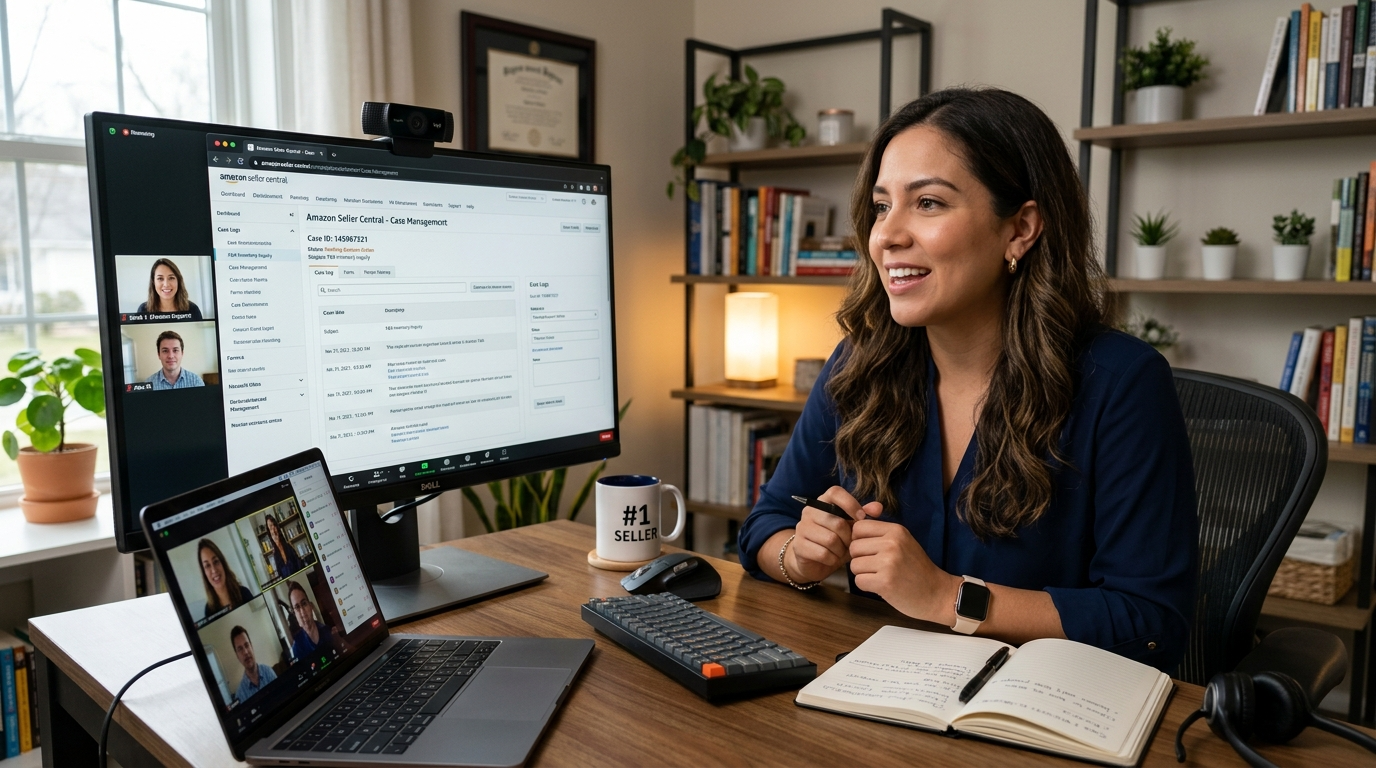
- Customer service and case management: Responding to buyer messages within the 24-hour SLA, managing returns, and opening Seller Central support cases. (If you want a deeper look at this lane specifically, read our guide on hiring an Amazon customer service virtual assistant.)
- Reporting: Pulling weekly sales, traffic, and conversion data and formatting it into a simple dashboard you can review in 10 minutes.
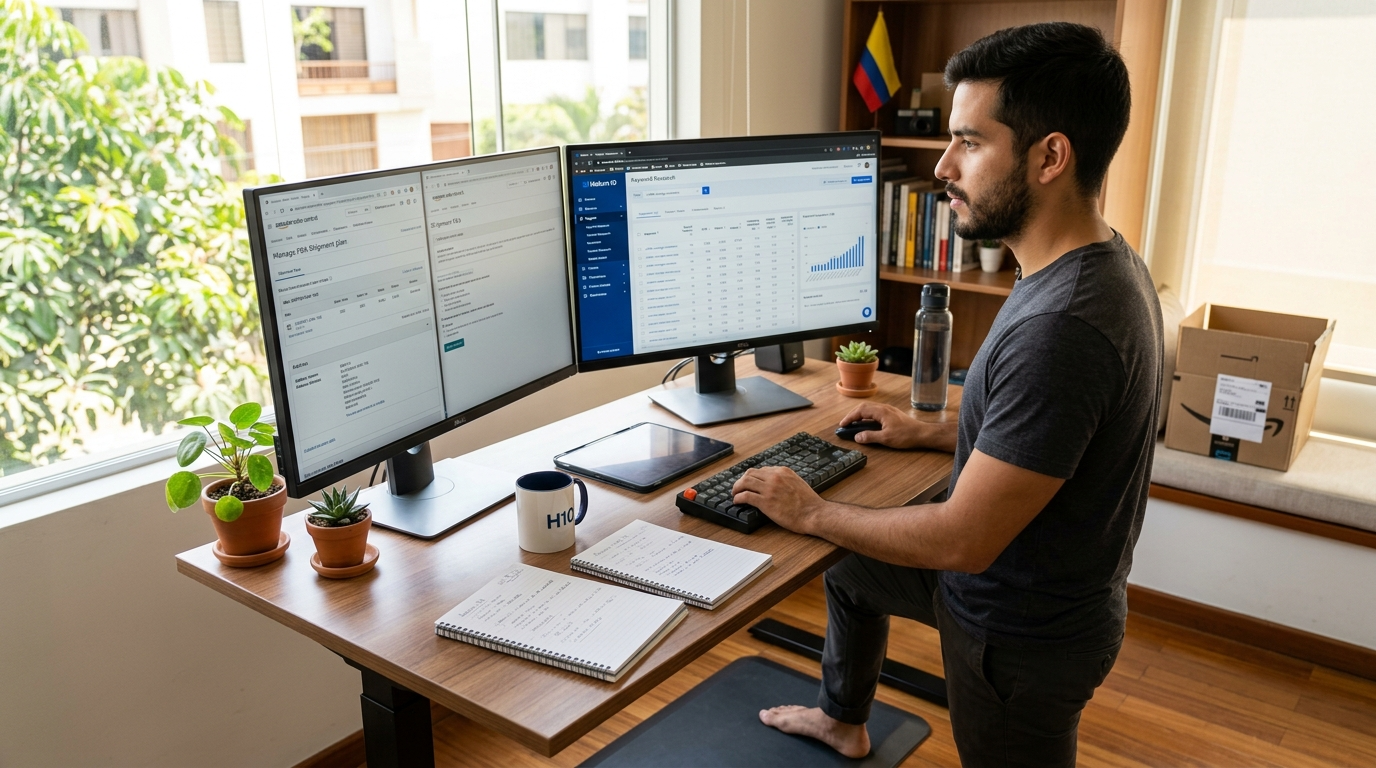
The key insight is that most of these tasks are tool-specific — they happen inside Seller Central, Helium 10, Jungle Scout, or your freight portal. That is why software familiarity is the first screen any good hiring process should apply.
How Nearshore FBA VAs Compare to Offshore and Onshore Hires in 2026
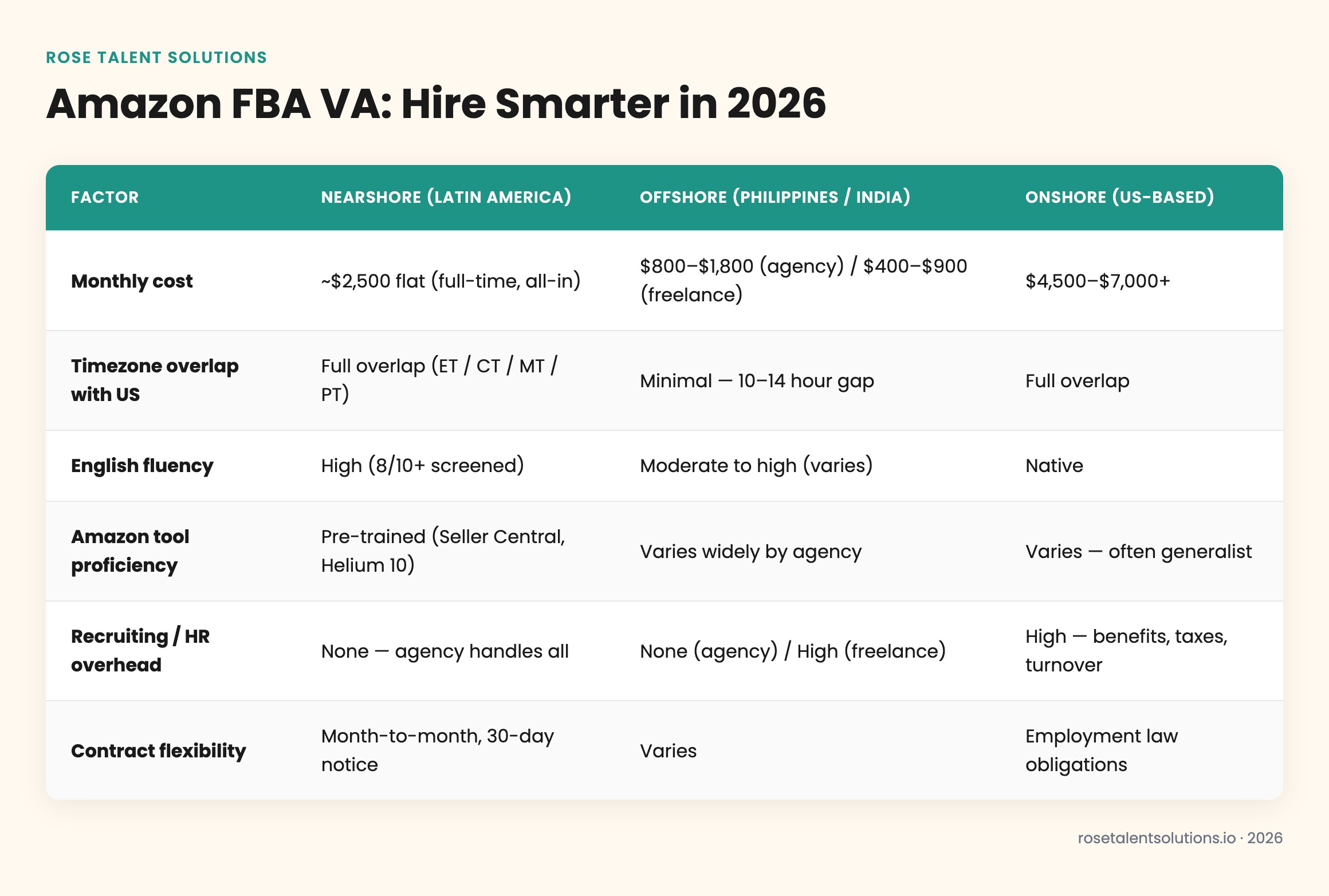
Not all virtual assistants are equal — and the geography of your hire shapes almost every practical dimension of the relationship. Offshore VAs based in the Philippines or India often cost less per hour on paper, but the timezone gap creates real operational drag. If your VA's workday ends when yours begins, every question becomes a 24-hour loop. For time-sensitive tasks like buyer message responses (Amazon's SLA is 24 hours) or PPC anomaly flags, that lag is expensive.
Nearshore VAs — based in Latin America and working US business hours — eliminate that lag entirely. They are online when you are online, which means synchronous Slack communication, same-day task turnarounds, and the ability to escalate urgent issues in real time. Rose's team members all meet an 8/10+ English proficiency bar, which matters both for external-facing buyer messages and for your own internal communication clarity.
"The biggest mistake Amazon sellers make when hiring a VA is optimizing for hourly rate instead of effective throughput. A VA 12 time zones away who batches responses overnight might cost $8/hour — but the compounding delay on listings, cases, and buyer messages costs far more in lost rank and return rate." — Will Tjernlund, Co-founder at Goat Consulting (2023)
| Factor | Nearshore (Latin America) | Offshore (Philippines / India) | Onshore (US-based) |
|---|---|---|---|
| Monthly cost | ~$2,500 flat (full-time, all-in) | $800–$1,800 (agency) / $400–$900 (freelance) | $4,500–$7,000+ |
| Timezone overlap with US | Full overlap (ET / CT / MT / PT) | Minimal — 10–14 hour gap | Full overlap |
| English fluency | High (8/10+ screened) | Moderate to high (varies) | Native |
| Amazon tool proficiency | Pre-trained (Seller Central, Helium 10) | Varies widely by agency | Varies — often generalist |
| Recruiting / HR overhead | None — agency handles all | None (agency) / High (freelance) | High — benefits, taxes, turnover |
| Contract flexibility | Month-to-month, 30-day notice | Varies | Employment law obligations |
How to Vet an Amazon FBA VA Before You Hire
The hiring mistake most sellers make is testing general intelligence rather than specific Amazon competency. A candidate might ace a grammar test and still have no idea how to file a reimbursement claim for lost FBA inventory or structure a PPC campaign for a new ASIN launch. Your vetting process needs to go tool-deep.
The single best predictor of FBA VA performance is a live task test inside Seller Central — not a resume, not a reference, and not a Zoom call. Ask candidates to walk you through how they would build a shipment plan or pull a search term report. The ones who know will show you immediately.
According to SHRM's workforce research (2023), organizations that use structured, skills-based hiring assessments reduce mis-hire rates by up to 50% compared to unstructured interviews. For a role as tool-specific as an Amazon FBA VA, that principle is even more pronounced. A structured practical test weeds out candidates who have memorized job description language without ever opening Seller Central professionally.
Beyond technical skills, look for these non-negotiables: proactive communication style (do they flag problems before you ask?), familiarity with your specific category and its compliance requirements, and the ability to follow SOPs without needing daily hand-holding. The best FBA VAs operate like a junior operator, not a task-executor waiting for instructions.
If you sell across multiple channels, note that the skills transfer — a strong FBA VA can often extend into Shopify operations with modest additional training. We cover this overlap in our post on Shopify customer service virtual assistants for sellers managing multi-channel storefronts.
What Does an Amazon FBA VA Cost in 2026 — and What Should You Expect?
Pricing for Amazon FBA VAs varies enormously depending on how you source them. Freelance platforms like Upwork show hourly rates ranging from $5 to $35+ per hour for Amazon-specific work, according to Upwork's Freelance Forward research (2023). At the low end, you typically get low experience and high management overhead. At the high end, you are approaching the cost of an agency anyway — without the vetting, replacement guarantee, or HR support.
Full-service nearshore staffing agencies like Rose Talent Solutions charge a flat $2,500 per month for a full-time (40 hours/week) dedicated team member. That rate includes recruiting, vetting, payroll processing, HR compliance, and ongoing performance management. There is no long-term contract — you pay month-to-month and can cancel with 30 days written notice. If the placement isn't a fit, Rose replaces them at no additional cost.
The math is straightforward: a full-time US-based Amazon VA or coordinator would run $55,000–$75,000 per year in salary alone, before benefits, payroll taxes, and recruiting costs. A nearshore VA through Rose runs $30,000 per year all-in. The Bureau of Labor Statistics (2024) puts the median annual wage for administrative support roles in the US at over $44,000 — and Amazon-specific roles command a premium above that. Nearshore staffing closes the cost gap without the timezone and fluency tradeoffs of deep offshore options.
One dimension that is easy to overlook: the AI advantage. Every Rose team member ships with a role-specific AI copilot trained on their core software — in the FBA context, that means Seller Central workflows, Helium 10 data interpretation, and PPC reporting. Explore how this works on the Rose AI advantage page. Sellers who have worked with AI-augmented VAs consistently report faster ramp times and fewer escalations in the first 30 days.
For sellers who need more than operational support — including product research and competitive analysis — the investment in a dedicated researcher pays back quickly. Our detailed breakdown of what a Amazon product research virtual assistant does covers that lane specifically.
How to Onboard an Amazon FBA VA for Maximum Output in 2026
The first 30 days determine whether a VA becomes a multiplier or a management burden. Most onboarding failures are not the VA's fault — they are the result of sellers handing over a login and expecting results with no structure. A deliberate onboarding sequence changes that outcome entirely.
Document your SOPs before day one
Record a Loom walkthrough of every recurring task — how you process a shipment, how you respond to a buyer message, how you handle a stranded ASIN. Your VA cannot replicate a process they have never seen. Even rough recordings are infinitely better than verbal instructions.
Grant tool access with the right permission levels
Add your VA as a user in Seller Central with the appropriate role (Admin or restricted, depending on what tasks they own). Do the same for Helium 10, your freight portal, and any communication tools like Slack or Asana. Blocked access on day one kills momentum.
Run a shadow week
Have your VA observe and mirror your existing workflow for the first five days before taking ownership. This surfaces gaps in your SOPs and gives the VA context they cannot get from a document alone.
Set a daily async check-in ritual
A brief end-of-day Slack message — three bullets: what they completed, what is blocked, what is on deck tomorrow — creates accountability without micromanagement. Most sellers report this alone reduces their oversight time by 70%.
Review and expand scope at day 30
Schedule a formal 30-day review. What tasks are fully owned? What needs more training? What capacity exists to add new workflows? Sellers who do this review consistently get better ROI within 60 days than those who set-and-forget.
Nearshore vs Offshore Amazon FBA VAs: The Real Trade-offs
The debate between nearshore and offshore hiring comes down to three practical variables: timezone overlap, communication quality, and operational risk. According to McKinsey & Company (2023), remote teams that share at least 4 hours of overlapping work time are measurably more productive and report fewer miscommunication-related errors than asynchronous-only teams. For an FBA business where a PPC anomaly or a stranded ASIN can cost you ranking overnight, that overlap is not a nice-to-have.
Nearshore VA — Pros
- Full US business-hours overlap — real-time Slack, calls, and escalations
- High English fluency (Rose screens to 8/10+ minimum)
- Culturally aligned with US business norms and buyer expectations
- AI-augmented — role-specific copilot included with Rose placements
- Month-to-month terms — no long-term contract lock-in
Offshore VA — Cons
- 10–14 hour timezone gap turns every question into a 24-hour loop
- English fluency varies significantly — buyer-facing messages are a risk
- Harder to verify tool proficiency without a live test
- Freelance platforms offer no replacement guarantee if the hire fails
- Hidden management overhead often negates the hourly rate savings
For sellers managing Seller Central at scale — multiple ASINs, FBA and FBM hybrid, or multiple storefronts — the real cost of an offshore mis-hire is not the agency fee. It is the compounding damage to rankings, review velocity, and account health during the time it takes to identify the problem and restart. To explore how this applies to the Seller Central platform specifically, our guide on Amazon Seller Central virtual assistants covers the platform-specific workflows in detail.
If you are ready to place a dedicated Amazon FBA VA, the fastest path is to get started with Rose Talent Solutions — the intake form takes under 10 minutes and typically produces a matched candidate within one week.