
Nearshore staffing has quietly become the highest-ROI hiring move for US, Canadian, and UK businesses that need real full-time support without a six-figure salary line. But when you start researching agency VA cost, the pricing landscape looks like a maze — hourly rates, monthly retainers, per-placement fees, seat fees, management markups — and most comparison articles bury the number you actually need. This guide cuts straight to it. By the end, you'll know exactly what different agency models charge, what's included (and what's not), and how to calculate the true cost of a virtual assistant hired through an agency in 2026.
According to Statista (2024), the global outsourcing market is on track to surpass $1.3 trillion — and a growing share of that growth is driven by small-to-mid businesses hiring remote staff through managed agencies rather than posting jobs on freelance platforms. The reason is simple: freelance platforms hand you a person; agencies hand you a system.
How Agency VA Pricing Models Work in 2026
Not all agencies charge the same way, and the model matters as much as the number. There are four dominant pricing structures you'll encounter when shopping agency VA cost in 2026.
Hourly billing is the oldest model. The agency charges a marked-up hourly rate — typically 1.5–2.5× what the VA actually earns — and invoices you based on tracked hours. At face value, it looks cheap. In practice, you're paying for every status update, every training call, every ramp-up hour. Hourly rates for offshore agency VAs typically run $12–$22/hr depending on the region and skill level.
Retainer or seat-fee models charge a flat monthly amount for a fixed number of hours — say, $1,200/month for 20 hours/week. These are common with boutique agencies that place part-time assistants. The math often works out to $15–$25/hr effective rate, with caps on what's included in the management fee.
Per-placement or recruiting-fee models charge you a one-time fee (often 10–20% of the VA's annual salary) to find and vet a candidate, then step back. After that, you handle payroll, HR, and management yourself. The upfront cost looks low; the ongoing administrative burden is real.
All-in flat-rate models — like the one Rose Talent Solutions uses — bundle recruiting, vetting, payroll, HR, and ongoing management into a single monthly rate. You pay one number, you get one full-time team member, and the agency handles everything behind the scenes. For businesses that want leverage without operations overhead, this is the structure that actually delivers it. You can explore a full breakdown of nearshore VA cost benchmarks to see how the numbers compare across model types.

What Does a 2026 Agency VA Cost Comparison Actually Look Like?
Numbers without context mislead. The table below maps four common agency VA models against the variables that actually determine your total annual spend: base cost, what's included, timezone alignment, and English proficiency screening.
| Model | Typical Monthly Cost | What's Included | Timezone Fit (US) | English Screening |
|---|---|---|---|---|
| Offshore Freelance (Philippines/India) | $400–$900 | Labor only. You manage everything. | Poor (8–12 hr gap) | Varies; no standard bar |
| Offshore Agency (managed) | $1,000–$1,800 | Labor + light HR. Payroll included. | Poor to moderate | Basic screening |
| Onshore US Agency | $3,500–$6,000+ | Full service, compliance included. | Perfect | Native |
| Nearshore Flat-Rate (Rose) | $2,500 flat | Recruiting, vetting, payroll, HR, management, AI copilot, free replacement. | US business hours | 8/10+ mandatory |
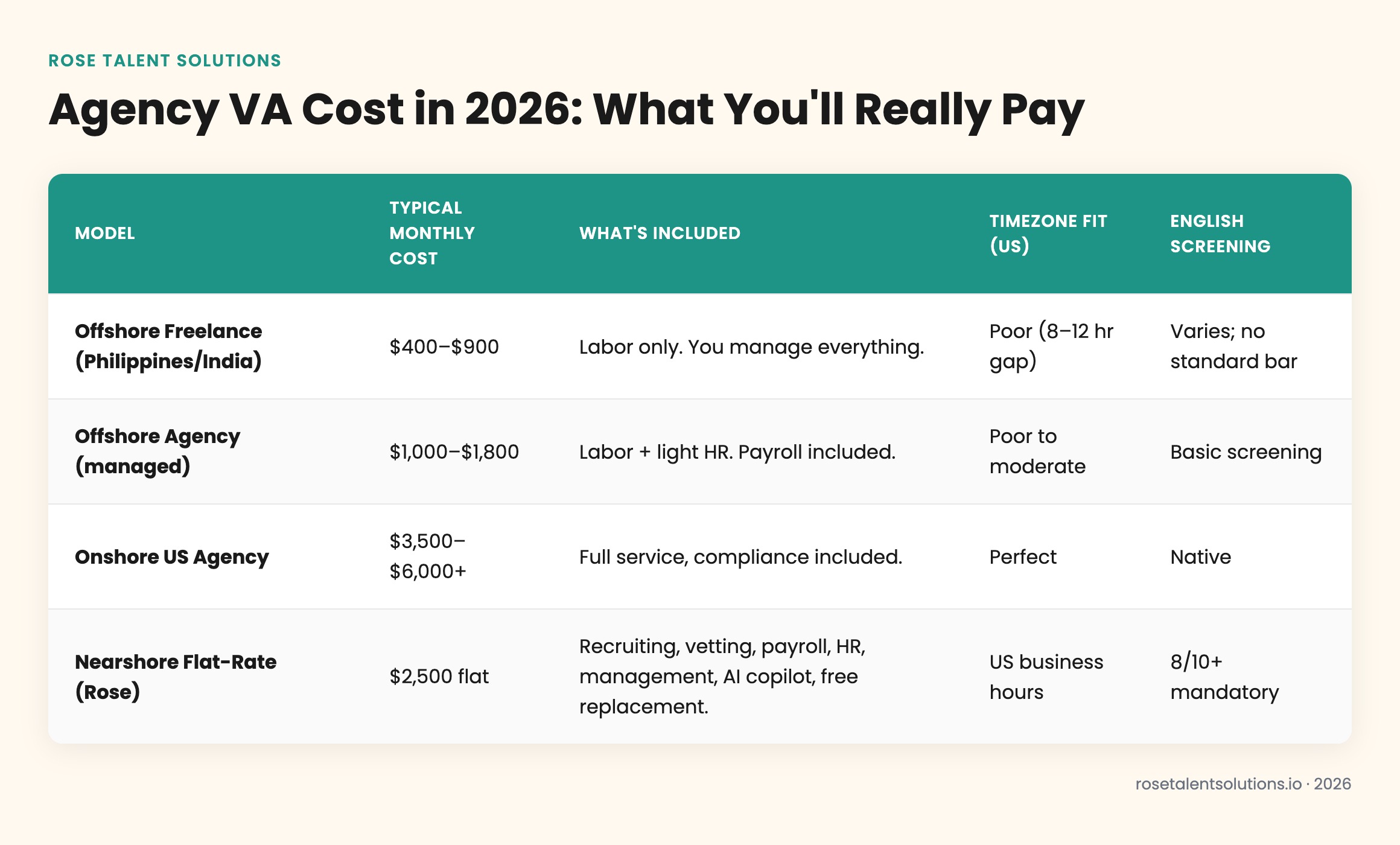
The offshore freelance number looks attractive until you add the hours you spend managing the relationship, the delays caused by timezone misalignment, and the cost of re-hiring when the placement doesn't work out. For a deeper look at how these categories stack up across every dimension, the nearshore vs. offshore vs. onshore comparison guide runs through the full analysis.
"The total cost of a hire is never just the wage — it's the wage plus the management tax. When you remove the management tax with a flat-rate model, the math almost always favors nearshore." — Matt Malouf, Business Growth Advisor and Author, The Stop Doing List (2023)
How Hidden Costs Inflate Your Real Agency VA Cost in 2026
The advertised rate is never the whole story. When you evaluate agency VA cost, you need to account for four categories of hidden spend that rarely appear on the pricing page.
Replacement and re-recruitment costs. When an hourly or per-placement VA doesn't work out, most agencies charge a new placement fee — often $500–$2,000 — or restart you at a new hourly rate while a replacement is sourced. According to SHRM (2022), the average cost per hire across industries is $4,683. Even at a discount for VA roles, one failed placement and re-hire cycle can erase months of savings. Rose's model covers this with a free replacement if the team member isn't a fit — no extra charge, no restart fee.
Ramp and training time. A VA who isn't pre-screened for your software stack — AppFolio, Buildium, QuickBooks, whatever your business runs on — can spend 4–8 weeks learning tools before they hit full productivity. That's labor cost with minimal return. Rose's AI copilot advantage addresses this directly: every team member ships with a role-specific AI trained on the software they'll use on day one, compressing ramp time significantly.
Timezone friction. An 8–12 hour gap between your team and an offshore VA isn't just inconvenient — it's expensive. Every question that can't be answered in real time becomes a 24-hour delay. If your business handles property management inquiries, client escalations, or bookkeeping exceptions, that delay compounds fast. Latin American nearshore VAs work your actual business hours, eliminating this friction entirely.
The hidden cost of offshore agency VAs isn't the hourly rate — it's the cumulative loss from timezone delays, unstructured ramp time, and replacement cycles that most pricing calculators never include. A higher flat monthly rate that eliminates all three will almost always cost less over a 12-month period than a low hourly rate that doesn't.
Payroll and compliance overhead. Per-placement models leave you responsible for contractor compliance, 1099 issuance, and in some cases misclassification risk. According to the IRS (2024), misclassifying a worker as an independent contractor when they function as an employee can trigger back taxes, penalties, and interest — a risk that all-in agency models eliminate by design.

How the Nearshore Model Delivers More Value Per Dollar
Latin American nearshore talent represents a structural pricing advantage that has nothing to do with cutting corners. Cost of living differences between Latin America and the US allow agencies to hire highly educated, English-fluent professionals at rates that would be impossible domestically — while still paying those team members well above local market wages. That spread is where your savings come from, without the quality or timezone compromises that come with far-offshore models.
According to the US Bureau of Labor Statistics (2024), the median annual wage for administrative support workers in the United States is $46,760 — roughly $3,897/month before benefits, payroll taxes, and equipment costs push total employment cost to $55,000–$65,000/year. A fully managed nearshore VA at $2,500/month is $30,000/year all-in. For businesses where an executive assistant or operations coordinator is a force-multiplier role rather than a revenue-generating one, that delta is real operating leverage.
The full breakdown of Latin America virtual assistant cost explains why the region has become the dominant nearshore talent pool for North American businesses — driven by a combination of education levels, English proficiency, and cultural alignment with US work norms.
Rose places team members across a range of functions. The two highest-demand categories are property management virtual assistants — handling maintenance coordination, leasing inquiries, and tenant communication — and bookkeeping and accounting support, where VAs work inside QuickBooks, Xero, and similar platforms on reconciliations, AP/AR, and reporting.
Nearshore Flat-Rate Agency: Pros
- Single predictable monthly cost — no hourly surprises
- Recruiting, payroll, HR, and management included
- US-hours timezone alignment; real-time collaboration
- English fluency screened to a published standard (8/10+)
- Free replacement if the team member isn't a fit
- Role-specific AI copilot included — faster ramp time
- No long-term contract — month-to-month with 30 days written notice
DIY Offshore Freelance: Cons
- You own recruiting, vetting, onboarding, and HR
- 8–12 hour timezone gap creates daily communication delays
- No standard English proficiency bar
- Replacement = full re-hire cost and lost time
- Payroll and compliance risk sits with your business
- No structured ramp process or software training
- Apparent low rate inflates when management hours are counted
How to Get Started: Rose's 2026 Onboarding Process
Understanding agency VA cost is one thing — knowing what happens after you say yes is another. Here's how the Rose onboarding sequence works from first conversation to productive team member.
Intake and Role Scoping
Rose's team conducts a 30-minute intake call to define the role, the software stack, the working hours, and the communication style your business needs. This shapes the candidate search criteria.
Candidate Matching and Vetting
Rose screens candidates against the role spec — including English proficiency (8/10+ floor), software familiarity, and availability for your time zone. You review a shortlist, not a stack of resumes.
Interview and Selection
You interview your top match and confirm the hire. Rose handles the offer, contracting, and payroll setup on the backend — no administrative lift on your side.
AI Copilot Activation
Your team member's role-specific AI copilot is configured for your software stack before day one, so they arrive trained and ready rather than learning from scratch.
Ongoing Management
Rose stays in the relationship — monitoring performance, handling HR issues, and providing a free replacement if the team member ever isn't the right fit for your business.
If you're ready to price out a specific role, the get started page walks through the intake process in under five minutes. Month-to-month terms mean there's no long-term contract commitment to evaluate — just the first 30 days to see what a dedicated nearshore team member actually changes in your operation.
For businesses evaluating which Latin American staffing agency to work with, the factors that matter most are transparency on what's included, the English proficiency standard enforced at intake, and whether the agency stays involved after placement. A one-time recruiter who disappears is not the same value proposition as a managed agency — a distinction the guide to choosing a Latin America staffing agency covers in depth.
According to Gallup's State of the Global Workplace report (2023), only 23% of employees worldwide are engaged at work — a figure that drops even lower in pure freelance, unmanaged arrangements. Managed agency models, by contrast, embed accountability structures (ongoing check-ins, performance visibility, HR support) that keep team members engaged and productive over time. That's not a soft benefit — it's a retention and output factor that directly affects your agency VA cost per unit of work delivered.