
What Is a Property Management VA — and Why Does It Matter in 2026?
A property management VA (virtual assistant) is a remote team member who handles the operational backbone of a rental portfolio: tenant communications, maintenance coordination, lease administration, rent collection follow-ups, vendor scheduling, and software management inside platforms like AppFolio, Buildium, and Yardi. A skilled PM VA frees you — the operator — to focus on acquisitions, owner relationships, and growth.
What's changed in 2026 is where the best VAs are coming from. The market has matured past generic offshore outsourcing toward nearshore staffing — meaning team members based in Latin America who work your exact business hours, speak English fluently, and use the same property management tools your in-house team already runs. That shift is directly reshaping property management VA cost conversations across the industry.
According to the Buildium 2024 State of the Property Management Industry Report (2024), 82% of property management companies that grew revenue year-over-year cited operational staffing as a primary lever — not new software, not new doors. People first.
So before you price out a VA, you need to understand what you're actually buying — and which staffing model delivers the best return for a property management operation specifically.
How Much Does a Property Management VA Cost Per Month in 2026?
Property management VA cost varies widely depending on the sourcing model. Here's the honest breakdown operators need to see before they sign anything.
Freelance platforms (Upwork, Fiverr, OnlineJobs.ph): Expect $8–$18/hour for offshore VAs, typically based in the Philippines or South Asia. At 40 hours/week, that's roughly $1,280–$2,880/month before platform fees — but you carry all the recruiting, vetting, onboarding, and replacement risk yourself. Time zone misalignment regularly adds 4–8 hours of lag per issue cycle.
US-based virtual assistants: Rates run $25–$45/hour, putting full-time support at $4,000–$7,200/month. That's before payroll taxes, benefits overhead, and the cost of training someone on AppFolio from scratch. According to the U.S. Bureau of Labor Statistics (2024), the mean hourly wage for property, real estate, and community association managers in the United States is $35.87 — and that's just wages, not total employment cost.
Nearshore staffing agencies (Latin America): Rose Talent Solutions charges a flat $2,500/month — all-in. That includes recruiting, vetting, payroll, HR, and ongoing management. Full-time, 40 hours/week, on your schedule, in your time zone.

How Does Property Management VA Cost Compare Across Staffing Models?
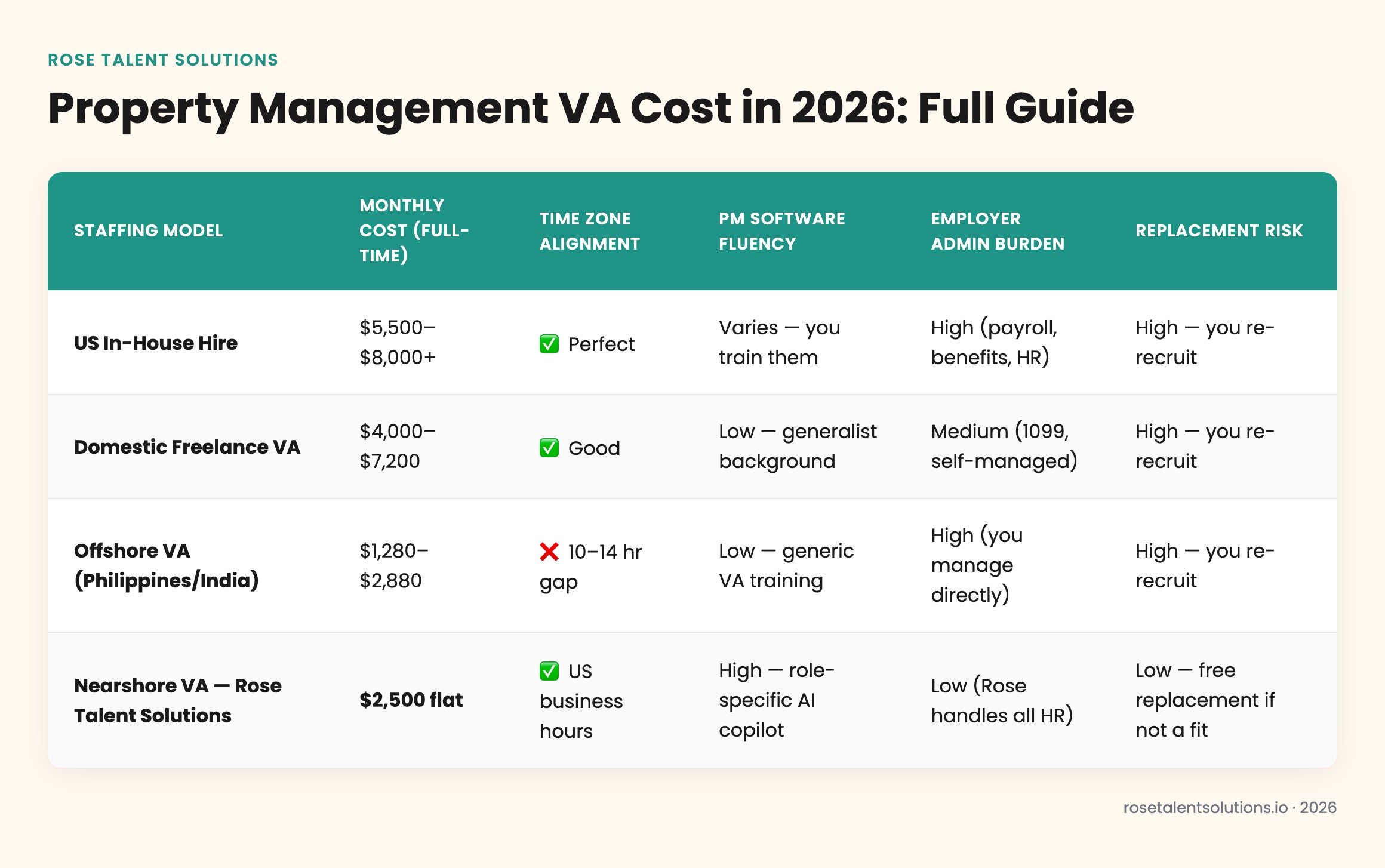
Numbers only tell half the story. The real cost of a property management VA includes time-zone friction, software ramp time, turnover risk, and the admin burden you carry when something goes wrong. The table below breaks down all four staffing models across the dimensions that actually matter to a PM operator.
| Staffing Model | Monthly Cost (Full-Time) | Time Zone Alignment | PM Software Fluency | Employer Admin Burden | Replacement Risk |
|---|---|---|---|---|---|
| US In-House Hire | $5,500–$8,000+ | ✅ Perfect | Varies — you train them | High (payroll, benefits, HR) | High — you re-recruit |
| Domestic Freelance VA | $4,000–$7,200 | ✅ Good | Low — generalist background | Medium (1099, self-managed) | High — you re-recruit |
| Offshore VA (Philippines/India) | $1,280–$2,880 | ❌ 10–14 hr gap | Low — generic VA training | High (you manage directly) | High — you re-recruit |
| Nearshore VA — Rose Talent Solutions | $2,500 flat | ✅ US business hours | High — role-specific AI copilot | Low (Rose handles all HR) | Low — free replacement if not a fit |
What Does the 80/20 Rule Mean in Property Management — and How Does a VA Apply It?
The 80/20 rule in property management means roughly 80% of your time gets consumed by 20% of your tasks — specifically the reactive, repetitive, high-volume work: maintenance requests, tenant calls, lease renewals, rent reminders, vendor coordination. These tasks don't generate new revenue. They just keep the machine running.
A trained property management VA is purpose-built to absorb that 80%. When a VA owns the reactive layer, you reclaim 25–30 hours a week to focus on owner acquisition, portfolio expansion, and the strategic work that actually moves your revenue. According to AppFolio's 2024 Property Management Industry Pulse (2024), property managers who leverage technology and support staff spend 31% more time on revenue-generating activities than those who don't.
The tasks that fit cleanly inside a VA's scope include: responding to Zillow and other listing platform inquiries, processing applications in AppFolio or Buildium, logging maintenance work orders, sending lease renewal reminders, reconciling rent rolls, and handling vendor follow-ups. None of these require physical presence. All of them drain your day if you don't delegate them.
Rose's property management VA service places team members who arrive pre-trained on these exact workflows — not generalists who need six weeks of onboarding before they're useful.
The hidden cost of offshore VAs isn't the hourly rate — it's the 6–14 hour timezone gap that turns a simple maintenance escalation into a two-day email chain. Nearshore VAs in Latin America operate in real time alongside your US-based tenants and vendors, cutting resolution time dramatically.
What's a Reasonable Management Fee — and How Does a VA Change the Math?
Traditional property management companies typically charge 8–12% of monthly rent for full-service management, plus leasing fees (50–100% of one month's rent), maintenance markup (10–20% on vendor invoices), and a constellation of smaller line items: lease renewal fees, inspection fees, vacancy fees, and — in some markets — junk fees that exist mainly to pad margin. On a $2,000/month rental, you could easily see $400–$600/month in management-related costs before maintenance markups.
One of the most common red flags in property management contracts is the maintenance markup clause. Some management companies apply a 15–20% administrative markup on every vendor invoice — meaning a $500 HVAC repair actually costs you $575–$600. Always ask for a copy of the actual vendor invoice and confirm in writing whether markups apply. The Virginia Residential Landlord and Tenant Act (VRLTA) requires property managers operating in Virginia to disclose all fees in writing before a management agreement is signed — but disclosure isn't the same as negotiation. Push back on maintenance markup clauses, vacancy fee structures, and early termination penalties exceeding 30 days.
Now contrast that with an in-house VA model: you pay a flat $2,500/month to Rose, retain full control of your vendor relationships, and eliminate the markup layer entirely. On a 50-door portfolio averaging $1,800/month per unit, switching from a 10% management company to a self-managed + VA model can realistically recover $6,000–$9,000/month in fees — while the VA handles the same operational load the management company was performing.

How Nearshore VAs Outperform Offshore for Property Management in 2026
The offshore VA model — primarily Philippines or India-based workers — carries structural disadvantages that compound badly in property management. Tenants don't schedule their emergencies for 9am Manila time. Leasing leads from Zillow go cold within hours. Maintenance vendors don't wait 12 hours for a callback. Time zone misalignment isn't an inconvenience in property management — it's a direct hit to tenant satisfaction and owner confidence.
Nearshore VAs based in Latin America work US business hours natively. They're answering your tenant's 10am maintenance call at 10am. They're responding to that Zillow leasing inquiry before the competitor down the street does. According to the National Association of Realtors (2024), speed of response is among the top three factors renters cite in choosing a rental — meaning a 12-hour delayed reply from an overnight offshore team isn't a minor issue, it's a leasing conversion killer.
Rose's team members also ship with a role-specific AI copilot trained on property management software — AppFolio, Buildium, QuickBooks, and others. This isn't a chatbot bolted onto a generic hire. It's a workflow-embedded assistant that helps your VA process work orders faster, draft lease renewals accurately, and flag anomalies in rent rolls without waiting for you to review everything manually.
Nearshore VA — Pros
- Works US business hours — real-time tenant and vendor coverage
- English fluency screened at 8/10+ before placement
- AI copilot trained on AppFolio, Buildium, QuickBooks
- Flat $2,500/month — no payroll overhead, no HR burden
- Free replacement if the team member isn't a fit
- No long-term contract — month-to-month flexibility
Offshore VA — Cons
- 10–14 hour time zone gap creates daily communication delays
- Generic VA training — you rebuild PM workflows from scratch
- Higher turnover risk with no managed replacement process
- English proficiency inconsistent across platforms
- You carry full recruiting, onboarding, and HR admin burden
How Rose Talent's Onboarding Process Works in 2026
Understanding the process removes uncertainty from the cost equation. Rose operates a structured five-step placement model designed specifically for property management operators who need a productive VA fast — not a three-month ramp.
Role Scoping Call
Rose's team maps your portfolio size, software stack, and the specific tasks you need covered — AppFolio coordination, maintenance dispatching, tenant communications, or bookkeeping support.
Candidate Matching
Rose sources from its pre-vetted Latin America network, screening for PM software experience, English proficiency (8/10+ floor), and time zone availability aligned to your market.
Interview & Selection
You interview the shortlisted candidate(s) directly and make the final call — Rose handles the logistics, you keep full control of who joins your team.
AI Copilot Activation
Your VA's role-specific AI copilot is configured before day one — trained on your software environment so they arrive ready to work, not waiting to be taught.
Ongoing Management
Rose handles payroll, HR compliance, and performance monitoring on an ongoing basis. If the placement isn't a fit, Rose replaces the team member at no additional cost.
For operators who also need financial oversight on their portfolios, Rose's bookkeeping and accounting VA service places team members trained in QuickBooks and property management-specific reconciliation workflows — a natural complement to an operations-focused PM VA.
Questions to Ask Before Hiring Any Property Management VA in 2026
Whether you're evaluating Rose or any other VA source, these are the six questions that separate good placements from expensive mistakes:
- What property management software have they used hands-on? Generic "computer skills" doesn't mean AppFolio proficiency. Ask for specific platforms and task examples.
- What time zone do they actually work in? "Available US hours" on a profile and actually being live at 9am EST are different things. Confirm the operating schedule in writing.
- Who handles payroll, HR, and compliance? If the answer is "you do," price that admin burden into your true cost calculation.
- What happens if the VA doesn't work out? A freelance platform gives you a refund window. A managed agency like Rose provides a free replacement — at no additional cost — if the team member isn't a fit.
- Is there a long-term contract? Rose operates month-to-month with 30 days written notice to cancel. No long-term contract means no risk lock-in.
- What does onboarding look like? A VA who needs 60 days to become productive costs you two months of near-zero output. Ask for a specific onboarding timeline and what accelerates it.
According to SHRM's Talent Benchmarking Research (2024), the average cost to replace a failed hire is 50–200% of that role's annual salary. For a $2,500/month VA, a single bad placement with no replacement guarantee costs you $1,500–$6,000 in lost productivity and re-recruitment time before you've recovered. That replacement guarantee matters more than most operators realize until it's too late.