
What Is a Nearshore Virtual Assistant for Property Management?
A nearshore virtual assistant is a full-time remote team member based in Latin America — countries like Colombia, Mexico, or Costa Rica — who works inside your US business hours, speaks fluent English, and operates directly inside your property management software. The word "nearshore" is the key distinction: nearshore talent sits in the same or adjacent time zones as your tenants, owners, and vendors, so nothing batches overnight and every issue gets a real-time response.
For property managers specifically, a nearshore VA handles the operational layer of your business — answering tenant calls, processing work orders in AppFolio or Buildium, drafting lease renewals, chasing delinquencies, and updating owner portals — while you focus on portfolio growth. According to Buildium's State of the Property Management Industry Report (2024), 68% of property management companies say administrative tasks consume more than half their working hours, leaving almost no bandwidth for business development.
A nearshore VA solves exactly that problem. They are not a task-rabbit you ping once a week — they are a dedicated, fully managed team member working 40 hours a week inside your systems. Rose Talent Solutions pre-vets every candidate to an 8/10 or higher English proficiency score before you ever see a résumé, and every placement is sourced exclusively from Latin America.
What Does the 80/20 Rule Mean in Property Management — and How Does a VA Fix It?
The 80/20 rule in property management states that roughly 80% of your time gets consumed by 20% of your tasks — and those tasks are almost always reactive: tenant maintenance requests, late-rent calls, lease renewal paperwork, and vendor follow-ups. These are high-volume, low-complexity activities that keep you from acquiring new properties or improving owner relationships.
A nearshore virtual assistant is purpose-built to absorb that 80%. Tenant emails answered within two hours. Work orders logged, assigned, and followed up in Buildium before end of day. Delinquency notices drafted and sent on schedule. When the reactive volume is off your plate, you get your week back. According to the National Association of Realtors (2024), property managers who delegate administrative functions spend 2.4 more hours per week on revenue-generating activity than those who do not.

How Much Does a Real Estate Virtual Assistant Cost in 2026? (Full Cost-of-Ownership Breakdown)
Pricing comparisons for virtual assistants are almost always misleading because they compare hourly rates without accounting for recruiting fees, payroll overhead, software seats, and management time. The table below gives you a true total-cost-of-ownership view for a 200-unit residential portfolio that needs one full-time administrative coordinator.
| Option | Monthly Cost | Includes Recruiting & HR? | US Hours Coverage | PM Software Trained? | Long-Term Contract? |
|---|---|---|---|---|---|
| Rose Nearshore VA (Latin America) | $2,500 flat | Yes — fully managed | Yes — Latin America time zones align with US hours | Yes — AI copilot included | No long-term contract |
| Domestic Part-Time Coordinator (20 hrs/wk) | $3,200–$4,500 | No — you hire, you manage | Yes | Requires your own training | At-will, but benefits exposure |
| Full-Service Third-Party PM Company | 6–10% of gross rent (~$4,000–$8,000 on 200 units) | N/A — they own the relationship | Varies by firm | Their software, not yours | Typically 12-month contracts |
| Low-Cost Offshore VA (non-nearshore) | $800–$1,400 | Rarely | No — 10–14 hr time zone gap | Rarely pre-trained | Varies |
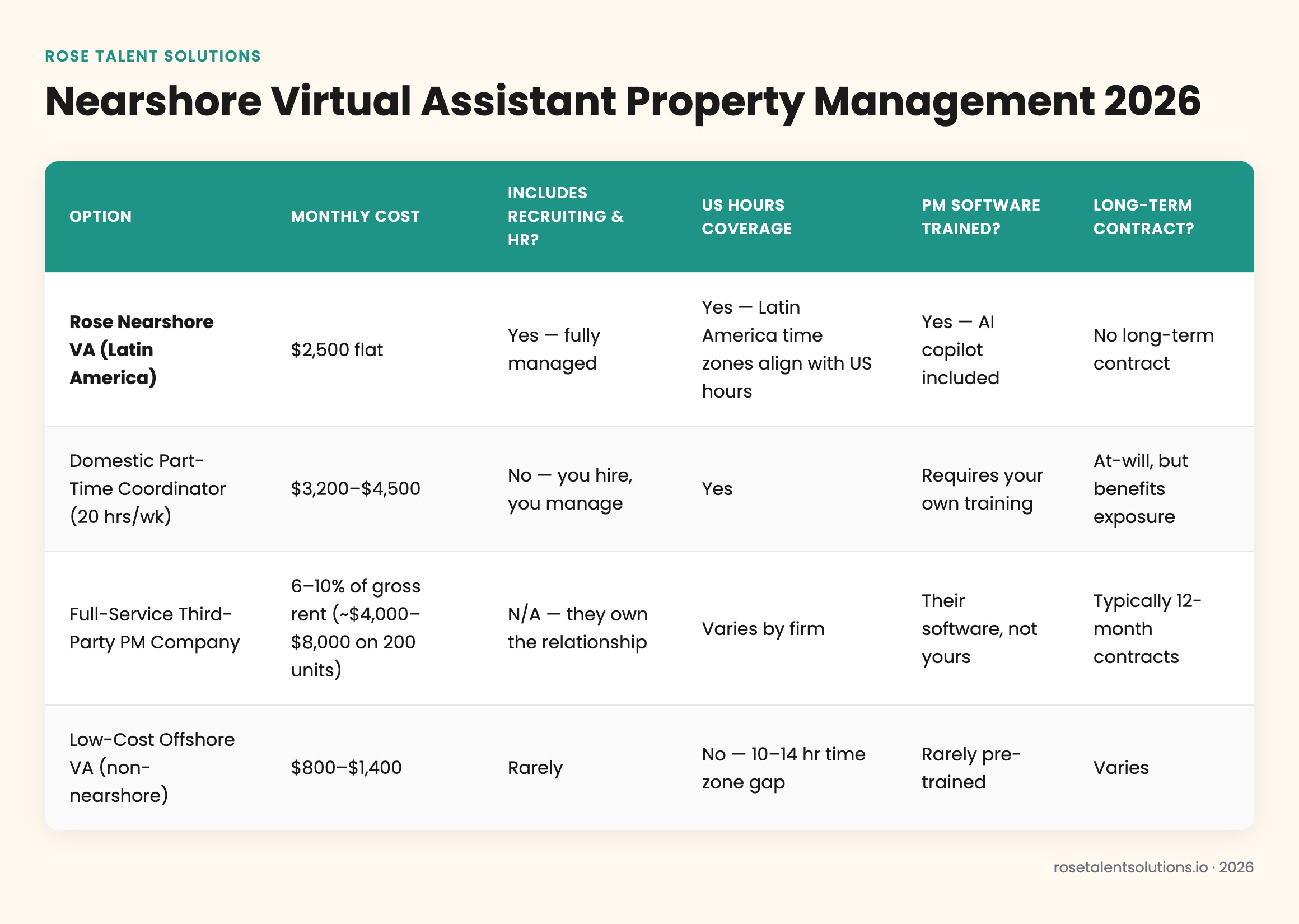
The low-cost offshore price looks attractive until you factor in the time zone gap. A tenant maintenance emergency at 2pm EST arrives when a non-nearshore VA's workday has long ended. That delay costs you owner trust, not just hours. According to SHRM's workforce research (2023), unresolved customer service gaps driven by communication delays are among the top three reasons small-business operators switch vendors or staffing models within 18 months.
What Are Red Flags When Hiring a Property Management Virtual Assistant?
Most operators who've had a bad VA experience made the same three mistakes. First, they hired based on hourly rate alone and got someone with zero property management software experience — meaning they spent 30+ hours training a person on AppFolio basics before any real work happened. Second, they used a marketplace platform that classified workers as independent contractors without verifying local labor law compliance, exposing the business to misclassification risk. Third, they had no KPIs in place, so performance problems went undetected for months.
Here are the red flags to watch for when evaluating any nearshore or remote VA provider:
- No English proficiency screening — a provider that can't tell you their English benchmark is guessing, not vetting.
- No software pre-training — if the candidate has never opened AppFolio, Buildium, or Yardi before day one, your team absorbs all the ramp cost.
- Contractor-only classification with no compliance layer — in Colombia, Mexico, and Costa Rica, misclassified remote workers carry real legal exposure for the US-based client. A managed staffing model like Rose handles employment classification on the ground, so you are not the employer of record.
- No replacement guarantee — if a provider won't replace a bad placement at no additional cost, they are not confident in their own vetting.
- Geography mislabeled as "nearshore" — genuine nearshore means Latin America, with same or adjacent time zones to the US. Always confirm your team member's country of residence before signing anything.
The hidden cost of a non-nearshore VA isn't the hourly rate — it's the 10–14 hour time zone gap that turns every urgent tenant issue into a next-morning problem and erodes owner confidence faster than a missed rent payment. Latin America-based nearshore VAs eliminate that gap entirely.
How to Onboard a Nearshore VA into AppFolio, Buildium, or Yardi in 2026
Onboarding is where most remote staffing arrangements fail — not because the VA can't do the work, but because the operator hands over login credentials and assumes competence. A structured onboarding process eliminates 90% of that friction. Every Rose placement comes with a role-specific AI copilot trained on their software stack, which accelerates ramp time significantly. But the operator's side of onboarding matters just as much.
Access & Systems Setup (Days 1–2)
Provision a named user license in your PM software, set role-based permissions, and create a shared password manager entry. Add the VA to your communication stack — email, Slack or Teams, and your phone system if they'll handle calls.
SOP Walkthrough (Days 3–5)
Walk through your top 10 recurring tasks on a recorded Loom — how you log a maintenance request, how you send a delinquency notice, how you update the owner portal. The VA watches twice, then shadows you live once. This one investment saves you 20+ back-and-forth messages in week two.
Supervised Reps (Week 2)
The VA handles real tasks with you reviewing outputs before they go out. Catch template errors, tone issues, and process gaps early. Most Rose placements need fewer than five corrections before working independently.
KPI Baseline (End of Week 2)
Set your first performance benchmarks: first-response time under two hours, work order log rate at 100% same day, lease renewal drafts submitted 60 days before expiry. These are the metrics you review monthly, not annually.
Independent Operations + Monthly Check-in (Week 3 onward)
The VA runs their task queue independently. You hold a 30-minute weekly sync and a 60-minute monthly performance review. Rose's account management layer handles HR, payroll, and any personnel issues — you manage the work, not the employment relationship.

Nearshore Virtual Assistant Property Management: KPIs That Actually Predict Performance in 2026
Vague performance management is the single biggest reason remote PM hires underperform. "She's doing a good job" is not a KPI. If you want a nearshore VA to operate independently and deliver consistent results across a 200–500 unit portfolio, you need to track specific numbers on a weekly cadence. According to Gallup's State of the Global Workplace report (2024), remote employees who receive weekly feedback on specific metrics are 3.6x more likely to be engaged than those who receive feedback only at annual reviews.
The core KPIs for a nearshore property management VA:
- Tenant first-response time — target under 2 hours for email, under 4 rings for live calls.
- Work order same-day logging rate — target 100%. Any request not logged same day is a gap in your audit trail.
- Lease renewal pipeline coverage — all leases expiring in 60 days should have a renewal draft or non-renewal notice in progress.
- Delinquency contact rate by day 5 — target 100% of late accounts contacted by the 5th of each month.
- Owner portal update frequency — monthly financial summaries posted within 5 business days of month close.
Tie these to your bookkeeping and reporting workflows so the data is visible in your PM software dashboard, not buried in a spreadsheet. When KPIs are visible, performance conversations take five minutes instead of fifty.
Nearshore Virtual Assistant Property Management Salary vs. Flat-Rate Staffing: What You're Actually Paying For in 2026
Searches for "nearshore virtual assistant property management salary" usually come from operators trying to figure out whether to hire direct or go through a staffing partner. Here is the honest breakdown. A direct hire of a bilingual English-Spanish property management coordinator in Colombia or Mexico costs between $1,200 and $1,800/month in local compensation — but that number excludes your recruiting time (typically 40–80 hours), payroll compliance setup in-country, benefits administration, equipment, and the productivity gap during the 4–6 week ramp period.
Rose's $2,500/month flat rate covers all of those line items: recruiting, vetting, payroll, HR management, and ongoing account support. According to the US Bureau of Labor Statistics (2024), the median annual wage for a US-based property and community association manager is $60,670 — or roughly $5,050/month. A fully managed nearshore VA at $2,500/month delivers the same administrative output at less than half that cost, while you retain direct control of your systems and tenant relationships.
Nearshore Managed Staffing (Rose Model)
- All-in flat rate — no surprise invoices
- Pre-vetted, PM software-trained on day one
- HR, payroll, and compliance handled for you
- Free replacement if the placement isn't a fit
- No long-term contract — cancel with 30 days written notice
Direct Hire in Latin America (DIY)
- Lower base salary, but 40–80 hours of your time to recruit
- In-country payroll compliance is your liability
- You absorb all software training and ramp costs
- No replacement safety net if the hire doesn't work out
- HR issues land on your desk, not a dedicated account manager
The $500–$800/month premium for a managed model pays for itself the first time you don't spend a weekend renegotiating a contract with a VA who accepted another offer on your start date. Operational certainty has real dollar value. If you want to see exactly what a nearshore property management VA handles day-to-day, the role breakdown covers the full task matrix.