
Nearshore virtual staffing has quietly become one of the most effective levers for solving the remote team work-life balance problem — not because it sounds good in a pitch deck, but because shared time zones change the mechanics of how a distributed team actually operates day-to-day. When your remote team members are online when you are, the "always-on" anxiety that destroys productivity and health dissolves on its own. That's the starting point every other tactic builds on.
But time zone alignment alone doesn't save you. Remote team management in 2026 demands a full stack of practices: structured daily rhythms, role-specific burnout prevention, the right technology guardrails, and a staffing model that treats human sustainability as a performance input — not a soft HR talking point. This guide covers all of it, with specifics competitors consistently skip.
That number — 77% burnout rate among remote workers, per Gallup (2023) — should reframe how you think about productivity. Burning out a remote employee doesn't just hurt them. It costs you 50–200% of their annual salary to replace them, according to SHRM's employee turnover research. Protecting work-life balance is the highest-ROI management decision you can make in 2026.
How Time Zone Alignment Shapes Work-Life Balance for Distributed Teams in 2026
Most conversations about remote work and work-life balance focus on the employee — their schedule, their habits, their discipline. That's backwards. The structural reality of your team's time zone spread determines whether balance is even possible before a single habit is formed.
Offshore models — teams based in the Philippines or India — create a 9–13 hour gap with US business hours. That gap means one of three things: your offshore staff works a graveyard shift (health catastrophe), you batch all communication overnight (productivity catastrophe), or someone is always available at the wrong time (both catastrophes simultaneously). The hidden cost of offshore VAs isn't the hourly rate — it's the permanent after-hours pressure the timezone gap creates for everyone on the call chain.
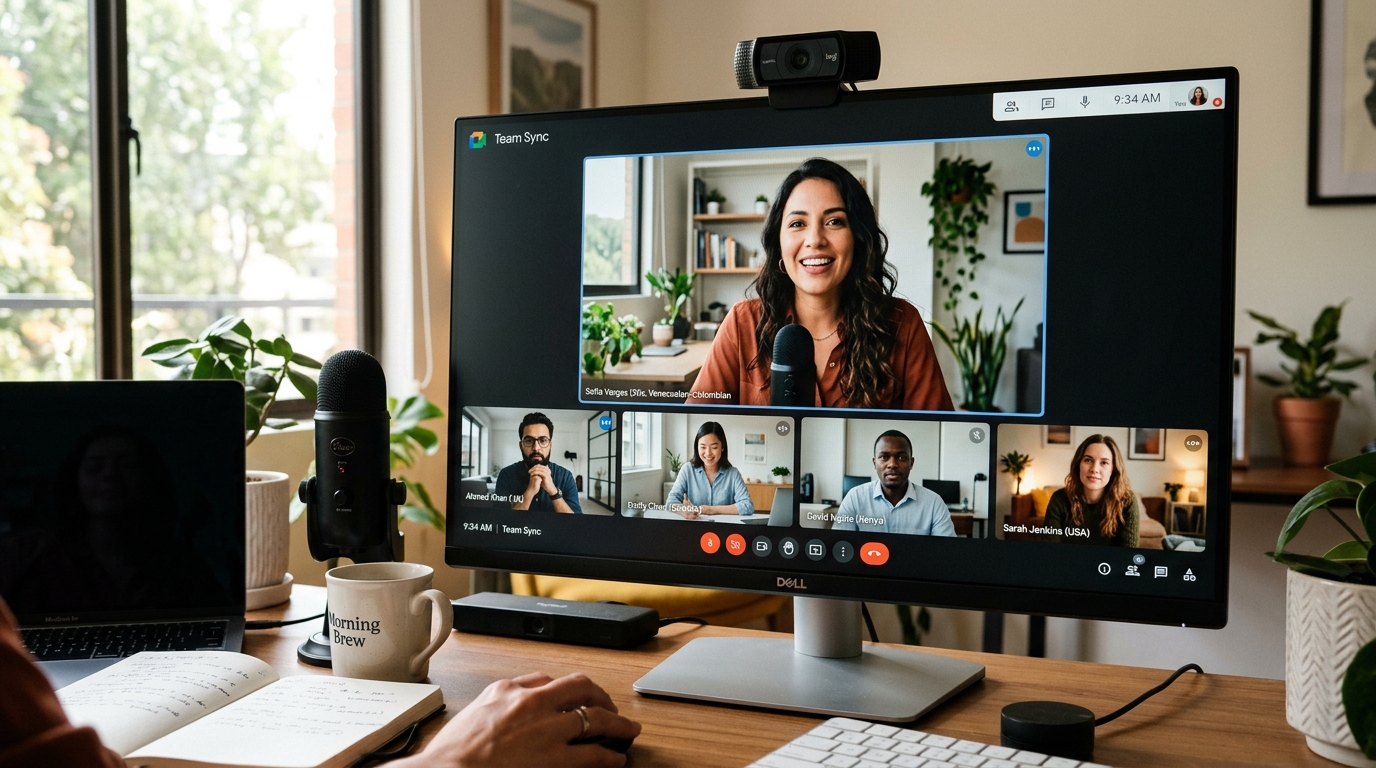
Nearshore team members in Latin America work your business hours — Pacific, Mountain, Central, or Eastern — without anyone burning the midnight oil. That structural alignment is the prerequisite for every other work-life balance strategy below to actually function. A daily standup at 9 a.m. only works if everyone can attend at 9 a.m. without sacrificing sleep.
What Is a Nearshore Virtual Assistant? (And Why the Definition Matters Here)
A nearshore virtual assistant is a full-time remote team member based in a geographically proximate country — in Rose Talent Solutions' case, Latin America — who works your exact business hours, communicates in fluent English, and is managed, vetted, and supported by a staffing agency rather than hired as an independent contractor. The "nearshore" distinction separates this model from offshore outsourcing (Asia-based, large time gap) and domestic hiring (US-based, 3–5x the cost).
For work-life balance specifically, the nearshore model matters because it eliminates the timezone mismatch that forces someone — your team member, your client, or you — to work at an unhealthy hour. Every tactic in this article assumes your team can actually be present during normal business hours. If your current model can't guarantee that, fix the model first.
How to Build Daily Routines That Protect Productivity and Prevent Burnout
Remote work erases the natural structure that an office provides — commute bookends, lunch breaks with colleagues, a physical separation between work and home. Without intentional replacement structures, remote workers default to working whenever a notification appears, which means working always. Pew Research (2020) found that 36% of remote workers said the lines between work and personal life had blurred significantly since shifting to remote — a number that has only grown as remote work normalized post-pandemic.
The most effective daily structure for remote teams combines three elements: a fixed start ritual, time-blocked deep work windows, and a hard-stop routine. Here's how to implement it across your team:
Fixed Start Ritual (15 minutes)
Every team member begins with the same sequence: open their task manager, review the day's three priority tasks, and send a brief async check-in to their manager. This replaces the office commute as a psychological "work begins now" signal.
Deep Work Blocks (90-minute windows)
Schedule two 90-minute blocks of uninterrupted focus time per day — one in the morning, one after lunch. Notifications off. No meetings scheduled. This is where high-output work happens, and protecting these blocks is the single biggest productivity lever available to remote managers.
Async Communication Windows
Designate two 30-minute windows per day for Slack, email, and messaging responses — mid-morning and mid-afternoon. Outside those windows, communication is not expected to be instantaneous. This policy alone reduces the "always-on" anxiety that drives burnout.
Hard-Stop Routine (10 minutes)
At end-of-day, each team member closes all browser tabs, writes tomorrow's top three tasks, and sends a brief "signing off" message. The ritual creates a psychological boundary that an office building's exit door used to provide naturally.
These routines work best when managers model them first. If a team lead sends Slack messages at 10 p.m., no written policy about after-hours boundaries will be believed. Leadership behavior sets the real working hours of a remote team, regardless of what the handbook says.
How the Right Staffing Model Reduces Burnout Risk in 2026: Nearshore vs. Offshore vs. Onshore
Not all remote staffing models carry equal burnout risk. The comparison below maps the three primary models across the variables that directly affect work-life balance and productivity — because the wrong model makes every other strategy harder.
| Factor | Nearshore VA (Latin America) | Offshore VA (Philippines / India) | Onshore Hire (US-Based) |
|---|---|---|---|
| Time zone alignment (US hours) | ✅ 0–3 hour overlap | ❌ 9–13 hour gap | ✅ Perfect |
| Burnout risk from schedule conflict | Low — works standard hours | High — graveyard or batch delays | Low — same hours |
| English fluency standard | 8/10+ screened | Varies widely | Native |
| Communication lag | Real-time during business day | Overnight batching common | Real-time |
| Monthly cost (full-time) | $2,500 flat, all-in | $800–$1,500 (hidden costs extra) | $5,000–$8,000+ fully loaded |
| Recruiting, HR, payroll included | ✅ Yes | ❌ Usually DIY | ❌ Usually DIY |
| Contract flexibility | Month-to-month, 30-day notice | Varies | At-will but high severance risk |
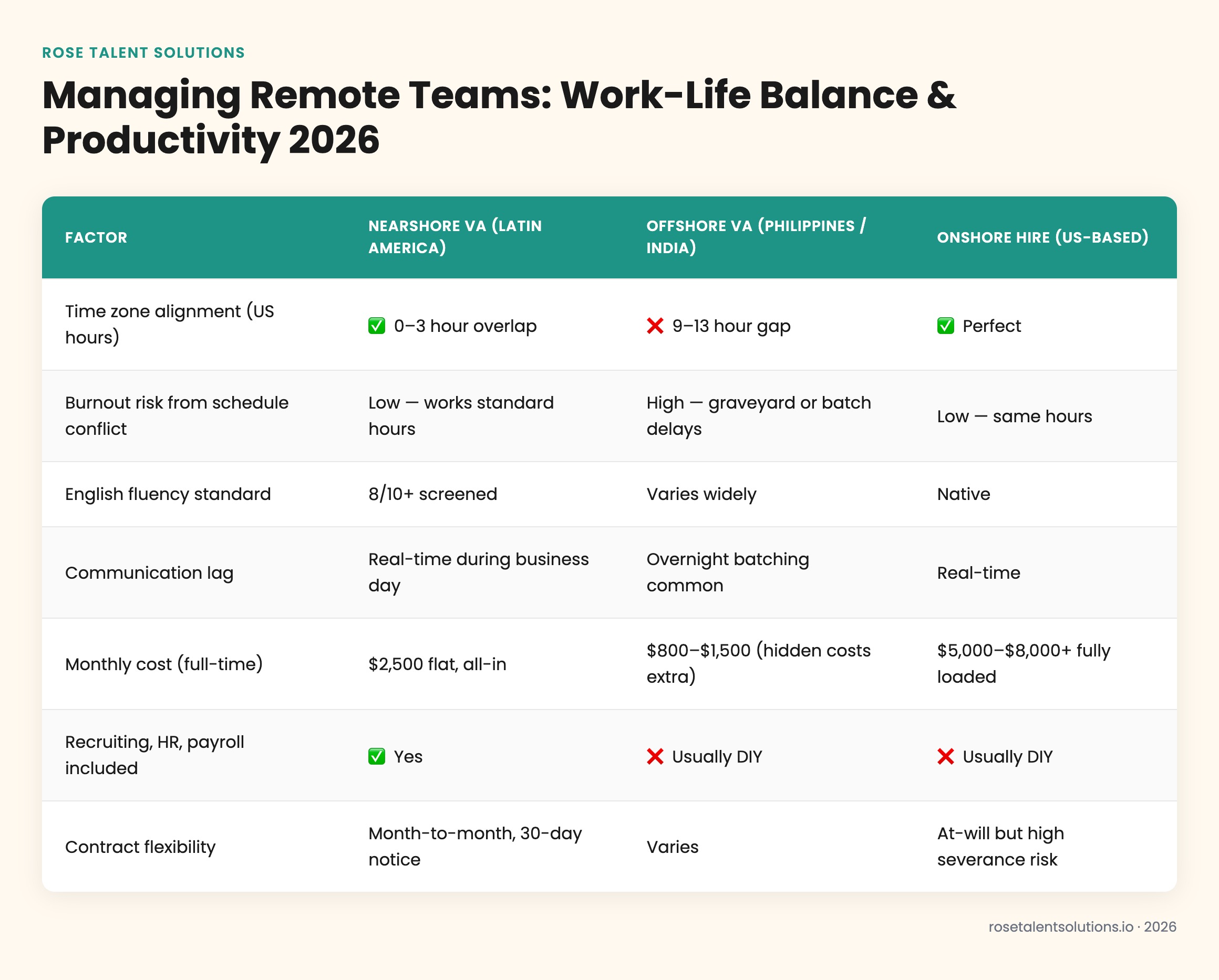
The offshore model's lower sticker price is frequently offset by what McKinsey's organizational research calls "communication friction costs" — the compounded delays, rework, and escalations that happen when teams can't collaborate in real time. For work-life balance specifically, those communication delays push work into evenings and weekends for the onshore side of the team.

Burnout Prevention Frameworks for Remote Teams: What Research Says Works in 2026
Burnout is not a willpower failure. The World Health Organization (2019) classifies burnout as an occupational phenomenon resulting from chronic workplace stress that has not been successfully managed — defined by exhaustion, cynicism, and reduced effectiveness. Remote environments accelerate all three vectors when left unmanaged.
Burnout in remote teams is a systems problem, not a personal discipline problem. The three root causes — always-on availability expectations, isolation from colleagues, and lack of visible progress — are all addressable through management structure, not motivational messaging.
The most evidence-backed burnout prevention framework for distributed teams combines three interventions. First, weekly one-on-ones focused on workload calibration (not just status updates) — Gallup research shows managers account for 70% of variance in employee engagement scores. Second, measurable output targets instead of hours-logged metrics — when remote workers are evaluated on deliverables rather than availability, the pressure to perform "visibility theater" drops significantly. Third, documented PTO minimums, not just maximums — teams that track minimum vacation taken, not just maximum allowed, see meaningfully lower burnout rates, according to SHRM's vacation utilization research.
For managers specifically, the burnout risk is compounded by role sprawl — the tendency to absorb tasks that a well-placed virtual assistant could handle. If you're the one chasing invoices, scheduling maintenance calls, and building reports at 8 p.m., that's not a productivity problem. That's a delegation problem. Rose Talent Solutions places full-time nearshore VAs at $2,500/month specifically to recapture those hours — with a free replacement guarantee if the match isn't right.
Technology Tools That Enforce Boundaries and Support Remote Work Productivity
Technology can create burnout or prevent it, depending on how you configure it. The same Slack that enables real-time collaboration becomes a burnout machine if notification settings are left at default. Here's a role-specific breakdown of tools that enforce healthy boundaries rather than erode them.
For time-blocking and focus: Clockwise or Reclaim.ai automatically protect deep work blocks on your calendar by analyzing meeting patterns and defending focus windows. Both integrate with Google Calendar and have team-wide policy settings that managers can enforce, not just recommend.
For async communication: Loom replaces the "quick sync" meeting with a 2-minute recorded video — reducing meeting load by 30–40% for teams that adopt it systematically, per Loom's internal usage data (2023). Notion or Confluence as a centralized knowledge base eliminates the "always-available for questions" expectation by making answers self-serve.
For managers of nearshore teams: Project management in ClickUp or Asana with clear daily task assignments replaces the ambient anxiety of not knowing whether a remote team member is working. When tasks have clear owners, due dates, and status fields, the urge to send a "just checking in" message at 7 p.m. disappears because the data is already visible.
For role-specific needs: Rose's nearshore team members arrive pre-trained on role-specific software — AppFolio, Buildium, QuickBooks, and others — via a built-in AI copilot. That means less training time for you, and a team member who can operate independently from day one rather than requiring constant supervision that bleeds into your evenings. Learn more about how this works on the Rose Talent Solutions homepage.
That 32% drop — documented in Harvard Business Review's remote work research (2022) — represents hours of recovered personal time per week for every team member. At scale across a five-person remote team, that's potentially 50+ hours of after-hours reclaimed monthly. That's the difference between a team that lasts and one that quietly quits.
How to Structure Remote Work Arrangements for Specific Roles: Parents, Managers, and Full-Time VAs
Generic work-life balance advice fails because "remote worker" is not a single profile. A parent of young children has fundamentally different scheduling constraints than a solo operator running a property management firm, who has different needs than a full-time virtual assistant juggling three client accounts. Role-specific structures outperform universal policies.
What Works for Parent Remote Workers
- Shift deep work blocks to school hours (8–11 a.m. and 1–3 p.m.) rather than forcing standard 9–5 uniformity
- Async-first communication so school pickups don't trigger guilt spirals or missed "urgents"
- Deliverable-based evaluation so visible output matters more than logged hours
- Explicit "off" windows that managers respect by not sending messages during them
What Breaks Down Without Structure
- Meeting-heavy cultures that require back-to-back availability during school pickup windows
- Synchronous-only communication that treats every Slack message as requiring an immediate response
- Hours-based performance metrics that punish split-shift schedules even when output is high
- Vague PTO policies that make taking a half-day for a school event feel like a capital offense
For managers of remote teams specifically, the structural risk is being available to everyone all the time — your team, your clients, your vendors. The fix is a published "manager office hours" window: two 60-minute blocks per day where you're available for synchronous questions. Outside those blocks, async only. This is not a productivity hack; it's a sustainability requirement. Managers who model boundary-setting give their teams permission to do the same.
For nearshore virtual assistants placed through a firm like Rose Talent Solutions, the structure is baked in from day one — defined hours, clear task ownership, and an ongoing HR relationship that isn't solely dependent on the client-VA dyad. That buffer matters for sustainability. When a VA has HR support beyond just their direct client, small frictions get resolved before they become burnout triggers.