
Why UK Businesses Are Turning to Nearshore Marketing VAs in 2026
Nearshore marketing virtual assistants — specialists based in Latin America who work fully overlapping business hours with UK and North American teams — have moved from "nice experiment" to serious operational strategy for growth-stage businesses. The driver is simple: UK marketing budgets are being squeezed while content, paid media, email, and social demands keep climbing. Hiring a full-time in-house marketing coordinator in London now costs upward of £35,000–£45,000 per year in salary alone, before you factor in employer NI contributions, benefits, office overhead, and recruiting fees.
The demand signal is measurable. Global virtual assistant adoption grew by over 35% between 2022 and 2024, according to Statista's Virtual Assistant Market Overview (2024), driven heavily by SMBs in the UK, US, and Canada rethinking their fixed headcount models after the post-pandemic cost reset. Marketing functions — content scheduling, campaign reporting, email sequence management, SEO admin, and influencer outreach — are leading that adoption wave because they're high-volume, process-driven, and tool-based. A skilled VA with the right martech training can handle them without constant supervision.
What this article does that most others don't: it gives you the actual numbers on virtual assistant adoption in UK marketing, a task delegation framework for your specific workflows, a step-by-step onboarding process, and a straight comparison of your staffing options so you can make a decision backed by data rather than vendor copy.
What Is a Nearshore Marketing Virtual Assistant? (2026 Definition)
A nearshore marketing virtual assistant is a full-time remote team member based in a geographically proximate, lower-cost country — typically in Latin America — who works your time zone, communicates in fluent English, and executes marketing tasks inside your existing tools. Unlike a freelancer on Upwork who juggles 12 clients, a nearshore VA is dedicated to your business exclusively for a set number of hours per week. They are recruited, vetted, onboarded, and HR-managed by the staffing agency on your behalf.
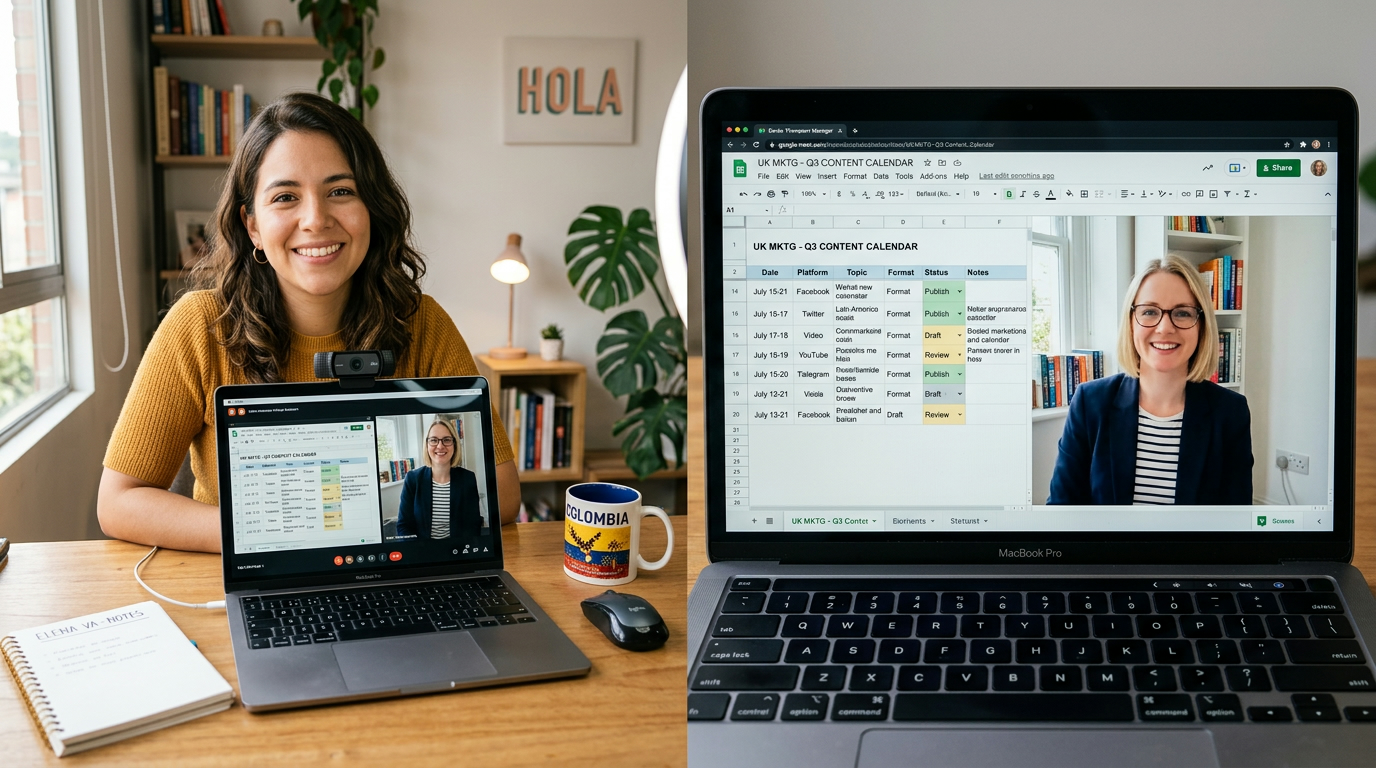
The distinction from "offshore" matters operationally. An offshore VA in the Philippines or India typically sits 8–13 hours ahead of UK time. That gap doesn't just affect Slack response times — it means every async question takes 24 hours to resolve, campaign edits pile up overnight, and your marketing cadence slows to match their availability. A Latin America-based nearshore VA operates on GMT-5 to GMT-8, which overlaps fully with UK mornings and most of the working day. Real-time collaboration is possible. That's the core value proposition.
UK Virtual Assistant Adoption Statistics: What the 2024–2025 Data Shows
The case for hiring a marketing VA in 2026 isn't built on anecdote — it's built on a measurable shift in how UK businesses staff marketing functions. According to the CIPD Flexible Working Survey (2024), over 62% of UK employers now use some form of flexible or remote working arrangement, with smaller businesses disproportionately turning to contract and remote-specialist models to fill skill gaps without committing to full-time employment contracts.
On the automation and AI side, McKinsey's report on the economic potential of generative AI (2023) found that marketing and sales functions have the highest potential for task automation across all business functions — with content drafting, campaign analytics, and social scheduling among the top automatable activities. But the operative word is "automatable," not "automated." Most SMBs still need a skilled human to prompt, QA, publish, and iterate. That's exactly what a trained marketing VA does.
Cost savings metrics from businesses that have made the shift are consistent. Deloitte's Global Outsourcing Survey (2022) found that 70% of companies cite cost reduction as a primary reason for outsourcing, and businesses report average cost savings of 15–40% compared to equivalent in-house hires when accounting for total employment cost. For UK marketing teams specifically, that math is stark: a full-time nearshore marketing VA through Rose Talent Solutions runs $2,500/month (roughly £1,950–£2,000 at current rates) all-in, versus £3,500–£4,500/month in fully-loaded costs for an equivalent London-based junior coordinator.
How Nearshore VAs Compare to Offshore and Onshore Alternatives in 2026
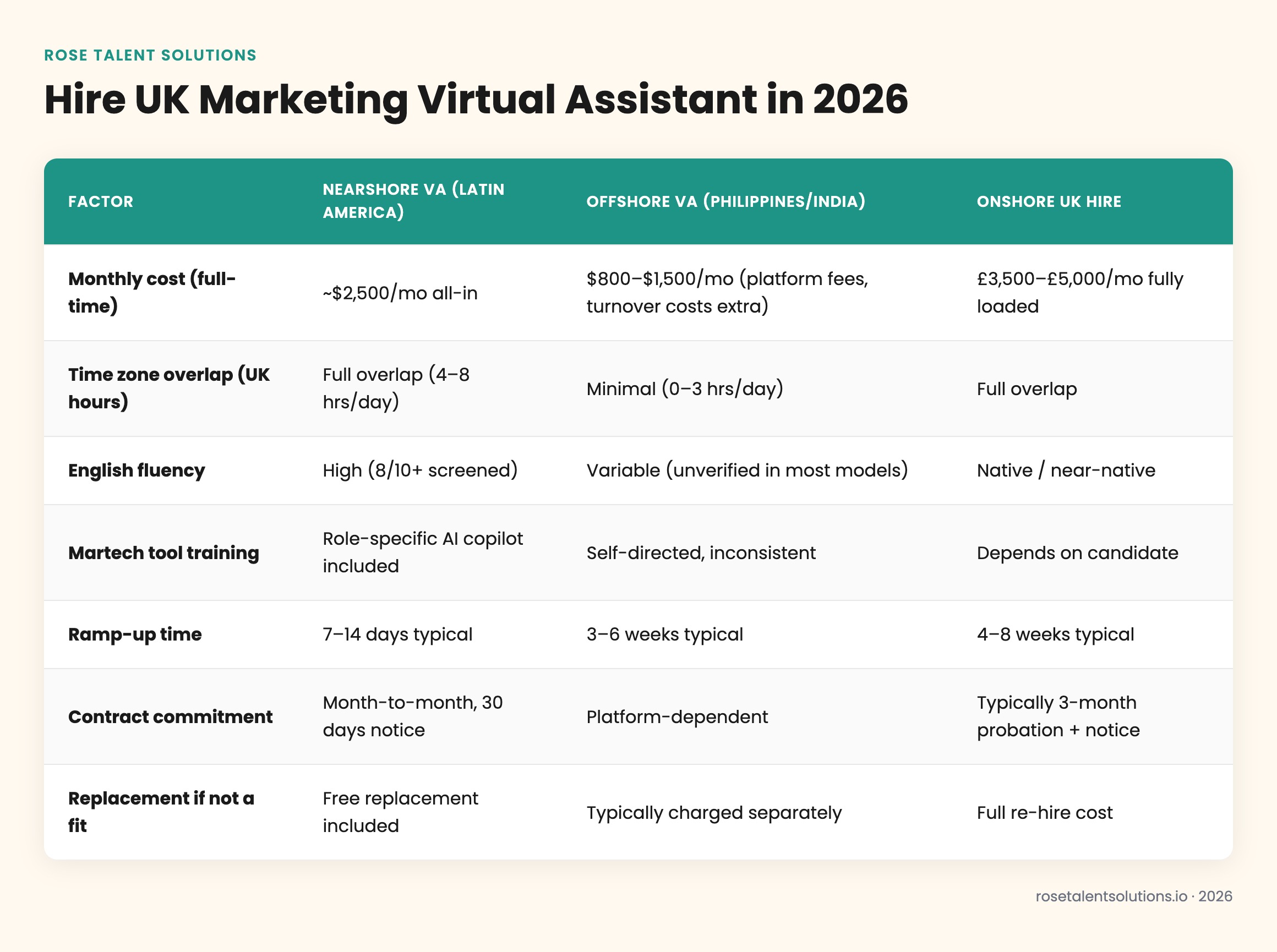
Most guides skip the honest comparison. Here's the actual breakdown across the four factors that determine whether a marketing VA hire succeeds or fails: cost, time zone fit, English fluency, and ramp-up speed.
| Factor | Nearshore VA (Latin America) | Offshore VA (Philippines/India) | Onshore UK Hire |
|---|---|---|---|
| Monthly cost (full-time) | ~$2,500/mo all-in | $800–$1,500/mo (platform fees, turnover costs extra) | £3,500–£5,000/mo fully loaded |
| Time zone overlap (UK hours) | Full overlap (4–8 hrs/day) | Minimal (0–3 hrs/day) | Full overlap |
| English fluency | High (8/10+ screened) | Variable (unverified in most models) | Native / near-native |
| Martech tool training | Role-specific AI copilot included | Self-directed, inconsistent | Depends on candidate |
| Ramp-up time | 7–14 days typical | 3–6 weeks typical | 4–8 weeks typical |
| Contract commitment | Month-to-month, 30 days notice | Platform-dependent | Typically 3-month probation + notice |
| Replacement if not a fit | Free replacement included | Typically charged separately | Full re-hire cost |
Which Marketing Tasks Should You Delegate? A 2026 Framework
One of the most consistent failure modes when businesses hire a marketing VA is the absence of a clear delegation framework. Owners hand over tasks reactively — whatever's burning today — rather than systematically offloading the high-volume, repeatable work that a VA can own without hand-holding. The result is a VA who's underutilized and an owner who still feels overwhelmed.
The framework is simple: delegate tasks that are process-driven, tool-based, and documented. Keep in-house anything that requires original strategic judgment, client relationship management, or sensitive commercial decisions. Here's how that maps to a typical UK marketing function:
- Delegate to your VA: Content calendar management, social media scheduling and posting, email sequence setup and A/B test reporting, SEO keyword tracking, backlink outreach emails, influencer list building, campaign performance reporting, ad creative QA, landing page copy updates, competitor monitoring, newsletter formatting and deployment.
- Keep in-house: Brand positioning decisions, campaign strategy, high-stakes client pitches, budget allocation, agency partner negotiations, creative brief development, and any tasks requiring signatory authority.
According to McKinsey's Generative AI economic potential report (2023), marketing professionals spend approximately 37% of their time on tasks that could be delegated or automated without loss of quality. For a £50,000/year marketing manager, that's roughly £18,500 in annual salary cost spent on work a well-trained VA could execute at a fraction of the price.
The delegation mistake most UK marketing leaders make isn't delegating too much — it's delegating without documentation. Before your VA starts, write a one-page SOP for each task you're handing over. Your VA can improve those SOPs over time. But they need a starting point, not a blank canvas.
How the Onboarding Process Works When You Hire Through Rose Talent Solutions
A common objection to hiring a marketing VA is the fear that integration into your existing martech stack will be slow, painful, or require a dedicated IT project. In practice, a well-run nearshore staffing agency handles the heavy lift before your VA shows up on day one. Here's exactly how the process works at Rose Talent Solutions:
Intake & Role Scoping
You complete a brief intake call where Rose maps your specific marketing workflows — the tools you use (HubSpot, Mailchimp, Hootsuite, SEMrush, etc.), the tasks you need covered, and your communication preferences. This drives the candidate brief.
Candidate Matching & Vetting
Rose recruits, screens for English proficiency (8/10+ floor), tests for tool familiarity, and presents you with matched candidates within days — not weeks. You interview and select.
AI Copilot Activation
Every Rose VA ships with a role-specific AI copilot trained on the software they'll be using — whether that's your CRM, email platform, or social scheduling tool. This cuts ramp time significantly compared to unassisted onboarding.
Day-One Access & SOP Handover
You grant tool access, share your SOPs (or build them together in week one), and your VA begins executing. Rose handles payroll, HR compliance, and ongoing management — you manage the work, not the employment relationship.
Ongoing Support & Replacement Guarantee
If the team member isn't the right fit at any point, Rose replaces them at no additional cost. No long-term contract means you're on month-to-month terms with 30 days written notice to exit.
Security, Privacy, and Compliance: What UK Businesses Need to Know in 2026
Data security is a legitimate concern when delegating marketing tasks to any remote team member — nearshore or otherwise. UK businesses operating under UK GDPR (ICO guidance) have specific obligations around who can access customer data, how it's processed, and where it's stored. A marketing VA will typically access your CRM, email platform, and analytics tools — all of which can contain personal data covered by UK GDPR.
The practical compliance checklist for hiring a marketing VA is shorter than most legal teams make it sound. First, ensure your VA accesses systems only through your provisioned accounts with role-appropriate permissions — never admin access for tasks that don't require it. Second, include a data processing addendum (DPA) in your agreement with the staffing agency, confirming the VA acts as a data processor under your instruction. Third, use your existing tool security features: two-factor authentication, IP restrictions where available, and access logging. According to IBM's Cost of a Data Breach Report (2024), the average cost of a data breach reached $4.88 million globally in 2024 — making access hygiene a business-critical habit, not a checkbox.

What Does It Actually Cost to Hire a UK Marketing Virtual Assistant in 2026?
Price transparency is rare in the VA staffing space, so here it is plainly. Rose Talent Solutions charges a flat $2,500/month for a full-time (40 hours/week) nearshore marketing VA. That rate is all-inclusive: recruiting, vetting, payroll, HR administration, and ongoing management. There are no add-on fees for replacement if the placement isn't a fit. The engagement is month-to-month — no long-term contract — and exits require 30 days written notice.
Comparable roles in the UK market cost significantly more. The ONS Annual Survey of Hours and Earnings (2024) puts the median full-time annual salary for UK marketing assistants and coordinators at approximately £28,000–£32,000 — which translates to £2,333–£2,667/month in gross salary alone, before employer National Insurance (13.8%), pension contributions (3% minimum), and any benefits. Total employer cost typically lands at £3,200–£4,200/month for the equivalent role, without recruiting fees. The math on nearshore is straightforward.
For businesses that need finance and marketing operations covered simultaneously, the flat-rate model scales without the compounding HR complexity of adding multiple UK-based employees. And for property management companies running their own marketing alongside operations, a single nearshore VA can often bridge both functions — handling listing copy, email campaigns, and social content while also supporting operational tasks.
Nearshore Marketing VA: Pros
- Full time zone overlap with UK hours — real-time collaboration, not async lag
- Flat $2,500/month all-in — no recruiting, HR, or payroll surprises
- English proficiency screened to 8/10+ minimum before placement
- Role-specific AI copilot accelerates tool ramp-up from weeks to days
- Free replacement if the fit isn't right — no re-hiring cost exposure
- Month-to-month terms — no long-term contract lock-in
Nearshore Marketing VA: Considerations
- Requires clear SOPs upfront — VAs execute well with documentation, not ambiguity
- Not a strategic marketing director — execution and reporting, not brand strategy
- Payments in USD (though savings vs. UK hire remain substantial at current exchange rates)
- Initial access provisioning and tool onboarding requires 2–3 hours of your time in week one
How to Get Started: Hiring Your UK Marketing Virtual Assistant Through Rose in 2026
The fastest path to a placed, producing marketing VA is a focused intake process rather than a long evaluation cycle. Rose's matching process is built to move quickly — most clients have a matched candidate in front of them within days of completing the intake brief. The AI copilot activation and tool onboarding happen in parallel, so your VA isn't sitting idle while systems access gets sorted.
If you're ready to scope the role, the start page walks you through the intake questions in under 10 minutes. If you want to understand the AI advantage layer before committing, the AI advantage overview explains exactly how the role-specific copilots work and which martech tools they're pre-trained on. The engagement is month-to-month — you're not betting a year's salary on a single hire. You're running a structured, supported placement with a free replacement backstop if it doesn't click. That's the offer.