
What Is an SEO Virtual Assistant — and Is SEO Even Worth It in 2026?
Nearshore SEO virtual assistants are remote specialists based in Latin America who handle the repeatable, high-volume execution work that makes organic search actually move — keyword research, on-page optimization, content briefs, internal linking audits, Google Search Console triage, and backlink outreach. They work your US business hours, communicate in fluent English, and cost a fraction of a domestic hire. If you've been putting off building an SEO function because you can't afford a $90,000 in-house strategist, an SEO VA is the lever you've been missing.
Before we go further, let's answer the question half of you are Googling on the side: Is SEO dead or evolving in 2026? The honest answer is that SEO is not being phased out — it is compounding in complexity. BrightEdge (2024) reports that organic search still drives 53% of all trackable website traffic, outpacing paid, social, and direct combined. What died is the 2015 playbook of keyword stuffing and mass link schemes. What replaced it is technical precision, topical authority, and AI-assisted content operations — exactly the kind of work a well-trained SEO VA executes every day.
An SEO VA is not the same as a full SEO strategist or consultant. A strategist sets the roadmap — which keywords to own, which competitors to attack, which content pillars to build. An SEO VA executes that roadmap at volume and speed. Most businesses earning under $5M annually don't need a full-time strategist; they need someone to implement the 80% of SEO work that is process-driven, repeatable, and documentable. That's the VA's lane. If you already have a strategic direction from an agency or fractional CMO, an SEO VA will make your spend 3x more productive overnight.
How Much Does It Cost to Hire an SEO Virtual Assistant in 2026?
Let's talk money plainly, because "hire SEO virtual assistant salary" is one of the most-searched variants of this topic and most articles dodge it. Here's what the market actually looks like:
The offshore rate sounds attractive until you add up the hidden costs: a recruiter fee (often one month's salary), a payroll provider, HR compliance overhead, and the productivity drag of a 10–14 hour timezone gap. According to SHRM (2023), the total cost of a bad hire at the mid-skill level runs 50–60% of that hire's annual compensation. A single mis-hire on a $15/hr offshore VA can cost you $15,000+ when you count lost time and re-recruiting.
Rose Talent Solutions charges $2,500/month flat — recruiting, vetting, payroll, HR, and ongoing management all included. No long-term contract. If the team member isn't a fit, we replace them at no additional cost. For a full-time SEO VA working 40 hours per week, that works out to roughly $15.63/hour fully loaded. You get nearshore talent, US-timezone availability, and a managed relationship — without the administrative burden of being someone's employer.

Nearshore vs. Offshore SEO VAs in 2026: How Do They Actually Compare?
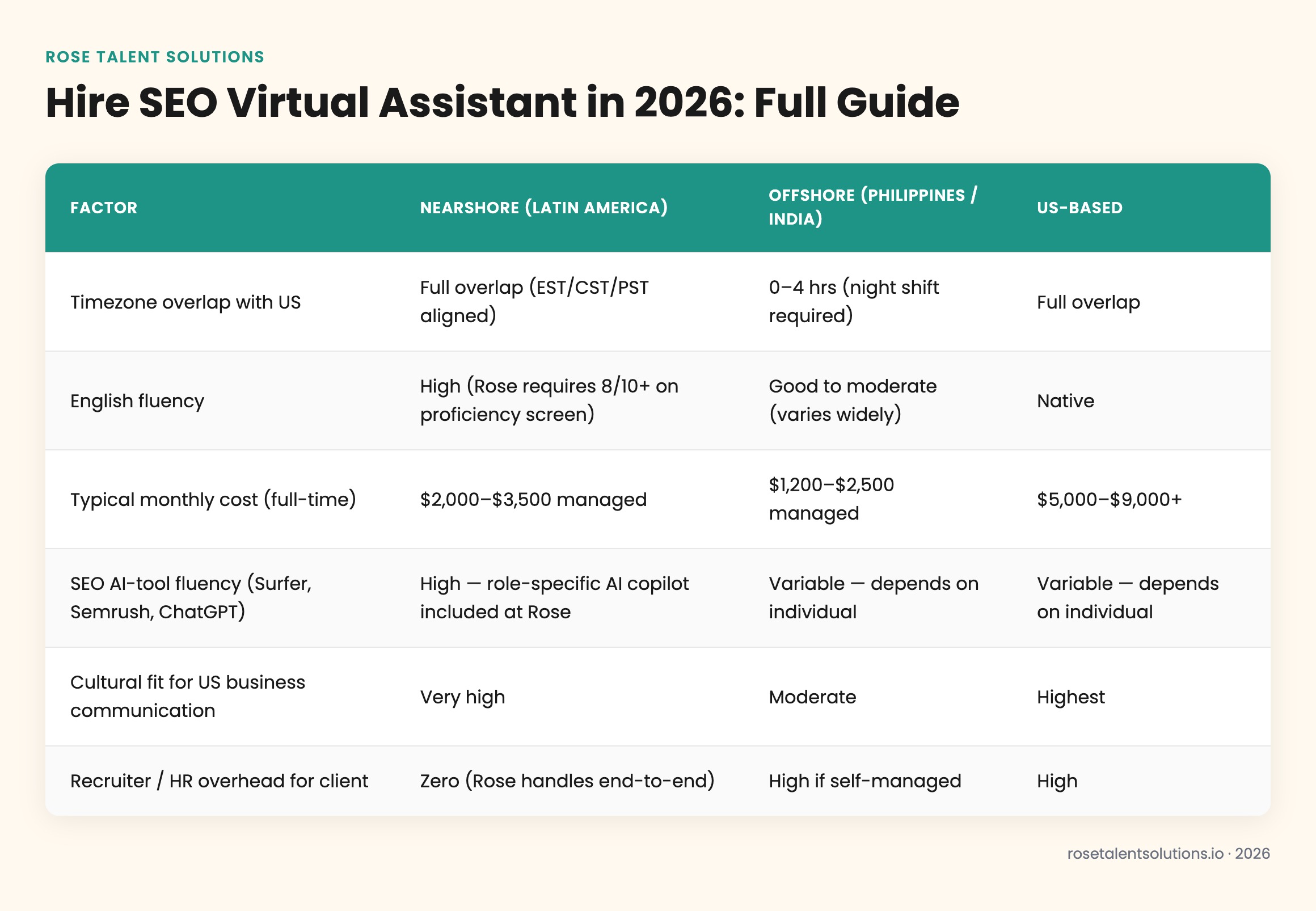
The phrase "SEO VA Philippines" gets searched thousands of times a month, and Philippine VAs are genuinely skilled. So why does nearshore Latin America consistently produce better outcomes for US businesses? Three reasons: timezone alignment, cultural proximity, and communication speed. When your VA is in Bogotá or Mexico City, they're working at 9am when you're working at 9am. Edits, Slack messages, and client-facing deliverables happen in real time — not the next morning.
| Factor | Nearshore (Latin America) | Offshore (Philippines / India) | US-Based |
|---|---|---|---|
| Timezone overlap with US | Full overlap (EST/CST/PST aligned) | 0–4 hrs (night shift required) | Full overlap |
| English fluency | High (Rose requires 8/10+ on proficiency screen) | Good to moderate (varies widely) | Native |
| Typical monthly cost (full-time) | $2,000–$3,500 managed | $1,200–$2,500 managed | $5,000–$9,000+ |
| SEO AI-tool fluency (Surfer, Semrush, ChatGPT) | High — role-specific AI copilot included at Rose | Variable — depends on individual | Variable — depends on individual |
| Cultural fit for US business communication | Very high | Moderate | Highest |
| Recruiter / HR overhead for client | Zero (Rose handles end-to-end) | High if self-managed | High |
How to Vet an SEO Virtual Assistant's Real Skill Level Before You Hire
Most businesses hire SEO VAs based on a polished resume and a confident Zoom call. Then they're surprised three weeks in when deliverables are thin, keyword research is pulled straight from a Google autocomplete, and "on-page optimization" means changing a title tag once. Here is how to actually evaluate an SEO VA before you commit a dollar.
The live audit test. Send the candidate a URL from a real (anonymized) client site or your own site and ask them to produce a prioritized on-page audit in two hours using whatever tools they prefer. You're not testing the output as much as you're testing the process: Did they use Screaming Frog or Sitebulb? Did they pull Core Web Vitals data? Did they cross-reference keyword gaps in Semrush or Ahrefs? A candidate who returns a color-coded spreadsheet with source data cited is a candidate who actually knows the workflow. A candidate who returns a bullet list of suggestions without data is guessing.
Red flags to screen out. Watch for candidates who claim to "do SEO" but can't explain the difference between a canonical tag and a 301 redirect. Ask them to walk you through a backlink disavow scenario. Ask what they do when a page drops 40% in impressions after a core update. Vague answers ("I would investigate and optimize") are a red flag. Specific tool-and-data answers ("I'd pull the GSC Performance report filtered by the update date window, compare it against a Semrush position tracking snapshot, and check if the drop correlates with E-E-A-T signals on the page") are what you want. According to the U.S. Bureau of Labor Statistics (2024), demand for digital marketing roles including SEO specialists is projected to grow 8% through 2033 — meaning competition for genuinely skilled SEO talent is only getting stiffer, and mis-hires are getting more expensive.
The single best interview filter for an SEO VA is a two-hour paid test task on a real URL. Candidates who can't produce a data-backed audit with specific tool outputs in two hours will not produce one in two weeks either — no matter how confident they sound on a call.
How AI Tools Are Reshaping What SEO VAs Do in 2026
The SEO VA role in 2026 looks meaningfully different from 2022. Manual keyword research that used to take eight hours now takes ninety minutes with a Semrush + ChatGPT workflow. Content briefs that required a senior editor's judgment can now be scaffolded by Surfer SEO's NLP engine in minutes. This isn't replacing the VA — it's multiplying their output. A skilled SEO VA using AI tools correctly can produce the volume of work that previously required a two-person team.
Rose's AI advantage program means every team member ships with a role-specific AI copilot trained on the tools they'll actually use. An SEO VA placed through Rose arrives knowing how to use Surfer SEO content scoring, Semrush's keyword magic tool, ChatGPT for meta-description drafts, and Screaming Frog for technical crawls — not as isolated features but as an integrated daily workflow. AI fluency is now table stakes for any SEO hire worth making in 2026, and it's baked into every placement at no additional cost.
According to McKinsey & Company (2023), generative AI tools can automate or augment up to 70% of tasks in marketing and sales roles — which means an SEO VA who knows how to prompt and iterate is doing the strategic leverage work, not just the busywork. That's a fundamentally different value proposition than the "offshore SEO task worker" model that dominated from 2015 to 2022.

How to Onboard and Manage an SEO Virtual Assistant So They Actually Produce
Hiring the right VA is step one. Getting real output from them is step two, and it's where most businesses fail. The mistake is treating an SEO VA like a black box — handing them a login and expecting results without infrastructure. Here is the onboarding sequence that consistently produces fast, measurable SEO output.
Grant tool access on day one
Give them seat access to your Semrush or Ahrefs account, Google Search Console, Google Analytics 4, and whatever CMS you're running (WordPress, Webflow, Shopify). An SEO VA without data access on day one is burning your first week.
Provide a 30-day SOP document
Document your current SEO status: existing keyword targets, competitors you track, pages that have historically performed, and any Google penalty history. Even a rough Notion doc beats a verbal briefing every time.
Set weekly KPI check-ins
Define three to five KPIs from the start: number of pages optimized per week, new keywords tracked, backlinks built, GSC click growth. Review them every Friday in a 15-minute async Loom or live standup.
Run a 30-day audit sprint
The highest-ROI first month is a full technical + on-page audit followed by a prioritized fix list. Have your VA document every finding in a shared spreadsheet with columns for priority, effort, and expected impact — then work through it together.
Establish a content pipeline cadence
By week five, your VA should be producing two to four keyword-targeted content briefs per week, publishing optimized pages, and updating your internal link structure. Treat the content pipeline as a standing deliverable, not an ad hoc request.
Rose's team handles the HR, payroll, and performance management infrastructure so your management overhead stays minimal. If you're running a property management business or a bookkeeping operation that needs SEO support alongside operational VAs, a nearshore team member integrates into your existing workflow — same timezone, same Slack, same tools. Learn more about how the AI advantage is built into every placement.
Common Mistakes Businesses Make When They Hire an SEO Virtual Assistant
Competitor articles tell you what an SEO VA does. Almost none tell you what goes wrong. Here are the failure modes we see most often — and how to sidestep each one.
What Works
- Hiring for a specific skill set (technical SEO vs. content SEO vs. local SEO) rather than a generic "SEO VA"
- Starting with a 30-day audit sprint to build a baseline before shifting to ongoing optimization
- Using nearshore talent for US-timezone real-time communication on client-facing deliverables
- Providing tool access and SOPs on day one — not week two
- Tracking output KPIs weekly: pages optimized, keywords ranked, GSC impressions growth
What Fails
- Hiring a generalist "SEO/social/email" VA and expecting deep SEO execution — breadth kills depth
- Giving an offshore VA a time-sensitive client deliverable across a 12-hour timezone gap and expecting real-time turnaround
- Measuring success by activity (hours logged, tasks completed) instead of outcomes (rankings, traffic, conversions)
- Skipping the live test task and hiring on resume credentials alone
- Treating the VA as a vendor to be managed at arm's length instead of a team member to be enabled with context
According to Gallup (2019), poor management is responsible for at least 50% of employee turnover across industries — and that number holds for virtual team members too. The VA isn't usually the problem. The onboarding infrastructure is. Build it once, and your SEO VA becomes a compounding asset rather than a recurring frustration.
If you want to understand how Rose structures the full placement process — from intake to first deliverable — the AI advantage page walks through exactly how role-specific copilots are configured for each new team member before their first day.