
Why Nearshore Remote Executive Assistants Are the 2026 Default for US Businesses
Nearshore remote executive assistants — based in Latin America and working US business hours — have become the dominant hiring model for US, Canadian, and UK businesses that need high-quality executive support without the six-figure salary overhead of a domestic hire. The shift isn't a cost-cutting trend; it's a talent-access story. Latin America produces hundreds of thousands of bilingual, university-educated professionals every year, and a growing share of them are choosing remote executive roles over local employment.
The numbers back this up. Remote work adoption among executive and administrative roles has grown dramatically since 2020, with the U.S. Bureau of Labor Statistics (2024) reporting that over 35% of management support occupations now perform their work entirely remotely. For business owners, that means the talent pool for your next executive assistant isn't your zip code — it's the entire Western Hemisphere.
What separates a nearshore EA from an alternative-timezone hire isn't just geography. It's real-time availability. A Latin America-based EA starts their day when you do, joins your 9am standup, and responds to your Slack message before you finish your coffee. That alignment matters more than most hiring managers realize until they've lived through the alternative.
What Does a Remote Executive Assistant Actually Do in 2026?
This is the question most job boards skip entirely — and it's exactly what you need to answer before you post a role or sign a staffing contract. A remote executive assistant in 2026 is not a phone answerer. The role has evolved into a true operational partner, and the best ones run on a tight daily rhythm.
Here's how a typical day looks for a full-time remote EA supporting a founder or senior executive:
Morning Triage (8–9am)
The EA reviews overnight emails, flags urgent items, and pre-loads the executive's calendar with prep materials — briefing docs, agenda links, background on who they're meeting. Nothing hits the exec's inbox unsorted.
Calendar and Travel Management (9–11am)
Scheduling across time zones, rescheduling conflicts, booking travel itineraries, and coordinating logistics. A skilled remote EA uses Calendly, Google Calendar, or Notion to keep everything visible and shared without back-and-forth.
Project and Admin Work (11am–2pm)
Research tasks, vendor follow-ups, CRM updates, document drafting, expense reports, and inbox management. This is the deep-work block where the EA clears operational debt so the exec doesn't have to.
Afternoon Communications (2–4pm)
Following up on open loops, drafting replies for exec approval, coordinating with internal teams, and managing any time-sensitive requests that came in during the day.
End-of-Day Handoff (4–5pm)
The EA sends a brief daily summary — what was completed, what's pending, and what needs a decision tomorrow. The exec closes their laptop knowing nothing fell through the cracks.
According to SHRM (2024), executives who use dedicated administrative support recover an average of 8 hours per week — time that flows directly back into revenue-generating work. That's essentially a full extra workday, every week, without hiring another senior employee.

How Do Hiring Models Compare for Remote Executive Assistants in 2026?
Most hiring guides online compare salary ranges. That's useful but incomplete. What actually determines whether your remote EA hire succeeds is the hiring model itself — how the person was sourced, vetted, and who holds accountability after day one. Here's an honest breakdown of your three main options.
| Hiring Model | Typical Monthly Cost | Vetting Quality | Timezone Fit (US Hours) | Replacement if Not a Fit | Ongoing HR/Payroll Handled |
|---|---|---|---|---|---|
| Freelance Platform (Upwork, Fiverr) | $800–$2,000 | Self-reported; you vet | Varies widely; mismatched timezone common | No — you start over | No |
| Direct Hire (Remote job boards) | $4,000–$8,000+ (salary + benefits) | You own the full process | Depends on candidate location | No — re-recruit from scratch | No — you're the employer |
| Nearshore Staffing Agency (Rose Talent Solutions) | $2,500 flat | Agency-vetted, multi-screen | Yes — Latin America, US hours | Yes — free replacement if not a fit | Yes — recruiting, payroll, HR included |
| Far-Shore Agency (Large timezone gap) | $1,200–$2,200 | Varies by agency | No — 8–12 hour gap typical | Sometimes | Partially |
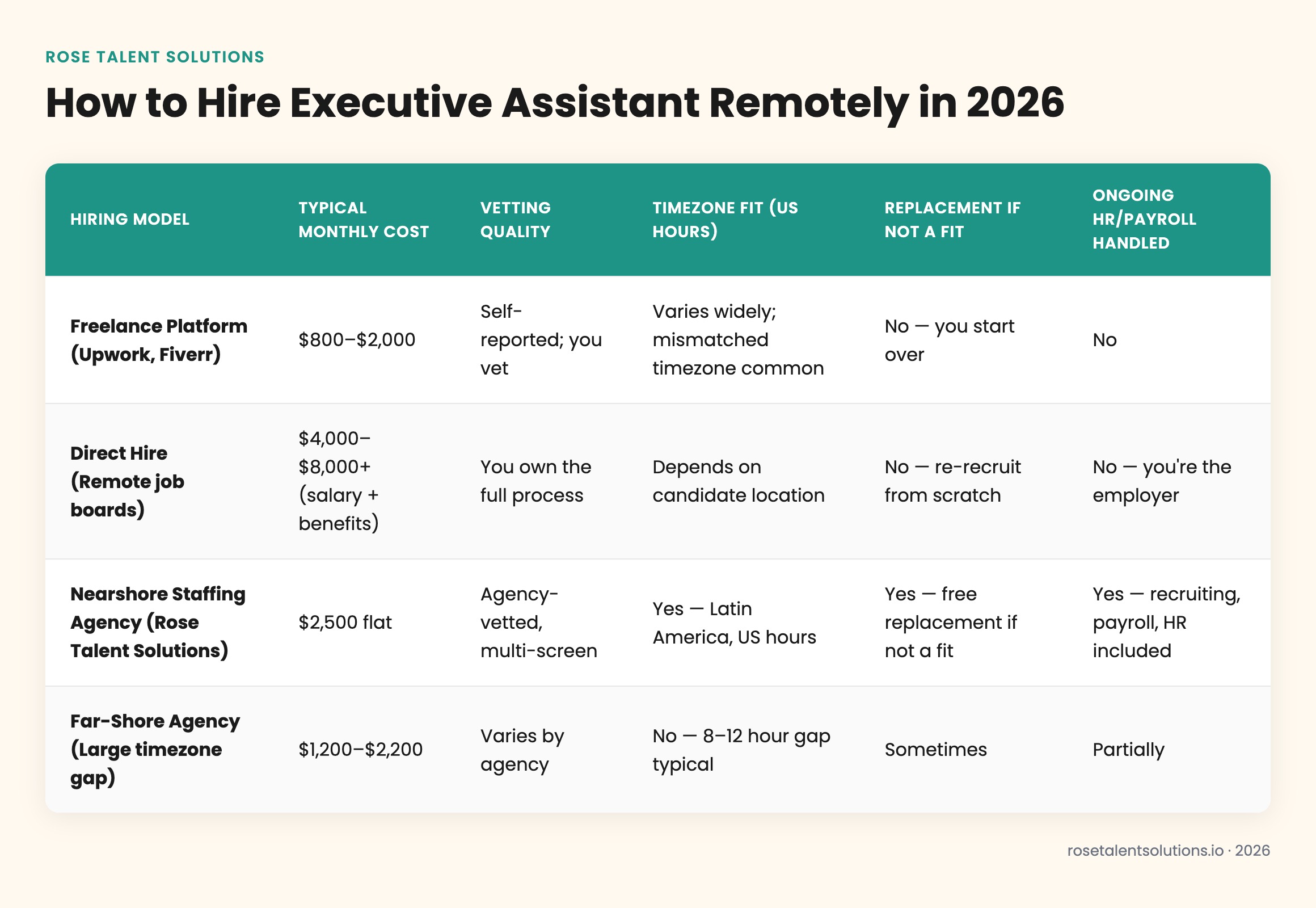
The freelance route looks cheap until you factor in your own sourcing time, a failed hire with no replacement guarantee, and the reality that platforms like Upwork skew heavily toward talent in mismatched time zones. Direct hire gives you full control but makes you the recruiter, HR department, and payroll processor all at once — and a $6,000/month domestic EA with benefits can run $80,000+ annually when you add employer-side costs, according to BLS Occupational Outlook data (2024).
What Are Executive Assistant Remote Jobs Paying in 2026? (Salary Reality Check)
Salary data for remote executive assistant roles varies dramatically depending on whether you're looking at US-based hires or nearshore talent. Understanding both sides of this market helps you make an informed decision — not just the cheapest one.
For US-based remote executive assistants, the Bureau of Labor Statistics (2024) reports a median annual wage of $47,080 for executive secretaries and executive administrative assistants. Senior remote EA roles supporting C-suite executives in tech or finance frequently reach $100,000–$150,000 — the "Executive Assistant Remote jobs $100K" and "Remote Executive Assistant jobs $150K" brackets you'll see on LinkedIn and Indeed reflect real compensation at the top of the market.
That premium exists for a reason: domestic senior EAs bring deep institutional context, fluent stakeholder communication, and years of C-suite exposure. But here's the honest question: does your business need a $120,000 domestic hire, or do you need a highly capable, English-fluent professional who covers 90% of that scope at $2,500/month? For most small-to-mid businesses, the answer is the latter.
A nearshore EA from Rose earns a competitive salary by local market standards, is fully benefits-compliant under Rose's employment structure, and brings the same software fluency — Notion, Slack, Zoom, Calendly, Google Workspace, QuickBooks — that a domestic hire would. The AI Advantage built into every Rose placement means your EA also ships with a role-specific AI copilot trained on your exact tool stack, not just generic AI prompts.
The $100K–$150K remote EA salary bracket reflects genuine C-suite support roles at large enterprises. For most growing businesses, a nearshore EA at $2,500/month delivers comparable day-to-day output — inbox management, calendar ownership, travel booking, vendor coordination — at a fraction of the fully-loaded cost. The gap isn't capability; it's context and tenure.
How to Vet and Onboard a Remote Executive Assistant Without Getting Burned
The most common failure mode for remote EA hires isn't a skills mismatch — it's a vetting mismatch. Business owners interview for personality, skip the practical test, and discover three weeks in that the candidate can't actually manage a complex calendar or draft a client email without heavy editing. Here's how to avoid that.
What to screen for before the interview: English proficiency is non-negotiable. Rose's published bar is 8/10 or higher on structured English proficiency screens — that means clear written communication, confident spoken English, and the ability to represent your brand in client-facing contexts. Anything below that creates friction every single day. Beyond language, look for demonstrated experience with the specific software you use. A candidate who has lived in Google Workspace is not interchangeable with one who has only used Outlook — the muscle memory is different.
The trial task framework: Before any offer, give candidates a 30–60 minute practical task that mirrors real work. Ask them to draft a scheduling email resolving a three-party calendar conflict, write a travel itinerary brief from a set of flight and hotel options, and summarize a two-page document into five bullet points. What you're measuring isn't perfection — it's judgment, tone, and how they handle ambiguity. According to SHRM's talent acquisition research (2024), structured skills assessments predict job performance 3x more accurately than unstructured interviews alone.
Red flags to reject immediately: vague answers about their current tool stack ("I use whatever the client needs"), no examples of proactive problem-solving in past roles, communication delays during the hiring process itself (a strong EA never goes dark), and any signs of over-reliance on the hiring manager to define every task. The whole point of a great EA is that they reduce your cognitive load — not add to it.

Onboarding a remote EA successfully requires a 30-day ramp plan, not a "figure it out" approach. Week one: shadow mode — the EA observes, reads documentation, and asks questions. Week two: supervised execution — they handle tasks with your review before anything goes out. Week three: independent execution with daily check-ins. Week four: full autonomy with weekly syncs. This structure builds trust in both directions without creating dependence.
Rose's property management virtual assistant placements and bookkeeping and accounting VA placements both use this same ramp framework — the principle applies equally to any executive support role.
Nearshore vs. Far-Shore Remote EAs: An Honest Pros and Cons for 2026
The debate between nearshore and far-shore VAs comes up constantly on forums like Reddit (search "hire executive assistant remotely reddit" and you'll find dozens of threads debating timezone-matched VAs versus cheaper far-shore alternatives). Here's the straight answer, without the agency spin.
Nearshore EA (Latin America) — Pros
- Works US business hours in real time — no overnight batching
- Same-day collaboration on Zoom, Slack, or phone
- Cultural alignment with US professional norms and communication style
- Minimal time zone math for US, Canada, and UK clients
- Easier to build long-term working relationships and institutional knowledge
- Strong English fluency from university-educated talent pool
Far-Shore EA (Large Timezone Gap) — Considerations
- 6–12 hour time zone gap means most real-time requests wait until the next day
- Asynchronous-only model works for some tasks but breaks down for executive support
- Communication styles may require more explicit expectation-setting
- Lower base cost, but timezone friction carries a real operational price
For roles like executive assistant — where the entire value is real-time responsiveness, judgment in the moment, and representing your brand to stakeholders — the timezone gap is a structural problem, not a preference issue. Executive support is not an async job. The best EA in the world loses significant value if they can't answer your message until 4am your time.
That's the core reason nearshore has become the default for executive-level remote hiring among US operators who've tried both models. The AI copilot advantage Rose builds into every placement amplifies this further — your EA isn't just available in real time, they're equipped with AI tools calibrated to your specific software stack from day one.
Rose places EAs at a flat $2,500/month — all-in. That includes recruiting, vetting (including the 8/10+ English proficiency screen), payroll, HR compliance, and ongoing support. No long-term contract. If the placement isn't the right fit, Rose replaces them at no additional cost. For more on how the broader virtual staffing model works across roles, see the Rose property management staffing page as a parallel example of the same model applied to a specialized vertical.
According to McKinsey's organizational performance research (2023), companies that build lean, high-leverage support structures around senior leaders outperform peers on executive productivity metrics by a measurable margin. A well-placed remote EA is exactly that kind of leverage point — and in 2026, nearshore Latin America is where the best value-to-quality ratio lives.