
Nearshore staffing has changed how smart operators think about the cost of a bad hire — but the underlying math of hiring mistakes applies to every business, from home care agencies to property management firms to e-commerce brands. If you've ever let someone go within the first 90 days, or watched a promising hire quietly quit by month six, you already know the gut-punch. What you may not know is exactly how much it cost you — and how to stop it from happening again.
This guide breaks down the real numbers behind recruitment ROI, employee turnover, and onboarding impact in 2026. It's built for business owners and HR professionals who need data-backed answers, not generic advice.
What Does "Cost of a Bad Hire" Actually Mean in 2026?
The cost of a bad hire is the total financial and operational damage a company absorbs when a new employee fails to meet expectations — whether they leave voluntarily, get let go, or simply underperform. It is not just the recruiting fee. It includes the salary paid during low-output weeks, the manager hours spent coaching someone who won't work out, the downstream errors that reached clients, and the full restart cost of finding a replacement.
According to SHRM (2022), the average cost-per-hire in the US sits at $4,700 — and that's just the intake cost. The US Department of Labor has long cited a rule of thumb that a bad hire costs at least 30% of that employee's first-year earnings. For a caregiver earning $36,000 annually, that's $10,800 minimum — per bad hire. For a $60,000 coordinator, you're looking at $18,000 or more vanishing before you even realize there's a problem.
Glassdoor research goes further, estimating that the total cost of replacing an employee can reach 150% of annual salary once you account for lost institutional knowledge, team morale erosion, and client relationship damage. That figure is not theoretical — it reflects what finance teams actually report when they audit involuntary separations.

How Employee Turnover Compounds Hiring Mistakes Over Time
Employee turnover and bad hires are not the same problem, but they feed each other. A bad hire who stays creates what researchers call "passive turnover drag" — they don't leave, but their low engagement pulls adjacent teammates down. A bad hire who leaves quickly triggers direct replacement costs. Either path is expensive.
According to Gallup (2019, foundational data still widely cited), voluntary employee turnover costs US businesses $1 trillion every year. Disengaged employees — many of whom were mismatched hires from the start — are responsible for 34% of that figure. In home care specifically, where caregiver turnover rates routinely exceed 60% annually, the math becomes existential.
The US Bureau of Labor Statistics Job Openings and Labor Turnover Survey (2024) confirms that health care and social assistance roles see some of the highest quit rates of any sector — averaging 2.4% monthly. For a 20-person care team, that's roughly one resignation every two months, each carrying five-figure replacement costs.
The hidden cost of high employee turnover isn't the exit interview — it's the three months of underperformance before the employee even decides to leave. Most disengaged workers mentally quit 60–90 days before they formally resign, and they take team productivity with them during that window.
How Onboarding Impact Shapes Recruitment ROI in 2026
Onboarding impact — how well you integrate and train a new hire in their first 30–90 days — is the single highest-leverage variable in recruitment ROI. You can hire correctly and still lose the investment with a weak onboarding process.
According to SHRM (2022), organizations with a strong onboarding process improve new hire retention by 82% and productivity by over 70%. That's the "Employee satisfaction rises to 82%" data point that circulates widely in HR circles — the full context is about retention lift from structured onboarding programs, not a baseline satisfaction score.
What does strong onboarding look like in practice? It means role-specific training materials on day one, a clear 30-60-90 day milestone plan, a designated check-in owner (not just "HR"), and software access that actually works before the employee's first task. Most small businesses fail on all four.
For agencies and businesses exploring virtual staffing for operational roles, the onboarding advantage of working with a managed provider is significant: the staffing partner handles software training, role calibration, and performance check-ins — removing the three biggest onboarding failure points from your plate.
Comparing Hiring Models: Where Recruitment ROI Breaks Down
Not all hiring models carry the same risk profile. The table below compares in-house hiring, offshore outsourcing, and nearshore virtual staffing across the dimensions that most directly affect your cost of bad hire exposure and long-term recruitment ROI.
| Factor | In-House Hire | Offshore Staffing (Philippines/India) | Nearshore VA (Latin America) |
|---|---|---|---|
| Average Monthly Cost | $4,500–$7,000+ (salary + burden) | $800–$1,500 | $2,500 flat (all-in) |
| Timezone Alignment (US) | Full overlap | 6–12 hour gap; async only | Full US business hours overlap |
| English Proficiency | Varies by candidate | Moderate; accent friction common | 8/10+ screened minimum |
| Onboarding Speed | 4–8 weeks typical | 2–4 weeks (limited by async lag) | 7 days to first placement; role-specific AI copilot included |
| Bad Hire Risk Reversal | Full replacement cost on employer | Varies by agency; often none | Free replacement if not a fit |
| Payroll / HR / Compliance | Employer responsibility | Partially managed by agency | Fully managed by Rose |
| No Long-Term Contract | Employment law applies; severance risk | Varies; often locked contracts | Month-to-month; 30-day written notice |
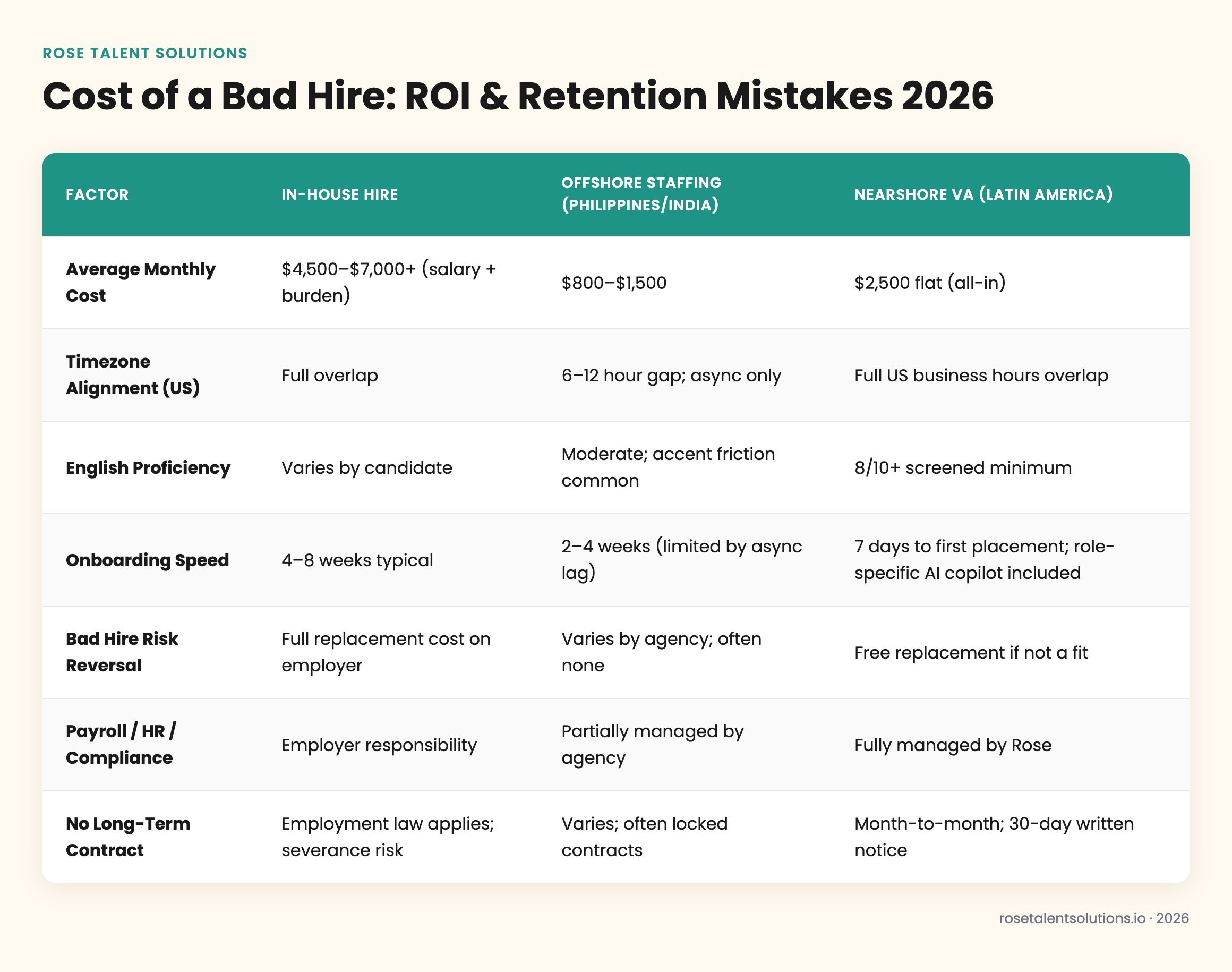
The cost differential between in-house hiring and nearshore virtual staffing is stark — but the more important number is the risk-adjusted cost. When every bad in-house hire carries a five-figure replacement bill and no safety net, the flat-fee, replacement-guaranteed model changes the math entirely. Learn more about how the AI copilot advantage accelerates ramp time for virtual team members.
How to Measure Recruitment ROI: The Metrics That Actually Matter in 2026
Most small businesses track cost-per-hire and stop there. That's like measuring a restaurant's food cost without tracking table turns or waste. Real recruitment ROI requires four metrics working together.
1. Quality of Hire Score — a composite of 90-day performance rating, manager satisfaction, and retention at 12 months. According to LinkedIn Talent Solutions (2024), quality of hire is now the #1 metric talent leaders say they want to improve.
2. Time-to-Productivity — how many days from start date until the employee hits baseline output independently. Industry benchmarks vary, but SHRM (2022) puts the average at 8 months for a professional role to reach full productivity — a number that shrinks dramatically with structured onboarding.
3. First-Year Retention Rate — what percentage of hires are still employed at the 12-month mark. For home care agencies, this is the survival metric. PHI National (2023) reports that direct care worker turnover averages 77% annually — meaning most agencies lose more than three-quarters of their care staff every year.
4. Bad Hire Rate — the percentage of hires who leave or are exited within 90 days. If your bad hire rate exceeds 15%, your screening and onboarding processes have structural problems, not just bad luck.
How to Fix Hiring Mistakes Before They Happen: A 2026 Action Framework
Diagnosing the cost of bad hires is useful. Preventing them is the goal. The five steps below address the most common failure points in small-business hiring, from sourcing through the first 90 days.
Define the Role Output, Not Just the Job Description
Write a 30-60-90 day outcome document before you post the job. Candidates who see specific deliverables self-select more accurately — and you have a built-in onboarding roadmap from day one.
Screen for Cultural Fit Alongside Skills
Use a structured behavioral interview scoring rubric, not gut feel. According to SHRM, structured interviews are 2x more predictive of job performance than unstructured conversations.
Build a Day-One Onboarding Checklist
System access, a named buddy, a scheduled week-one check-in, and written role expectations should all be ready before the employee's first morning. Remove the ambiguity that turns good hires into disengaged ones.
Set 30-Day Performance Checkpoints
Don't wait for the 90-day review to identify problems. A 30-day check-in catches misalignment while there's still time to course-correct — and signals to the employee that their growth matters.
Use Managed Staffing for Hard-to-Fill Roles
For operational, administrative, or bookkeeping and accounting roles, a managed nearshore provider handles recruiting, vetting, onboarding, and HR — eliminating the top four bad-hire risk factors in one move. See how Rose Talent Solutions structures placements for US businesses needing reliable, English-fluent support.
Nearshore vs. Traditional Hiring: Pros and Cons for Lean Teams
For agencies and small businesses weighing whether to hire locally, offshore, or through a nearshore staffing partner, the pros/cons break down clearly once you factor in the full cost of bad hire exposure rather than just the sticker price.
Nearshore Managed Staffing — Pros
- Flat $2,500/month rate covers recruiting, payroll, HR, and ongoing management
- Latin America–based team members work US business hours with real-time overlap
- 8/10+ English proficiency screen eliminates communication friction
- Free replacement if the team member isn't a fit — zero additional cost
- Role-specific AI copilot pre-trained on your software stack ships with every placement
- No long-term contract — month-to-month with 30 days written notice
Nearshore Managed Staffing — Considerations
- Not suitable for roles requiring physical presence or hands-on patient care
- Best fit for operational, administrative, and knowledge-work tasks rather than specialized licensed work
- Requires business owner to define role outputs clearly upfront for best match
For home care agencies specifically, nearshore virtual staffing works best for back-office functions: scheduling coordination, caregiver recruiting outreach, payroll processing, client intake, and compliance documentation. The clinical and direct care roles stay local — the administrative load that burns out your office staff moves to a dedicated virtual team member who costs less and comes with a performance guarantee.
If you're building out the operational backbone of a growing care agency, see how Rose structures support roles for operations-heavy businesses — the same model applies across industries.