
What Is an AppFolio Virtual Assistant — and Why Does "Nearshore" Matter in 2026?
An AppFolio virtual assistant is a dedicated remote team member who works inside your AppFolio account full-time — handling the daily operational load that pulls you away from growing your portfolio. Think leasing inquiries, work order routing, vendor coordination, owner statement prep, accounts payable, and tenant portal support. The role is specific. The software knowledge has to be real, not theoretical.
The word nearshore matters because it changes the entire working relationship. A nearshore VA is based in Latin America — same time zones as the US, same business hours, real-time communication. That is a fundamentally different experience from routing AppFolio tasks to a team sleeping when you are awake. Rose Talent Solutions' property management virtual assistants are all nearshore, all Latin America-based, and all vetted to an 8/10+ English proficiency floor before they ever reach a client.
Property management specifically rewards real-time responsiveness. A prospective tenant who submits a showing request at 10am on a Tuesday expects a reply before lunch — not the following morning. According to the National Association of Realtors (2023), 97% of home and rental buyers use the internet during their search, and speed-to-response is the single biggest differentiator in converting inbound leads. An offshore VA in a misaligned timezone cannot solve that problem. A nearshore VA can.
A nearshore virtual assistant, by definition, is a remote professional based in a geographically close country — in this context, Latin America — who works in your time zone, communicates in fluent English, and is available during standard US business hours. This distinguishes nearshore staffing from traditional offshore models in Asia, where a 10-to-13-hour time difference turns every back-and-forth into a 24-hour delay.
How Difficult Is AppFolio to Learn — and What Does That Mean for Your VA?
AppFolio is not a tool you hand to someone on Monday and expect mastery by Friday. The platform covers lease management, maintenance workflows, owner portals, bank reconciliations, tenant screening, and a full accounting ledger. According to AppFolio's own resource center, most property management teams need 30 to 60 days to fully implement the platform — and that's with dedicated internal staff.
The learning curve breaks into three layers. First, navigation: understanding how units, leases, owners, and vendors are structured in the database. Second, workflows: knowing the correct sequence for move-ins, move-outs, work orders, and lease renewals so nothing falls through the cracks. Third, reporting: pulling owner statements, vacancy reports, and delinquency summaries in formats owners actually understand. A generalist VA who has never touched AppFolio will spend weeks on layer one alone.
This is why software-specific training before day one is not optional — it is the entire value proposition. Every AppFolio VA placed through Rose ships with a role-specific AI copilot trained on AppFolio workflows, so the ramp time collapses from weeks to days. According to Buildium's 2023 Property Management Industry Report, companies that onboard VAs with platform-specific training see productivity benchmarks hit 2x faster than those who hire generalists and train from scratch.

AppFolio's own AI leasing assistant handles some front-of-funnel automation, but it does not replace a human coordinator. Prospective tenant questions escalate quickly beyond what a bot can resolve — lease terms, pet policies, parking assignments, income verification documents. A trained VA bridges the gap between AppFolio's automation layer and the nuanced judgment calls that require a real person.
One gap competitors consistently miss: AppFolio has real limitations. It is best suited for residential portfolios of 50+ units. Under that threshold, the per-unit cost relative to simpler tools like Propertyware or Rent Manager may not justify the investment. Equally, AppFolio's native accounting module — while solid for property-level tracking — often requires a dedicated bookkeeping and accounting VA to manage reconciliations and owner distributions at scale. The platform does not replace a trained accounting professional; it gives one a powerful interface to work from.
How Much Does a Real Estate Virtual Assistant Cost in 2026?
Pricing varies widely depending on where the VA is based, how they're sourced, and what's included in the engagement. A freelance VA hired directly through a marketplace like Upwork might run $8–$15/hour, but that number hides the real cost: no vetting, no replacement coverage, no HR, no management layer, and no guarantee the person actually knows AppFolio.
| VA Type | Monthly Cost (Full-Time) | Timezone Fit (US) | English Proficiency | AppFolio Training Included | Replacement Guarantee |
|---|---|---|---|---|---|
| Nearshore VA (Latin America) | $2,500 flat (all-in) | ✅ Same hours | 8/10+ screened | ✅ Role-specific AI copilot | ✅ Free replacement if not a fit |
| Offshore VA (Philippines) | $1,200–$1,800 + overhead | ❌ 12–13 hr gap | Variable (unscreened) | ❌ Generalist only | ❌ Rarely included |
| Offshore VA (India) | $1,000–$1,600 + overhead | ❌ 9–10 hr gap | Variable (unscreened) | ❌ Generalist only | ❌ Rarely included |
| US-Based W2 Admin | $4,500–$6,500+ total cost | ✅ Same hours | Native | ❌ Must train yourself | ❌ Full rehire cost |
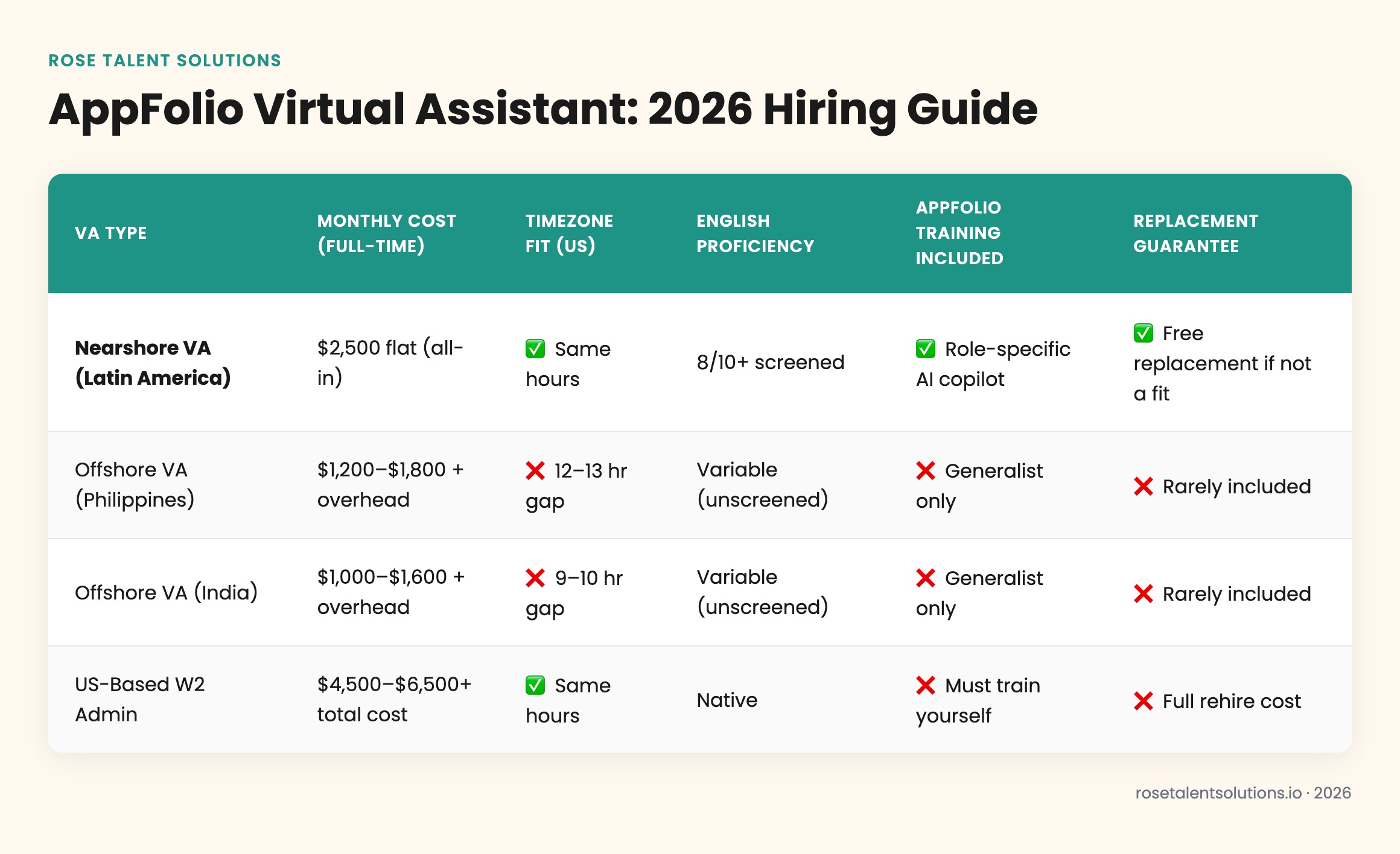
Rose Talent Solutions charges $2,500/month flat. That rate is all-in: recruiting, vetting, payroll, HR, ongoing management, and the AI copilot. No hidden fees for replacement. No long-term contract — cancel with 30 days written notice. The offshore options look cheaper on paper until you factor in the timezone cost, the ramp cost, and the replacement cost when things don't work out.
According to the U.S. Bureau of Labor Statistics (2024), the median annual wage for a property, real estate, and community association manager is $62,850 — over $5,200/month before benefits, payroll taxes, and overhead. A nearshore AppFolio VA at $2,500/month handles the operational execution layer at less than half that cost, freeing your licensed staff to focus on growth and owner relationships.
What Can a Virtual Assistant Do Inside AppFolio — Specific Tasks for 2026?
The most common question property managers ask before their first hire is: "What will they actually do all day?" The answer is more than most operators expect. A well-trained AppFolio VA can own entire operational categories, not just individual tasks.
The hidden cost of a generalist VA is not their hourly rate — it is the 60–90 days of AppFolio training time you absorb internally before they become productive. A platform-trained VA eliminates that cost entirely.
Here is what a trained AppFolio VA handles without hand-holding:
- Leasing pipeline: Responding to prospect inquiries via the AppFolio leasing portal, scheduling showings, sending applications, processing applications, and running background screens through AppFolio's integrated screening tools.
- Tenant communications: Managing inbound maintenance requests through the tenant portal, updating ticket statuses, and coordinating vendor scheduling directly in AppFolio work orders.
- Owner reporting: Pulling and formatting monthly owner statements, vacancy reports, and delinquency summaries — then distributing via the owner portal.
- Accounts payable: Entering vendor invoices, coding expenses to the correct property and account, and preparing payment batches for manager approval.
- AppFolio Portal support: Guiding tenants through the sign-up process for the AppFolio Resident Portal — including how to pay rent online — and troubleshooting common portal access issues so your phone stays quiet.
- Lease renewals: Generating renewal offers, sending to tenants via the platform, tracking responses, and updating lease records upon execution.
According to AppFolio's 2023 property management benchmarking data, maintenance coordination and leasing communications together consume an average of 15–20 hours per week for a single-PM operation managing 100 units. A dedicated VA absorbs both categories, freeing the operator entirely from reactive task work. That is the ROI calculation — not a soft benefit, but 15–20 recovered hours every single week.
The AI copilot advantage compounds this. Rose's VAs work alongside role-specific AI tools trained on AppFolio's interface — so when a new workflow emerges (a new lease type, a new vendor category, a new owner report format), the VA has an intelligent assistant surfacing the right steps rather than waiting on you to explain them.

How Does AppFolio VA Onboarding Work at Rose in 2026?
One gap in almost every competitor article is the step-by-step onboarding reality. Here is exactly how the process works when you hire a nearshore AppFolio VA through Rose:
Intake Call (Day 1)
Rose's team maps your specific AppFolio workflows, unit count, owner communication style, and task priority list. The VA role profile is built from your actual operation — not a generic job description.
Candidate Matching (Days 2–5)
Candidates are filtered against AppFolio experience, English proficiency (8/10+ floor), and timezone alignment. You review a shortlist and make the final selection — you are never assigned someone without approval.
Pre-Start Training (Days 5–7)
The matched VA completes role-specific AppFolio workflow training and is provisioned with their AI copilot before the first day. Common pitfall avoided: most operators skip this step with freelancers and pay for it in weeks of slow ramp.
Week-One Shadowing Protocol
The VA shadows your existing workflows, asks structured questions, and documents your standard operating procedures inside a shared knowledge base — so institutional knowledge is captured from day one.
Full Handoff (Week 2–3)
Task ownership transfers category by category — leasing first, then maintenance coordination, then owner reporting — so you never lose continuity during the transition.
One implementation pitfall competitors never mention: AppFolio's permission system is granular. Before your VA starts, you need to configure user roles inside AppFolio to match exactly what the VA should and should not access. Rose's intake process includes a permissions checklist so you are not scrambling on day one. According to AppFolio's platform documentation, user role permissions cover everything from accounting access to tenant record editing — getting these right upfront prevents both security gaps and workflow blockers.
Nearshore vs. Offshore AppFolio VAs: How the Real Trade-Offs Stack Up
The pricing difference between a nearshore and offshore VA looks significant on a spreadsheet — until you model the true cost of timezone friction on a property management operation. Every tenant complaint, every vendor question, every owner callback that sits in a queue for 8–12 hours is a relationship risk, not just a delay.
Nearshore AppFolio VA (Latin America)
- Works your exact business hours — US Eastern, Central, Mountain, or Pacific
- Real-time Slack, phone, and AppFolio portal communication
- English proficiency screened to 8/10+ before placement
- Cultural alignment with US business norms and tenant expectations
- Flat $2,500/month — recruiting, HR, payroll, management all included
- Free replacement if not a fit — zero financial risk to switch
Offshore AppFolio VA (Asia-based)
- 9–13 hour timezone gap turns real-time tasks into overnight queues
- English proficiency varies widely with no standardized screening
- AppFolio training typically absent — generalist backgrounds only
- Lower base rate, but overhead (HR, payroll, management) adds back cost
- No replacement guarantee — rehire cost falls on you
- Tenant-facing communication quality is inconsistent and hard to monitor
The security and data privacy dimension is also worth naming explicitly — another gap in most competitor articles. AppFolio holds sensitive data: Social Security numbers from tenant screening, bank routing details from owner distributions, lease financials. When you grant AppFolio access to any VA, that access needs to be controlled, logged, and scoped correctly. Nearshore VAs operating under a managed staffing agreement — with formal HR oversight and contractual data handling obligations — present a meaningfully lower risk profile than an unmanaged freelancer. According to the Federal Trade Commission's guidance on the Gramm-Leach-Bliley Act, businesses that handle consumer financial data have affirmative obligations around who accesses that data and how it is protected. A managed nearshore VA engagement includes those protections by default.
Month-to-month terms with no long-term contract mean you are not locked in if your portfolio shrinks, your needs change, or the role evolves. That flexibility — combined with a free replacement guarantee if the match is not right — removes the two biggest objections operators have about committing to a staffing engagement.