
What Is Accounting Firm Practice Management — and Why It Breaks Down in 2026
Accounting firm practice management is the operational framework that governs how a firm recruits staff, delivers client work, tracks performance, and grows revenue. This accounting firm practice management and operations guide for staffing solutions addresses everything from workflow software and billing systems to staff scheduling and client communication protocols. In 2026, the firms that are winning have stopped trying to hire all of that capacity locally — and started building hybrid teams with nearshore virtual staff based in Latin America who work US business hours.
A nearshore virtual assistant (VA) is a remote team member based in Latin America who works in your time zone, communicates in fluent English, and is pre-vetted for the specific software your firm runs — QuickBooks, Xero, Sage, or whatever your stack looks like. That is fundamentally different from offshore outsourcing in India or the Philippines, where a 6-to-12-hour time gap turns every review cycle into an overnight delay.
The staffing pressure on accounting firms is real and documented. According to the AICPA 2023 Trends in the Supply of Accounting Graduates (2023), the number of accounting graduates sitting for the CPA exam has declined for six consecutive years, shrinking the domestic talent pipeline precisely when demand for accounting services is accelerating.
That number matters for accounting business management because it reframes the staffing question entirely. You are not choosing between a great local hire and a virtual one. For many roles — bookkeeping, accounts payable, client onboarding, payroll processing — the local hire simply does not exist at a price point that keeps your margins intact. The operational answer in 2026 is a structured nearshore staffing model layered on top of a solid practice management framework — and that is exactly what this accounting firm practice management and operations guide for staffing solutions is designed to help you build.
How 2026 Practice Guidance Defines the Core Operating Pillars
Before you staff anything, you need a clear model for what your firm actually does and where the work lives. The best practitioner resources break accounting firm operations into four pillars: client delivery, people and capacity, technology and process, and business development. Every staffing decision should map back to one of these pillars.
Client delivery is the obvious pillar — getting accurate work out the door on time. But capacity planning is where most small-to-mid accounting firms quietly break. The U.S. Bureau of Labor Statistics (2024) projects 4% growth in accounting and auditing jobs through 2032, but that growth is in demand, not in available qualified workers. Firms that do not build a scaleable staffing model now will be capacity-constrained during every busy season for the next decade.
Technology and process is where nearshore virtual staff create immediate, measurable leverage. As part of any solid accounting firm practice management and operations guide for staffing solutions, technology adoption cannot be treated as optional. Rose Talent Solutions equips every team member with a role-specific AI copilot trained on the exact software your firm uses — QuickBooks, Xero, Sage Intacct, and others. That means your new team member is not learning the tool from scratch on your billable time. They arrive knowing the workflows, the shortcut keys, and the reconciliation procedures.

Business development is the pillar accounting firms neglect most, and it is the one that suffers most when partners are buried in delivery work. Offloading bookkeeping support, AP/AR processing, and client onboarding to a well-trained virtual team member frees senior staff to focus on advisory work, upsell conversations, and new client acquisition. That is not a soft benefit — it is a margin-per-partner calculation every managing partner should be running quarterly.
How to Measure Accounting Business Management With the Right KPIs in 2026
General practice management without metrics is just activity. The accounting firms that scale predictably track a short stack of KPIs religiously. As any reliable practitioner resources guide will confirm, these six metrics matter most when you are running a hybrid in-office and virtual team:
- Realization rate — billable hours collected vs. billable hours worked. A healthy firm targets 85–90%. If your virtual team member is logging time on non-billable admin, your realization rate tells you immediately.
- Utilization rate — billable hours worked vs. total available hours. Industry benchmark is 60–65% for staff accountants, per RHR International accounting benchmarks (2023).
- Client retention rate — the percentage of clients who renew year-over-year. Top-quartile firms retain 93%+ of clients annually, according to AICPA's Private Companies Practice Section (PCPS) (2023).
- Revenue per partner — total firm revenue divided by equity partners. Staffing leverage is the primary lever that moves this number.
- Average days to close — how long from engagement start to deliverable sign-off. Virtual bookkeeping support routinely cuts this by 20–30% by eliminating the data-gathering bottleneck.
- Net Promoter Score (NPS) — client satisfaction measured on a 0–10 referral likelihood scale. Gallup research (2023) consistently shows that response speed is the top driver of professional services NPS — which is exactly what time-zone-aligned nearshore staff improve.
The point of tracking these KPIs is not to create a reporting burden — it is to give you an early warning system. When realization drops below 80%, you have a scope-creep or staffing-mismatch problem. When utilization climbs above 75%, you have a capacity problem that will produce burnout and errors within 60 days. Both problems are staffing problems at their root, and both are addressable through a well-structured accounting firm practice management and operations guide for staffing solutions.
Nearshore vs. Offshore vs. Onshore: How Each Model Affects Accounting Firm Operations in 2026
Not all virtual staffing is the same, and the differences matter enormously when your work product is financial data that clients and regulators depend on. This accounting firm practice management and operations guide for staffing solutions compares the three models across the factors that affect accounting business management most directly.
| Factor | Onshore (US-based) | Offshore (Philippines / India) | Nearshore (Latin America) |
|---|---|---|---|
| Time zone alignment | ✅ Full overlap | ❌ 6–12 hr gap; async only | ✅ Full US hours overlap |
| Monthly cost (full-time) | $5,000–$8,000+ | $1,200–$1,800 | $2,500 flat (all-in) |
| English proficiency | Native | Variable (4–7/10 avg) | Screened 8/10+ floor |
| Software pre-training | Varies by hire | Rarely included | AI copilot included (QBO, Xero, Sage) |
| HR / payroll management | Your responsibility | Your responsibility | Fully managed by Rose |
| Replacement if not a fit | Full rehire cost | Full rehire cost | Free replacement, no add'l cost |
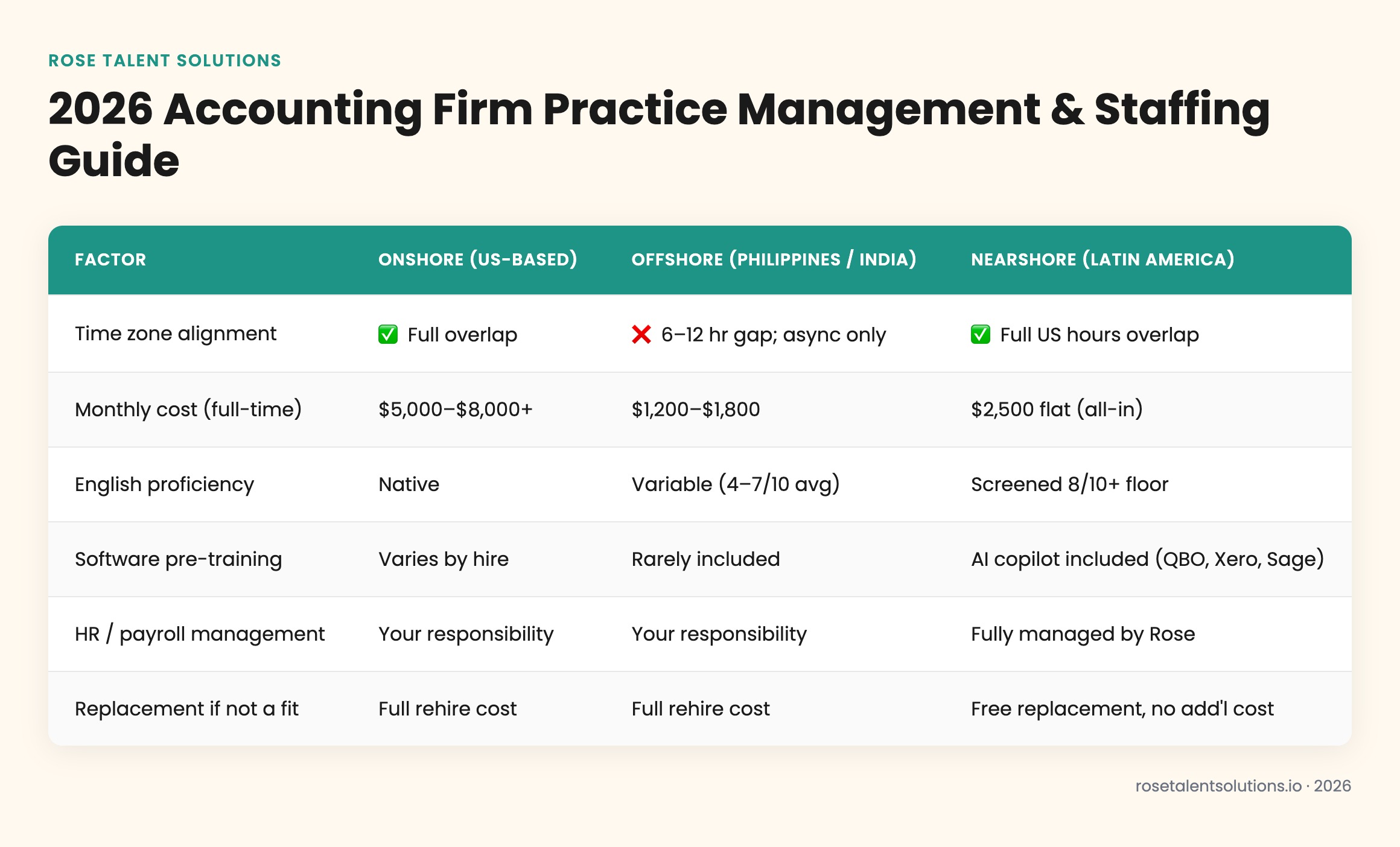
The offshore cost advantage looks compelling on paper until you price in the hidden friction: asynchronous review cycles that add 24 hours to every client deliverable, re-work caused by misunderstood instructions, and the management overhead of briefing a team that works while you sleep. For an accounting firm where accuracy and turnaround time are the core product, those costs are not theoretical — they show up in your realization rate and your NPS within 90 days.
To explore how Rose structures bookkeeping and accounting virtual staff specifically, including the pre-vetting criteria and software training included, the service page walks through each role type in detail.
How Accounting Firms Should Structure Their Virtual Team for General Practice Operations
The most common mistake accounting firms make with virtual staff is treating them as task-fillers rather than role-owners. A nearshore bookkeeper with a defined scope, clear KPIs, and AI-assisted tools will outperform a generalist local temp at twice the cost — but only if you give them a real role, not a to-do list. This is the single most important principle in any accounting firm practice management and operations guide for staffing solutions.
The most effective structure Rose sees across accounting firm clients is a three-layer team: a senior CPA or partner handles advisory and client relationships; a mid-level staff accountant manages review and sign-off; a nearshore virtual team member owns data entry, reconciliation, AP/AR processing, payroll support, and client communication scheduling. That structure keeps your expensive credentialed staff on high-value work and your virtual team member fully utilized on repeatable, well-defined tasks — the core goal of sound accounting business management.
Client retention strategy slots directly into this structure. According to Harvard Business Review (2014, principles still cited in 2024 retention literature), acquiring a new client costs 5–25 times more than retaining an existing one. The fastest way to lose an accounting client is a slow response to a tax question, a late deliverable, or a bookkeeping error that takes days to resolve. A dedicated nearshore team member — available during your client's business hours — eliminates all three failure modes.

Technology adoption is the pillar most accounting firms under-invest in, and it is where nearshore virtual staff create the biggest surprise advantage. Because Rose's team members arrive pre-trained on their designated software via role-specific AI copilots, firms that have resisted digital transformation often find that their new virtual team member becomes an internal champion for better tool usage. Learn more about how the AI copilot system works for accounting-specific roles.
How to Onboard a Nearshore Accounting VA in 2026: The Five-Step Process
Onboarding a virtual team member into an accounting firm is different from onboarding a generalist admin. The process needs to account for data security, client confidentiality, software access provisioning, and workflow documentation. Every effective accounting firm practice management and operations guide for staffing solutions should include a repeatable onboarding sequence — here is the one Rose uses with accounting firm clients:
Role Scoping Call
Rose meets with the firm's managing partner or operations lead to document the exact tasks, software stack, turnaround SLAs, and communication protocols. This call takes 45 minutes and produces a written role brief.
Candidate Matching
Rose screens from its Latin America talent network for accounting-specific experience, verifies English proficiency at 8/10 or above, and presents 2–3 matched candidates within days — not weeks.
Software Access and AI Copilot Activation
The selected team member is provisioned on your software (QuickBooks, Xero, Sage, etc.) and their role-specific AI copilot is activated, covering the firm's preferred workflows and common task types.
Supervised First-Week Tasks
The team member completes a defined set of real firm tasks under light supervision from their Rose account manager, allowing the firm to calibrate output quality before full autonomy is granted.
Ongoing Management and QA
Rose handles all HR, payroll, time tracking, and performance management. If the placement is not the right fit at any point, Rose replaces the team member at no additional cost — no long-term contract required.
That last point is worth emphasizing: the engagement runs month-to-month with 30 days written notice to cancel. For a firm that has been burned by a long-term staffing contract or an outsourcing arrangement that did not deliver, the structure is intentionally designed to remove that risk. The $2,500/month flat rate covers recruiting, vetting, payroll, HR compliance, and ongoing management — there are no hidden per-task fees or setup charges.
Pros and Cons of Nearshore Staffing for Accounting Firm Operations and General Practice Management
No staffing model is perfect for every firm. As a practical closing section to this accounting firm practice management and operations guide for staffing solutions, here is an honest look at where nearshore virtual accounting staff excel — and where firms need to plan carefully before they start.
Pros
- Full US time-zone overlap — client calls, real-time review, same-day turnaround
- Flat $2,500/month rate is 40–60% below equivalent US hire fully loaded cost
- Software-trained on arrival via AI copilot — QBO, Xero, Sage Intacct included
- Rose manages HR, payroll, and compliance — zero employer overhead
- Free replacement if the fit is wrong — no long-term contract, 30-day cancellation
- English proficiency screened to 8/10+ floor — no communication rework
Cons
- Requires the firm to document workflows clearly upfront — poorly documented processes produce poor output regardless of VA quality
- Not a substitute for licensed CPA judgment on complex advisory work
- Data security protocols must be established by the firm before access is provisioned
- Maximum leverage requires a real role brief — firms that treat VAs as task-fillers see lower ROI
The firms that see the highest ROI from nearshore accounting staff are the ones that treat the virtual team member as a genuine employee with a defined role, clear KPIs, and direct access to the firm's communication channels. The bookkeeping and accounting service page details which specific role types Rose places — from bookkeeping coordinators to payroll support specialists — and what the vetting criteria look like for each.
For accounting firms that also manage client entities with property holdings, Rose's property management virtual staff can support AppFolio or Buildium workflows in parallel with accounting tasks — a common need for CPA firms serving real estate investors and landlords. According to the U.S. Census Bureau's Survey of Business Owners (2022), real estate is among the top five industries served by small CPA firms, making cross-trained nearshore staff a genuine operational asset for any accounting business management strategy.